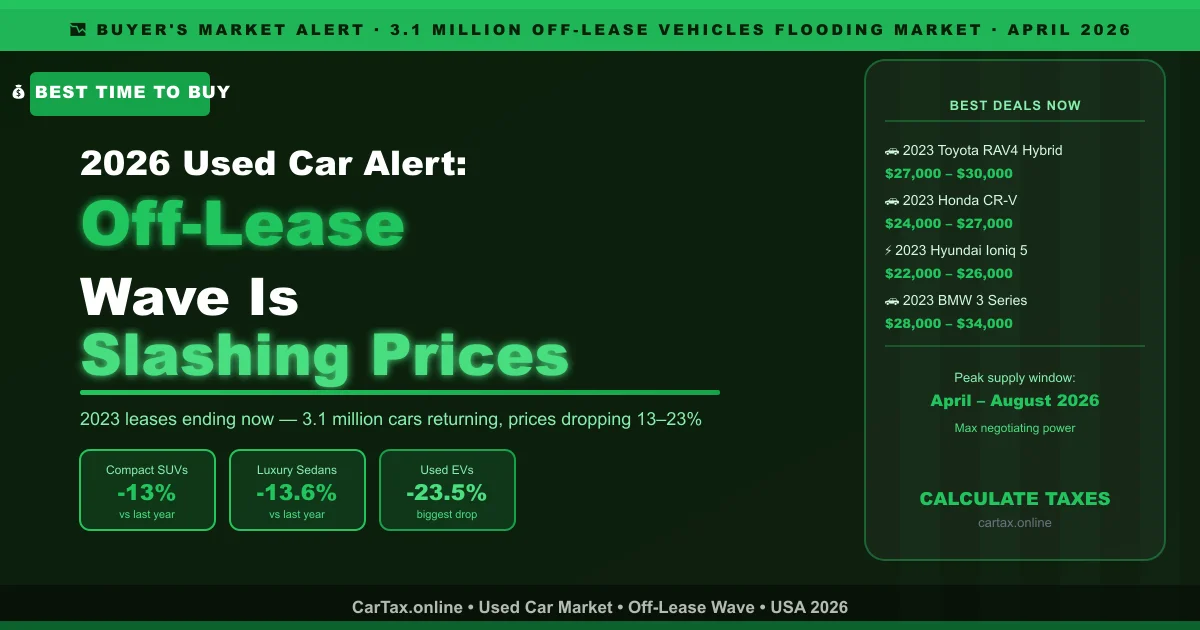
Here is something that does not come around often — a genuine buyer's market for used cars. After two years of sky-high prices and almost zero negotiation room, the used car market in April 2026 has shifted dramatically in favor of buyers. The reason is simple math: 2023 was a record year for new vehicle leases in the United States. Three-year leases signed in 2023 are now terminating. An estimated 3.1 million off-lease vehicles are expected to re-enter the used market between January and September 2026, according to Cox Automotive's lease return forecast data.
If you have been waiting for the right moment to buy a used car, this is probably it. But not every segment is affected equally, and how you approach the process — down to which state you register in — determines whether you walk away with a real deal or just think you did.
What Is the "Off-Lease Wave" and Why Does It Matter?
When someone leases a car for three years, they return it to the dealer at the end of the lease term. The dealer then either sells it as "certified pre-owned" (CPO) or sends it to a wholesale auction, where it flows back into the used market. This process is predictable and cyclical — lease volume in year X creates used-car supply in year X+3.
The 2023 leasing surge was driven by several factors: normalized inventory levels after the 2021–2022 chip shortage, aggressive lease incentives from manufacturers trying to move volume, and consumers who had delayed purchases during COVID choosing to lease rather than commit to buying. The result? One of the largest single-year lease origination volumes in the last decade. And now those cars are all coming back at once.
The categories flooding the market include:
- Compact SUVs: Toyota RAV4, Honda CR-V, Hyundai Tucson, Kia Sportage — historically the most-leased vehicles in America
- Sedans: Honda Civic, Toyota Camry, Nissan Altima — volume vehicles from the leasing-friendly mainstream brands
- Luxury vehicles: BMW 3 Series, Mercedes C-Class, Audi A4 — leasing has always been the dominant acquisition method in this segment
- EVs: Tesla Model 3, Chevrolet Bolt (final year), Hyundai Ioniq 5 — early adopters are trading up, flooding the 2023 vintage into the secondary market
How Much Are Prices Actually Dropping?
Used car prices are not crashing — but they are declining meaningfully on the vehicles most affected by the lease return wave. Black Book (an industry vehicle valuation source) noted wholesale prices on the most-affected segments:
| Vehicle Segment | Average Wholesale Price (Q1 2025) | Average Wholesale Price (April 2026) | Change |
|---|---|---|---|
| Compact SUVs (2–3 yr old) | $27,400 | $23,800 | -13.1% |
| Midsize Sedans (2–3 yr old) | $22,100 | $19,400 | -12.2% |
| Luxury sedans (2–3 yr old) | $41,200 | $35,600 | -13.6% |
| Used EVs (2–3 yr old) | $28,900 | $22,100 | -23.5% |
| Full-size trucks (2–3 yr old) | $48,600 | $46,100 | -5.1% |
The truck market has held up better because trucks are not heavily leased — most truck buyers purchase outright. EVs have seen the steepest declines, partly due to the off-lease wave and partly because the used EV federal tax credit was eliminated by the OBBBA, removing the $4,000 subsidy that previously supported used EV pricing.
The Tax Side of Buying a Used Car in 2026
Used car purchases are not eligible for the new $10,000 auto loan interest deduction under the OBBBA (that applies only to new vehicles). The Section 25E used EV credit has also been eliminated. But state sales tax still applies — and this is where many buyers leave money on the table.
| State | Used Vehicle Sales Tax Rate | Trade-In Credit? | Tax on $25,000 Purchase |
|---|---|---|---|
| California | 7.25–10.75% | Yes | $1,813–$2,688 |
| Texas | 6.25% | Yes | $1,563 |
| Florida | 6.0% | Yes | $1,500 |
| New York | 4.0% + local | Yes | $1,000–$2,125 |
| Oregon | 0% | N/A | $0 |
| Montana | 0% | N/A | $0 |
| New Hampshire | 0% | N/A | $0 |
| Pennsylvania | 6.0% | Yes | $1,500 |
| Washington | 6.5% + local | Yes | $1,625–$2,250 |
If you are near a state border, it is worth understanding the registration requirements for out-of-state purchases. You generally pay tax in your state of residence when you register — not the state where you buy.
How to Leverage the Off-Lease Wave: 7 Practical Tips
1. Target Vehicles Between 30,000–45,000 Miles
Off-lease vehicles typically come back at 30,000–45,000 miles under a 36-month, 12,000-mile-per-year lease. This mileage range is the sweet spot: the car is past its initial depreciation cliff but has plenty of useful life remaining, often including the tail end of the manufacturer's powertrain warranty.
2. Shop Certified Pre-Owned Programs Aggressively
Manufacturers are flooding CPO programs with lease returns. Toyota, Honda, BMW, and Mercedes-Benz have all expanded CPO inventory in early 2026. CPO vehicles come with manufacturer warranty extensions — typically to 100,000 miles or 6–7 years from original sale date — and pass a multi-point inspection. The price premium over a standard used vehicle is shrinking because there is so much CPO supply right now.
3. Negotiate the Dealer-to-Wholesale Spread
Dealers buy lease returns at wholesale auction prices — often $2,000–$4,000 below what they list them for on the lot. When a dealer is holding high inventory, there is more room to negotiate toward wholesale. Ask the sales manager directly: "What did you pay at auction for this vehicle?" Many will tell you, and the answer gives you a concrete negotiating floor.
4. Get a Pre-Purchase Inspection — Even on CPO
CPO inspections vary significantly in thoroughness by brand and dealer. For any used vehicle, spending $150–$200 on an independent pre-purchase inspection from a mechanic unaffiliated with the dealer is one of the best investments you can make. For EVs specifically, request a battery health report — most dealers can pull State of Health (SoH) data from the vehicle's onboard diagnostics.
5. Understand Used vs. New Loan Rate Differences
Used car loan rates are typically 1.5–2.5% higher than new car loan rates at the same credit score. In the current rate environment, expect 8.5%–11% on used vehicles versus 6.5%–8.5% on new. The math sometimes favors buying a new base-trim vehicle — which also qualifies for the OBBBA loan interest deduction — over a used vehicle at a lower sticker price but a higher interest rate.
6. Don't Sleep on Private Party Sales
Lease returns sold at auction don't all end up on dealer lots. Many are acquired by private sellers — particularly in the luxury and EV segments — who buy at auction and resell privately. Facebook Marketplace, Craigslist, and CarGurus private listings are showing significantly higher inventory in 2026's lease return window. Private party prices tend to be 5–10% lower than dealer listings for equivalent vehicles.
7. Check Remaining Manufacturer Warranty Coverage
A 2023 vehicle purchased new in January 2023 is still within the 5-year/60,000-mile powertrain warranty from most manufacturers through early 2028. For EVs, battery warranties typically run 8 years/100,000 miles — meaning that 2023 Tesla Model 3 or Hyundai Ioniq 5 still has 5+ years of battery coverage regardless of how many miles are on it.
Best Off-Lease Deals Right Now (April 2026)
| Vehicle | Lease Return Vintage | Estimated Market Price | Why It's a Good Deal |
|---|---|---|---|
| 2023 Toyota RAV4 Hybrid | 2023 → 2026 | $27,000–$30,000 | High supply, still under powertrain warranty, proven reliability |
| 2023 Honda CR-V | 2023 → 2026 | $24,000–$27,000 | Volume lease vehicle; prices dropped 12% in past year |
| 2023 BMW 3 Series | 2023 → 2026 | $28,000–$34,000 | Large luxury lease volume; CPO warranty extension adds real value |
| 2023 Hyundai Ioniq 5 | 2023 → 2026 | $22,000–$26,000 | EV prices softest segment; 8-yr battery warranty fully intact |
| 2023 Kia Sportage | 2023 → 2026 | $21,000–$24,000 | Strong reliability record; aggressively priced in current market |
| 2023 Mercedes-Benz C300 | 2023 → 2026 | $31,000–$37,000 | Record CPO supply pushing prices toward their floor |
Frequently Asked Questions
Is now actually a good time to buy a used car?
Yes — April through August 2026 represents the peak of the off-lease wave, which means maximum supply and maximum buyer negotiating leverage. If you're flexible on the exact model, you'll find the best selection and pricing during this window. Waiting until fall 2026 will likely mean tighter supply as the wave crests and inventory levels normalize.
Do used car buyers get any federal tax breaks in 2026?
Unfortunately, no. The OBBBA eliminated the Section 25E used EV credit that was introduced by the Inflation Reduction Act. The $10,000 auto loan interest deduction applies only to new vehicle purchases. If federal tax benefits matter in your decision, buying new may be more financially advantageous than the sticker price comparison suggests.
How do I verify a lease return vehicle has been well-maintained?
Request the Carfax or AutoCheck report, ask for service records, and get an independent pre-purchase inspection. Leased vehicles are typically serviced on schedule because lessees want to avoid end-of-lease fees for neglected maintenance. But not always — the independent inspection is non-negotiable for any purchase over $15,000.
Are used EVs a good buy right now?
If you're comfortable with the charging infrastructure and range, 2023-vintage EVs are the most aggressively priced segment in the used market right now — down 20%+ in some cases. The caveat is that there's no federal tax credit anymore. But sticker prices have dropped enough that the math still works for many buyers, especially if they can charge at home overnight. Always get a battery State of Health report before buying any used EV.
Use our Car Tax Calculator to see the full sales tax and registration fee picture for any used vehicle in your state — before you sign the paperwork.