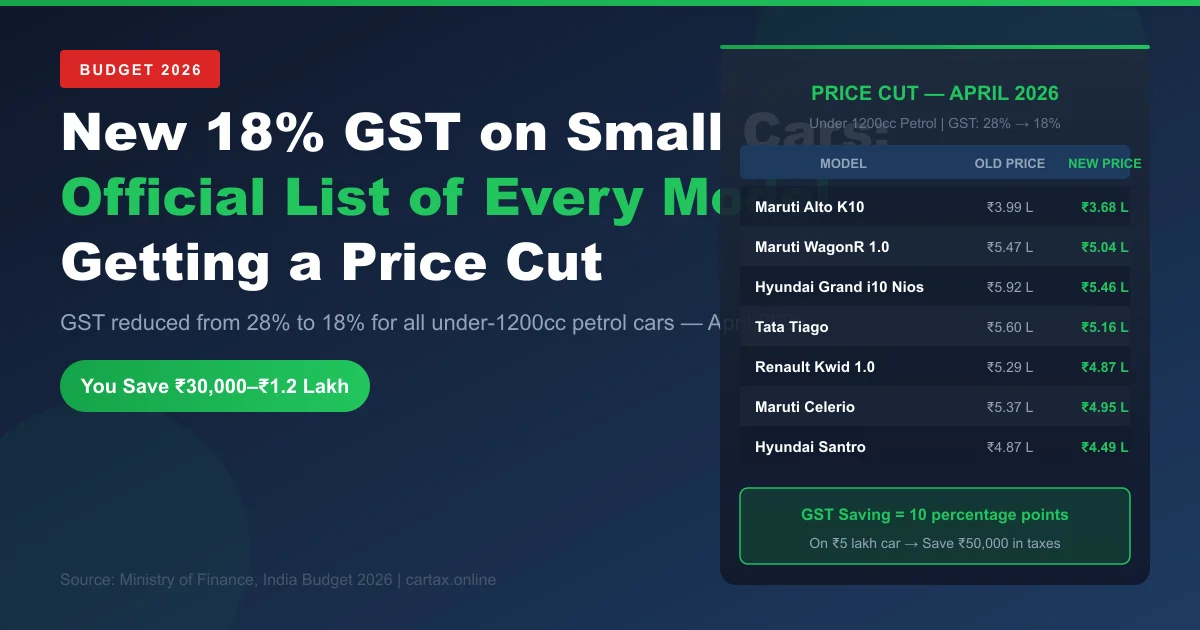
If you have been waiting to buy a small car in India, the wait just became a lot more rewarding. The Union Budget 2026 has done something the middle-class car buyer has wanted for years: the GST rate on petrol cars with engine displacement under 1,200cc has been cut from 28% to 18%. That single percentage point shift of 10 points translates directly into a price reduction of ₹30,000 to ₹1.2 lakh on the most popular entry-level and hatchback models in the country.
This is not a dealer discount or a temporary offer. It is a structural tax change that permanently reduces the on-road price of a specific segment of cars. The new rates came into effect in April 2026. If you are buying any small petrol hatchback, you are now paying less — as long as you know which models qualify and how much to expect to save.
Which Cars Qualify? The Exact GST Slab Criteria
The 18% GST rate applies to petrol cars meeting all of the following criteria:
- Engine displacement: Not exceeding 1,200cc (for petrol engines)
- Length: Not exceeding 4,000mm overall body length
- Fuel type: Petrol (CNG variants of the same model also qualify if the engine displacement is under 1,200cc)
Diesel cars below 1,500cc were in a different slab (previously at 28% + 3% cess) and remain unchanged at this stage. Hybrid cars, regardless of engine size, have actually moved in the opposite direction — to a higher slab. Electric vehicles continue to attract just 5% GST, unchanged.
The Official Price Cut List: Every Qualifying Model
| Model | Engine | Pre-April 2026 Ex-Showroom | Post-April 2026 Ex-Showroom | Approximate Saving |
|---|---|---|---|---|
| Maruti Suzuki Alto K10 | 998cc petrol | ₹3,99,000 | ₹3,68,000 | ~₹31,000 |
| Maruti Suzuki S-Presso | 998cc petrol | ₹4,26,000 | ₹3,93,000 | ~₹33,000 |
| Maruti Suzuki Celerio | 1,197cc petrol | ₹5,37,000 | ₹4,95,000 | ~₹42,000 |
| Maruti Suzuki WagonR 1.0 | 998cc petrol | ₹5,47,000 | ₹5,04,000 | ~₹43,000 |
| Tata Tiago | 1,199cc petrol | ₹5,60,000 | ₹5,16,000 | ~₹44,000 |
| Hyundai Grand i10 Nios | 1,197cc petrol | ₹5,92,000 | ₹5,46,000 | ~₹46,000 |
| Renault Kwid 1.0 SCe | 999cc petrol | ₹5,29,000 | ₹4,87,000 | ~₹42,000 |
| Hyundai Santro | 1,197cc petrol | ₹4,87,000 | ₹4,49,000 | ~₹38,000 |
| Datsun redi-GO 1.0 | 999cc petrol | ₹4,40,000 | ₹4,05,000 | ~₹35,000 |
| Maruti Suzuki Ignis | 1,197cc petrol | ₹5,84,000 | ₹5,38,000 | ~₹46,000 |
Note: Prices are indicative ex-showroom Delhi estimates based on the GST rate change. Actual prices may vary slightly by city due to octroi and local levies. Confirm with your dealer before booking.
How the GST Math Actually Works
It helps to understand exactly how the tax change converts into rupee savings. GST is levied on the manufacturer's selling price to the dealer — not the ex-showroom price directly, but the price ultimately determines what you pay.
On a car priced at ₹5,00,000 ex-showroom (inclusive of 28% GST):
- Base price (before GST) = ₹5,00,000 / 1.28 = ₹3,90,625
- GST at 28% = ₹1,09,375
At the new 18% rate on the same base price:
- Base price = ₹3,90,625
- GST at 18% = ₹70,312
- New ex-showroom = ₹4,60,937
- Saving = ₹39,063
This is why a ₹5 lakh car saves roughly ₹39,000 — not ₹50,000. The percentage applies to the base price, not the total. On pricier models in the segment that cost ₹7–8 lakh, the saving grows to ₹55,000–₹70,000.
State-Wise Road Tax: The Other Cost You Must Budget
The GST cut helps significantly, but road tax is collected separately by state governments and has not changed. It can add 6% to 20% on top of the ex-showroom price depending on where you register the vehicle.
| State | Road Tax on Small Car (approx.) | On ₹5 Lakh Car |
|---|---|---|
| Delhi | 4% (CNG: 2%) | ₹20,000 |
| Maharashtra | 7% | ₹35,000 |
| Karnataka | 13% | ₹65,000 |
| Tamil Nadu | 10% | ₹50,000 |
| Uttar Pradesh | 8% | ₹40,000 |
| Rajasthan | 6% | ₹30,000 |
| Gujarat | 6% | ₹30,000 |
| West Bengal | 7.5% | ₹37,500 |
Buyers in Karnataka and Tamil Nadu pay the highest road tax in the country on small cars — the GST saving helps offset it, but the total on-road price still varies significantly by state.
What Is Not Included in the GST Cut
Several charges that appear in your on-road cost breakdown are not affected by the GST change:
- Road tax / Motor Vehicle Tax: Set by individual states, unchanged
- Registration fee: Fixed amount per RTO, unchanged
- Insurance (1st year): IRDAI regulated, not GST-driven
- Handling and logistics charges: Dealer-level, negotiable
- Accessories (fitted at factory): Subject to GST at their respective rate (not necessarily 18%)
- Extended warranty and AMC: Taxed as service at 18% — same rate as car GST now, but still separate
Should You Buy Now or Wait for Further Cuts?
The natural question when a price cut happens is whether to buy now or wait for another reduction. The honest answer is that the shift from 28% to 18% is a large structural move — the Government of India has essentially reclassified small cars out of the luxury/demerit slab into the middle slab. Further cuts to 12% or 5% for petrol cars are unlikely in the near term, as the EV push means the government wants to maintain a pricing gap between petrol cars and electric vehicles.
Waiting carries real cost: vehicle prices increase 2–4% annually from manufacturer price hikes independent of taxes. A car priced at ₹5.16 lakh today will likely be ₹5.36–₹5.37 lakh by mid-2027 even without any tax change. Buying after the GST cut locks in both the reduced tax and the current base price.
CNG Variants: An Important Note
Many buyers consider CNG variants for lower running costs. CNG variants of under-1200cc cars also qualify for the 18% GST rate, since the classification is based on engine displacement, not fuel type. A Maruti WagonR CNG (998cc) qualifies just as the petrol WagonR does. However, the CNG kit fitted at factory is taxed at 18% as a component — the savings profile is similar to the petrol version.
Frequently Asked Questions
Does the GST cut apply to used cars too?
No. Used cars are taxed under a different GST framework. Registered dealers selling used cars charge GST on the margin (the difference between their purchase and selling price), not the full vehicle value. The April 2026 GST rate change applies exclusively to new vehicle purchases from manufacturers and authorized dealers.
My dealer is quoting the old price. What should I do?
If the new GST rate is effective and your dealer is quoting a pre-cut price, ask them specifically for the ex-showroom price breakdown showing the current GST component. Dealers sometimes delay passing on tax benefits — especially if they have inventory purchased at the old tax rate. You are entitled to the new rate on vehicles registered after the effective date. If the dealer won't negotiate to the new rate, compare prices at another dealership in your city.
What if I booked before April but take delivery after?
The applicable GST rate is typically the rate at the time of invoice / delivery, not at the time of booking. If you booked under the old 28% rate and take delivery after the new 18% rate is effective, you should receive the car at the lower-tax price. Verify this with your dealer before delivery and check your booking invoice date versus delivery date.
Are automatic transmission variants cheaper too?
Yes, if the engine displacement is under 1,200cc, the transmission type does not affect GST classification. AMT (Automated Manual Transmission) and AGS variants of qualifying models receive the same GST reduction as manual variants.
Calculate your complete on-road cost including road tax, insurance, and any applicable cess using our India Car Tax Calculator — updated for the April 2026 GST changes.