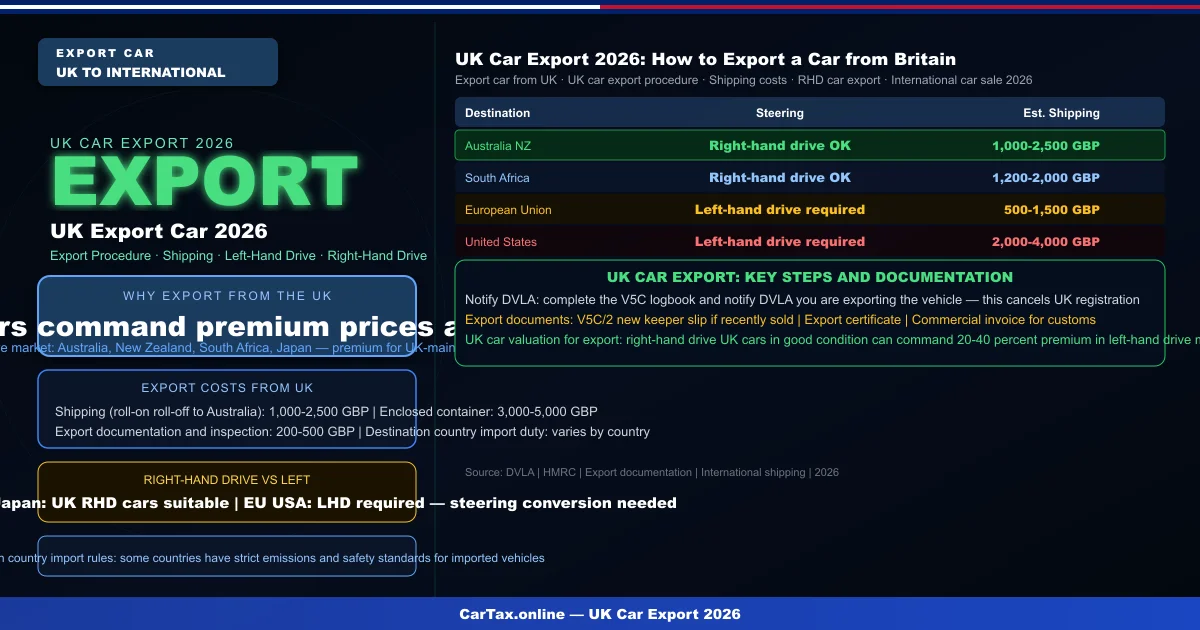
Exporting a car from the UK involves specific documentation requirements, VAT considerations and shipping logistics that differ depending on whether you are permanently moving the car abroad or selling it to an overseas buyer. Understanding these requirements before starting the export process prevents delays, unexpected costs and potential legal issues.
Documentation Required for UK Car Export
The V5C registration certificate (logbook) is the primary document for UK car export. To export the vehicle, you must complete the export section on the V5C and send it to DVLA, or if selling to an overseas buyer, transfer the V5C to them with the appropriate notification. For permanent exports, you should notify DVLA using the export declaration on the V5C and retain the green slip to use when registering the vehicle in the destination country.
A Certificate of Export or commercial invoice is required for all vehicle exports, particularly when selling to an overseas buyer. This document details the vehicle's specification, VIN, mileage and sale price and is required for customs clearance in both the UK and the destination country. If the vehicle is financed, you will need a settlement figure from your finance company and their confirmation of settlement before the car can be exported.
VAT and Export Rules
When exporting a car from the UK to another EU country, the car must have been in the UK for at least six months and belong to the exporter for at least 12 months to qualify for VAT-free export under personal export rules. If selling to an EU buyer, VAT at 20 percent may apply depending on the transaction structure and whether the buyer is VAT-registered. Related: Uk Car Export To Hong Kong | Export Car to Europe 2026 | Export Car to Japan 2026 | Export Car to USA 2026.
The New Overseas Vehicles Acquisition (NOVA) system requires notification to HMRC for all new vehicle exports. Used vehicle exports do not require NOVA notification. For cars being permanently moved as part of a household relocation, HMRC has specific rules regarding import duty relief that vary by destination country.
Shipping Methods and Costs
Roll-on Roll-off (RORO) shipping is the most economical method, with costs from 500 to 1,500 GBP to most European destinations from UK ports. The car is driven onto and off the vessel at both ends. Container shipping costs 1,500 to 4,000 GBP depending on container size and destination, offering greater protection against weather and damage during transit.
For long-haul destinations such as Australia, New Zealand, South Africa or North America, container shipping is essential for vehicle protection, costing 2,000 to 5,000 GBP to most major ports worldwide. Air freight is available for urgent shipments but costs 10,000 to 30,000 GBP, making it viable only for very high-value vehicles.
Destination Country Import Requirements
Every destination country has its own import regulations, including emissions standards, safety requirements, age restrictions and import duty rates. Australia has strict import restrictions and requires either compliance with Australian Design Rules (ADR) or a Registered Automotive Workshop (RAW) approval. The United States requires DOT and EPA compliance for all imported vehicles. Most EU countries have straightforward import procedures for UK-origin vehicles following post-Brexit adjustments.
Frequently Asked Questions
Do I need to notify DVLA when exporting a car? Yes. You must complete the export section on the V5C logbook and either hand it to the shipping company or return it to DVLA. For private exports, the green slip is retained for overseas registration.
Is VAT charged on exported cars? VAT at 20 percent may apply when selling to an EU buyer, depending on the transaction. If the car is being permanently moved as part of a household relocation and meets the six-month ownership criteria, it may qualify for VAT-free export.
Official Resources: GOV.UK Check Vehicle Tax | GOV.UK Vehicle Tax | DVLA Online | MOT Check
Frequently Asked Questions
Q: How much is car tax (VED) in the UK 2026?
Car tax rates in the UK depend on your vehicle's CO2 emissions and list price. Standard rates start from £190 per year for petrol and diesel cars, with zero-rated VED for EVs. First-year rates vary from £0 to £2,605 depending on emissions. Additional premiums apply for vehicles over £40,000.
Q: How do I check if my car is taxed online?
You can check your vehicle's tax status for free on the Gov.uk website at gov.uk/check-vehicle-tax. You'll need your vehicle's registration number (number plate). You can also check via the Motor Insurance Database to verify road tax and insurance status simultaneously.
Q: Can I get a refund on car tax if I sell my vehicle?
Yes — if you sell or scrap your vehicle, you can claim a refund on any full months of remaining road tax. Contact DVLA with the V11 reminder letter or apply online at gov.uk. Refunds are usually processed within 4-6 weeks.
Q: Is road tax refund available when transferring ownership?
No — road tax does not transfer with the vehicle. When you sell your car, the tax is automatically cancelled and any remaining months are refunded to you by DVLA. The new owner must tax the vehicle immediately. As a buyer, always verify the vehicle's tax status before purchasing.
Q: What is the luxury car tax threshold in the UK 2026?
The additional rate for vehicles over £40,000 (list price) adds £410 per year to standard VED rates for years 2-6 of registration. This surcharge brings the annual cost for high-emission vehicles over £40,000 to around £600-690 per year. Pure EVs under £40,000 pay zero VED.