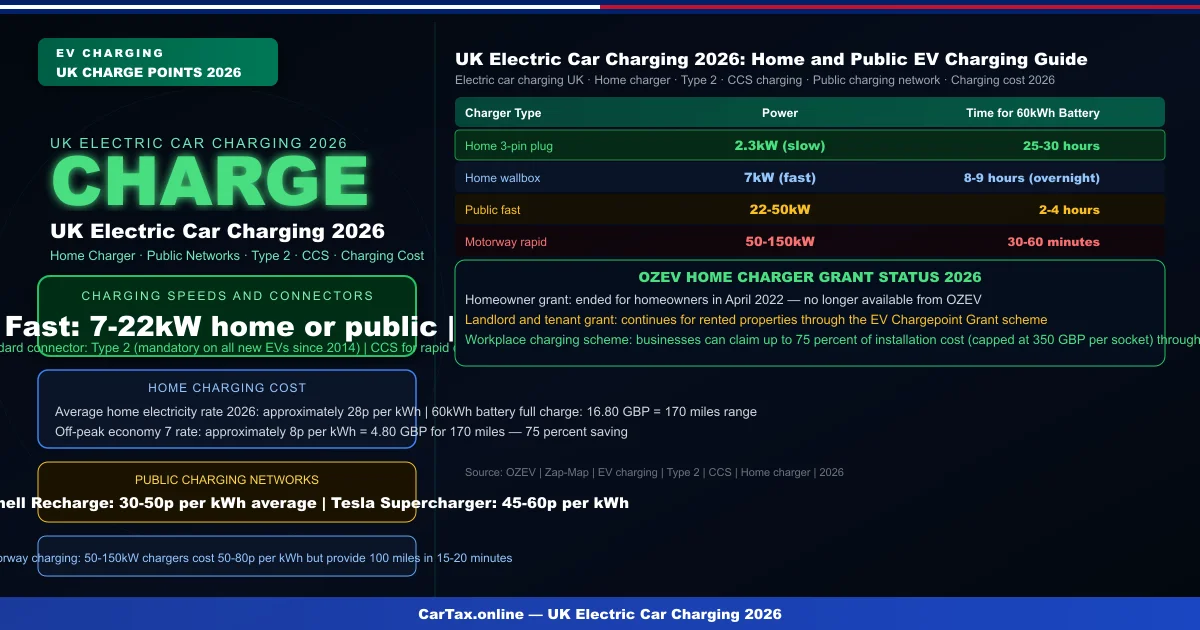
Electric vehicle charging infrastructure in the UK has expanded dramatically, with over 50,000 public charging points now available across the country. Understanding home charging options, public network costs and the practical realities of EV charging helps new EV owners get the most from their vehicles while minimising running costs.
Home Charging: The Cheapest Option
Home charging is the cheapest way to charge an EV, costing approximately 28 pence per kWh on a standard electricity tariff in 2026. A 60 kWh battery (providing approximately 200 to 250 miles of range) costs approximately 16.80 GBP for a full charge. Annual charging cost for 10,000 miles of driving at home is approximately 800 GBP, compared to 1,400 to 1,600 GBP for petrol equivalent.
Off-peak Economy 7 or dynamic tariff charging at approximately 8 pence per kWh reduces home charging cost to approximately 4.80 GBP for a full charge on a 60 kWh battery. Setting a timer to charge overnight during off-peak hours maximises savings, reducing annual charging cost to approximately 300 to 400 GBP for 10,000 miles.
Home Charger Installation
A dedicated 7 kW home wallbox charger (the most common home charging speed) costs 500 to 1,000 GBP for the unit plus 200 to 500 GBP for installation, depending on the complexity of the electrical installation. The OZEV Homeowner Grant ended in April 2022, so there is no longer a government subsidy for homeowners. The Landlord EV Chargepoint Grant continues for rental properties, and the Workplace Charging Scheme offers 75 percent of installation costs (capped at 350 GBP per socket) for businesses. Related: Electric Vehicle Tax India 2026 — EV Road Tax by State Guide | UAE EV Rebates 2026 | Car Tax and Electric Charging UK 2026 | Car Tax and EV Home Charging UK 2026.
Public Charging Networks
Public charging networks vary significantly in cost and availability. BP Pulse, Pod Point and Shell Recharge offer 7 to 22 kW charging at approximately 30 to 50 pence per kWh. Tesla Supercharger network, while originally exclusive to Tesla vehicles, is increasingly open to non-Tesla vehicles through the Tesla app and roaming agreements, at 45 to 60 pence per kWh. Rapid motorway chargers at 50 to 150 kW cost 50 to 80 pence per kWh but can deliver 100 miles of range in 15 to 20 minutes.
Connector Types Explained
Type 2 is the UK standard connector mandatory on all new EVs since 2014. It covers AC charging at home and most public points. CCS (Combined Charging System) is the standard for DC rapid charging and is mandatory on all new EVs sold in Europe. CHAdeMO, used by some Japanese EVs including Nissan, is being phased out in favour of CCS adapters.
Frequently Asked Questions
How much does it cost to install a home EV charger in 2026? A 7 kW home wallbox costs 500-1,000 GBP for the unit plus 200-500 GBP for installation, totalling approximately 700-1,500 GBP. The homeowner grant is no longer available. Landlords and businesses may still qualify for OZEV grants.
Is public charging more expensive than home charging? Yes, significantly. Public rapid charging at 50-80p per kWh costs 3-5 times more than home charging at 8-28p per kWh. Rapid charging should be reserved for longer journeys, with home or workplace charging as the primary method.
Official Resources: GOV.UK Check Vehicle Tax | GOV.UK Vehicle Tax | DVLA Online | MOT Check
Frequently Asked Questions
Q: How much is car tax (VED) in the UK 2026?
Car tax rates in the UK depend on your vehicle's CO2 emissions and list price. Standard rates start from £190 per year for petrol and diesel cars, with zero-rated VED for EVs. First-year rates vary from £0 to £2,605 depending on emissions. Additional premiums apply for vehicles over £40,000.
Q: How do I check if my car is taxed online?
You can check your vehicle's tax status for free on the Gov.uk website at gov.uk/check-vehicle-tax. You'll need your vehicle's registration number (number plate). You can also check via the Motor Insurance Database to verify road tax and insurance status simultaneously.
Q: Can I get a refund on car tax if I sell my vehicle?
Yes — if you sell or scrap your vehicle, you can claim a refund on any full months of remaining road tax. Contact DVLA with the V11 reminder letter or apply online at gov.uk. Refunds are usually processed within 4-6 weeks.
Q: Is road tax refund available when transferring ownership?
No — road tax does not transfer with the vehicle. When you sell your car, the tax is automatically cancelled and any remaining months are refunded to you by DVLA. The new owner must tax the vehicle immediately. As a buyer, always verify the vehicle's tax status before purchasing.
Q: What is the luxury car tax threshold in the UK 2026?
The additional rate for vehicles over £40,000 (list price) adds £410 per year to standard VED rates for years 2-6 of registration. This surcharge brings the annual cost for high-emission vehicles over £40,000 to around £600-690 per year. Pure EVs under £40,000 pay zero VED.