Car depreciation is the largest financial cost most private car owners face, often exceeding fuel, insurance and maintenance combined over a ownership period. Understanding which cars hold their value and which depreciate rapidly is essential knowledge for anyone planning to buy or sell a vehicle in 2026.
Average Car Depreciation Rates in 2026
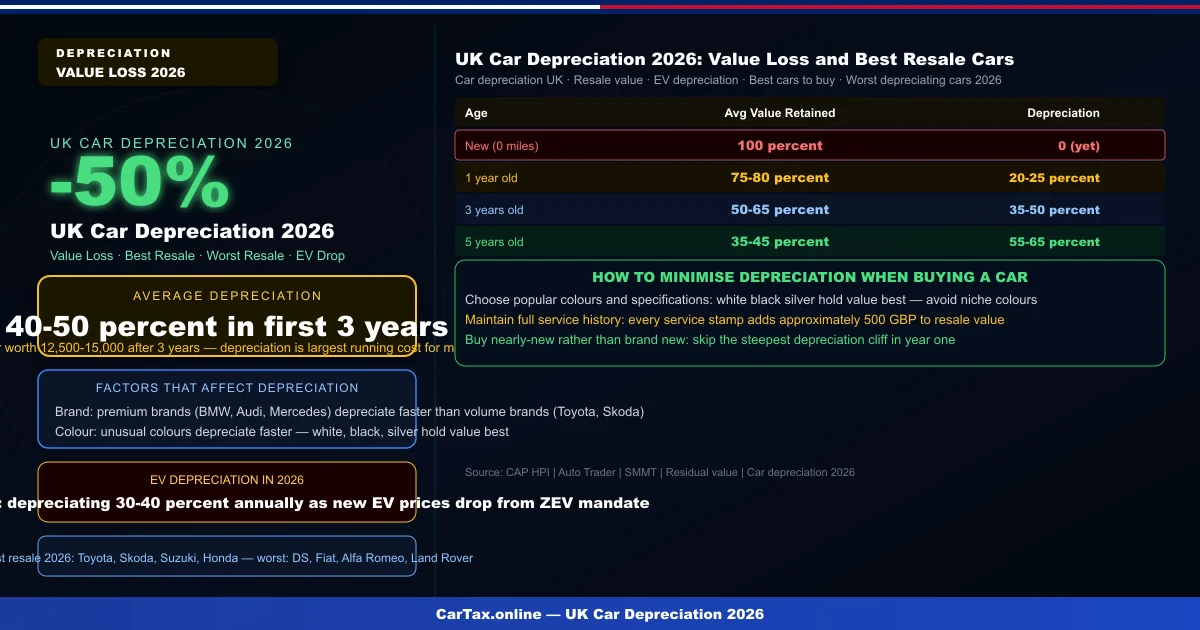
The average new car in the UK loses 40 to 50 percent of its value in the first three years of ownership. By five years, most cars retain only 35 to 45 percent of their original list price. This means a car purchased at 25,000 GBP new is worth approximately 12,500 to 15,000 GBP after three years and potentially only 8,750 to 11,250 GBP after five years.
Depreciation is fastest in the first year, with most cars losing 20 to 30 percent immediately upon registration. This is why buying nearly-new cars (one to two years old) with delivery mileage avoids the steepest first-year depreciation cliff.
Factors That Affect Depreciation
Brand perception plays a significant role. Premium brands including BMW, Audi, Mercedes-Benz and Land Rover tend to depreciate faster than their list prices suggest, often losing 45 to 55 percent in three years, because their high original prices are not fully supported by residual values. Volume brands such as Toyota, Skoda, Suzuki and Honda hold value more reliably, losing 35 to 45 percent over three years. Related: UK Used Car Market 2026 | Canada Vehicle CCA Depreciation 2026 | UK Car Depreciation Rates 2026 | Vehicle Bonus Depreciation 2026.
Colour choice affects resale value materially. Unusual colours (purple, yellow, bright orange) depreciate faster because fewer buyers want them. White, black, silver and grey hold value best and should be the default choice for buyers prioritising resale.
Specification level matters: high-specification variants depreciate more in percentage terms than mid-spec equivalents, because the premium paid for options does not translate proportionally to residual value. Buying mid-spec variants is a smarter financial move.
Electric Vehicle Depreciation in 2026
EV depreciation has been a major story in the 2024 to 2026 period. Tesla vehicles, once considered premium and relatively stable in value, have experienced 30 to 40 percent annual depreciation as new EV prices have dropped sharply. The combination of Tesla's frequent price reductions and increasing competition from Chinese manufacturers (BYD, MG, Geely) has severely impacted used EV values.
Premium EVs from traditional manufacturers including Mercedes EQS, Audi e-tron GT and BMW iX have also suffered significant depreciation as the market normalises from early-adoption pricing. Battery health concerns and rapidly advancing technology in new models continue to push used EV prices lower.
Best and Worst Resale Value Cars in 2026
Best resale value brands in 2026 include Toyota, Skoda, Suzuki, Honda and Mazda, which consistently outperform market-average residual values. Specific models with particularly strong resale include the Toyota Yaris, Toyota RAV4, Skoda Octavia, Skoda Fabia and Suzuki Jimny.
Worst depreciating cars include DS Automobiles (part of the Citroën group), Fiat, Alfa Romeo, Jaguar and Land Rover Discovery. These brands carry high list prices relative to their actual market desirability and typically suffer from poor residual values of 40 to 50 percent after three years.
How to Minimise Depreciation
Choosing popular colours and specifications that appeal to the broadest buyer pool reduces depreciation. Maintaining a full service history with every annual stamp adds approximately 500 GBP to resale value compared to cars with gaps in documentation. Keeping the car in a garage rather than on the street preserves paintwork and interior condition. Buying nearly-new rather than brand new eliminates the steepest first-year depreciation.
Frequently Asked Questions
Which brand has the best resale value in the UK? Toyota and Skoda consistently have the best resale values among mainstream brands, retaining 50-65 percent of original list price after three years.
Do electric cars depreciate faster than petrol cars? Yes, significantly in the current market. EVs are depreciating 30-40 percent annually in 2025-2026, compared to 15-20 percent for equivalent petrol cars.
What colour car holds its value best? White, black, silver and grey are the most desirable colours for resale. Unusual colours can reduce resale value by 5-15 percent.
How much does service history affect resale value? Each missing annual service can reduce resale value by approximately 500 GBP. Full service history is one of the most important factors in used car valuation.
Official Resources: GOV.UK Check Vehicle Tax | GOV.UK Vehicle Tax | DVLA Online | MOT Check
Frequently Asked Questions
Q: How much is car tax (VED) in the UK 2026?
Car tax rates in the UK depend on your vehicle's CO2 emissions and list price. Standard rates start from £190 per year for petrol and diesel cars, with zero-rated VED for EVs. First-year rates vary from £0 to £2,605 depending on emissions. Additional premiums apply for vehicles over £40,000.
Q: How do I check if my car is taxed online?
You can check your vehicle's tax status for free on the Gov.uk website at gov.uk/check-vehicle-tax. You'll need your vehicle's registration number (number plate). You can also check via the Motor Insurance Database to verify road tax and insurance status simultaneously.
Q: Can I get a refund on car tax if I sell my vehicle?
Yes — if you sell or scrap your vehicle, you can claim a refund on any full months of remaining road tax. Contact DVLA with the V11 reminder letter or apply online at gov.uk. Refunds are usually processed within 4-6 weeks.
Q: Is road tax refund available when transferring ownership?
No — road tax does not transfer with the vehicle. When you sell your car, the tax is automatically cancelled and any remaining months are refunded to you by DVLA. The new owner must tax the vehicle immediately. As a buyer, always verify the vehicle's tax status before purchasing.
Q: What is the luxury car tax threshold in the UK 2026?
The additional rate for vehicles over £40,000 (list price) adds £410 per year to standard VED rates for years 2-6 of registration. This surcharge brings the annual cost for high-emission vehicles over £40,000 to around £600-690 per year. Pure EVs under £40,000 pay zero VED.