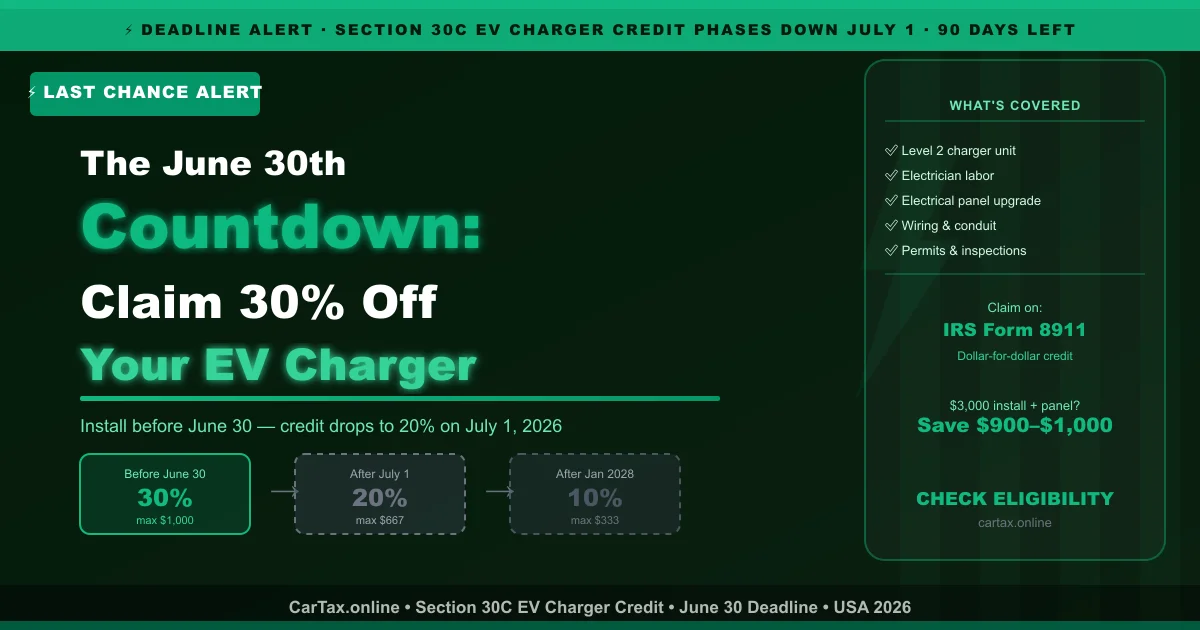
If you own an electric vehicle and have not yet installed a Level 2 home charger, you have less than 90 days to claim a federal tax credit that covers up to 30% of the installation cost — capped at $1,000 for residential installations. The Section 30C Alternative Fuel Vehicle Refueling Property Credit is still active and fully available, but under OBBBA modifications effective for the 2026 tax year, the residential credit rate is scheduled to phase down for installations completed after June 30, 2026.
This is not manufactured urgency. The credit structure genuinely changes on July 1, and installations completed before that date lock in the full 30%. Here is what the credit covers, who qualifies, and the exact six-step process to get your charger installed and properly documented before the deadline.
What Is the Section 30C Credit?
Section 30C of the Internal Revenue Code (Alternative Fuel Vehicle Refueling Property Credit) provides a tax credit for the cost of installing EV charging infrastructure. The credit is 30% of the total qualified installation cost, which includes:
- The cost of the EVSE unit itself (the charger hardware)
- Electrical panel upgrades required to support the charger
- Wiring and conduit installation by a licensed electrician
- Labor costs for the installation work
- Permitting fees directly related to the EV charger installation
| Taxpayer Type | Credit Rate | Maximum Credit | Notes |
|---|---|---|---|
| Individual (residential) | 30% | $1,000 | Per dwelling unit, not per vehicle |
| Business (commercial) | 30% | $100,000 | Per single item of qualifying property |
| Tax-exempt organizations | 30% | Direct payment eligible | Under elective pay provisions |
For a typical residential Level 2 installation — say, a $600 charger unit plus $1,200 in installation and electrical work totaling $1,800 — the 30% credit equals $540. For homeowners who need a panel upgrade (upgrading from 100A to 200A service costs $1,500–$3,500), the credit becomes more valuable. Full installation including a panel upgrade can run $3,000–$5,000, making the credit worth $900–$1,000. Not a small amount.
Why June 30th Matters: The OBBBA Phase-Down Schedule
The Inflation Reduction Act extended Section 30C through December 31, 2032. The OBBBA introduced a phase-down specifically for the residential portion of the credit:
| Installation Completed By | Credit Rate (Residential) | Maximum Credit (Residential) |
|---|---|---|
| June 30, 2026 | 30% | $1,000 |
| July 1 – December 31, 2026 | 20% | $667 |
| January 1 – December 31, 2027 | 15% | $500 |
| January 1, 2028 and after | 10% | $333 |
The business credit (commercial properties, rental properties with EVSE installed for tenant use, workplace charging) is not affected by the OBBBA phase-down and remains at 30%/$100,000 through 2032.
What Qualifies as a Creditable Installation?
The Charger Must Be Dedicated EVSE
The credit applies to dedicated Electric Vehicle Supply Equipment — not to simply plugging into an existing wall outlet. A standard 120V outlet is not qualifying property unless it's part of a dedicated circuit installed specifically for EV charging. Level 2 chargers (hardwired or NEMA 14-50/6-50 plug-in units) installed on a dedicated circuit qualify. Major brands that qualify include ChargePoint, JuiceBox, Wallbox, Emporia, and Tesla Wall Connector.
The Property Must Be in the United States
The charger must be installed at a U.S.-located property. Foreign properties do not qualify.
Ownership Matters for Renters
If you rent your home and the landlord installs the charger, the landlord claims the business credit — not you. If you personally install charging equipment in a rented property with the landlord's permission, the IRS has limited guidance on whether a renter can claim the residential credit (since the renter doesn't own the building). Most tax professionals advise having the landlord install and claim the credit when possible.
The 6-Step Checklist: Get It Done Before June 30
- Get multiple quotes now. Licensed electricians are booking 3–6 weeks out in most markets in spring 2026. If you start the process in June, you may miss the deadline even if you want the work done. Get at least two quotes — pricing varies significantly between contractors.
- Choose your charger. Level 2 chargers range from $200 (basic plug-in) to $800+ (smart chargers with app control, solar integration, bidirectional charging). The IRS does not require a specific brand or feature set — any dedicated EVSE installed on a dedicated circuit qualifies. Focus on the features you actually use.
- Confirm a permit is included. Many jurisdictions require an electrical permit for EV charger installations. Your electrician should handle the permit as part of the job. Confirm this before signing the contract. Permitting is required for the installation to be code-compliant, and IRS auditors may request permit documentation to verify the credit claim.
- Ensure installation is completed by June 30. The property must be "placed in service" by June 30 — meaning fully installed, functional, and connected to power. A deposit paid before June 30 with the installation completed after July 1 does not qualify for the 30% rate. Build schedule buffer into your timeline.
- Keep every receipt. Itemize everything: charger unit purchase receipt, electrician's invoice and payment receipt, panel upgrade costs if applicable, permit fees. Save the permit documentation separately. You do not file these with your return, but keep them for at least three years in case of audit.
- Claim on Form 8911. The Section 30C credit is claimed on IRS Form 8911 (Alternative Fuel Vehicle Refueling Property Credit). All major tax software programs include this form — answer the interview questions and it calculates automatically. The credit from Form 8911 flows to Schedule 3 (Form 1040), reducing your federal tax liability dollar-for-dollar.
Real-World Cost Scenarios
| Installation Scenario | Total Cost | Credit (30%, max $1K) | Your Out-of-Pocket Cost |
|---|---|---|---|
| Basic Level 2 (existing panel supports 240V) | $800–$1,200 | $240–$360 | $560–$840 |
| Standard Level 2 + minor wiring run | $1,200–$1,800 | $360–$540 | $840–$1,260 |
| Level 2 + panel upgrade required | $2,500–$4,500 | $750–$1,000 (capped) | $1,500–$3,500 |
| Level 2 + full panel + smart charger | $3,500–$5,500 | $1,000 (maximum) | $2,500–$4,500 |
Frequently Asked Questions
Can I claim the credit if I installed a charger in a previous year but didn't know about the credit?
Yes, if the installation was in a year still within the 3-year statute of limitations. File an amended return using Form 1040-X for the year the charger was placed in service. If you installed in 2024 and the credit was available that year, you can amend your 2024 return to claim it. If you installed in 2022, the 3-year window closed in 2025 and it's too late.
Can I claim the credit on my vacation home?
Yes, if the vacation property is in the United States and you own it. The credit applies per dwelling unit — so you can potentially claim it separately for your primary residence and your vacation home in the same tax year, subject to the $1,000 maximum per dwelling. The credit is non-refundable, meaning it reduces your tax liability to zero but will not generate a refund beyond what you owe.
What if my installation runs past June 30 due to contractor delays?
The credit requires the charger to be "placed in service" — fully installed and operational — by June 30. A charger partially installed but not yet functional by that date does not qualify for the full 30% rate. This is why starting now (April) rather than late May or June matters — you have buffer for scheduling delays and permit approval timelines.
Does the credit apply to workplace charging equipment my employer installs?
Your employer may claim the business credit (30%/$100,000 per unit) for chargers installed at the workplace. As an employee, you cannot personally claim the credit for employer-owned equipment. However, workplace EV charging provided by your employer is a tax-free fringe benefit to you — you do not owe income tax on the value of electricity provided for vehicle charging at work.
For a complete breakdown of federal and state EV tax incentives available in your situation, use our Car Tax Calculator — updated for all 2026 changes including Section 30C phase-down dates.