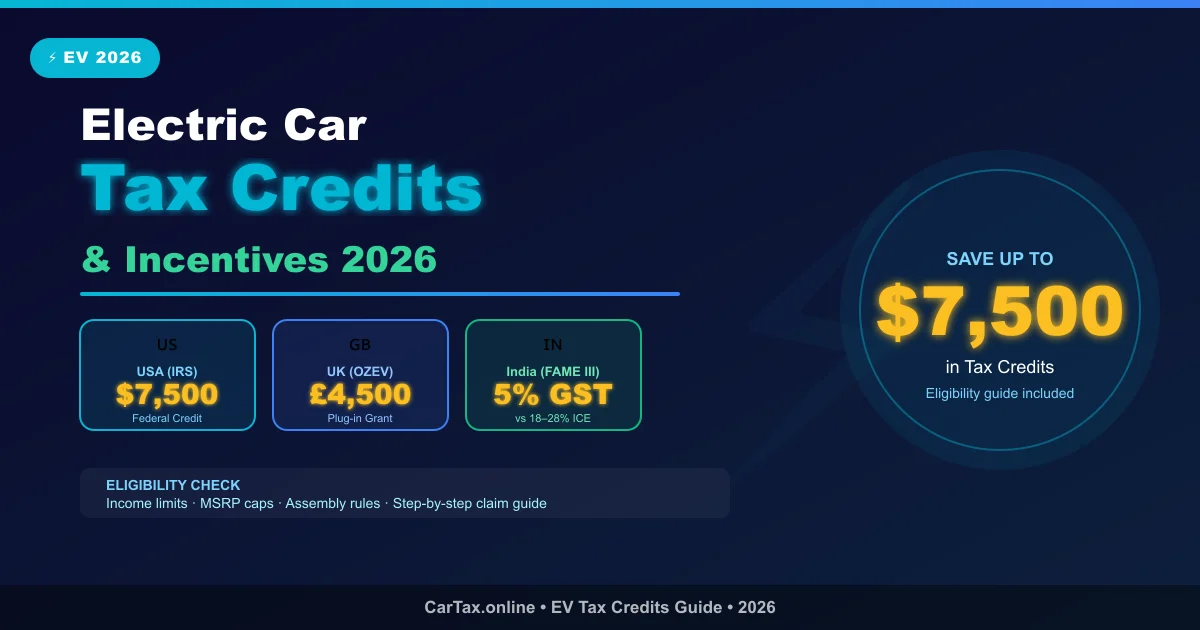
Governments worldwide are accelerating the shift to electric vehicles by offering some of the most generous tax credits and purchase incentives in automotive history. In 2026, a buyer in the right situation can save up to $7,500 on a new EV in the USA, £5,000 in the UK, or reduce GST liability significantly in India. This guide breaks down every major incentive by country so you can plan your purchase and maximize your savings.
USA: Federal Clean Vehicle Credit (Up to $7,500)
The Clean Vehicle Credit under the Inflation Reduction Act remains the largest single EV incentive available to US buyers in 2026. Here's what you need to know:
New EV Credit — Key Rules
To claim the full $7,500 federal credit on a new electric vehicle, all of the following must apply:
- Vehicle price cap: Sedans and cars ≤ $55,000 MSRP; SUVs, trucks, vans ≤ $80,000 MSRP
- Income limit: Single filers ≤ $150,000 AGI; head of household ≤ $225,000; joint filers ≤ $300,000
- North America assembly: Final assembly must occur in North America (USA, Canada, or Mexico)
- Battery sourcing: A minimum percentage of battery critical minerals and components must be sourced from the USA or free-trade-agreement partners
If only the battery component requirement is met (not mineral sourcing), the credit is halved to $3,750. Check eligibility on the official fueleconomy.gov EV incentives tool.
Used EV Credit — Up to $4,000
Buying a used electric vehicle? You may qualify for a $4,000 used clean vehicle credit (or 30% of the sale price, whichever is lower):
- Vehicle must be ≥ 2 model years old at time of purchase
- Sale price must be ≤ $25,000
- Income limit: Single ≤ $75,000 AGI; joint ≤ $150,000
- First time claiming the credit (once per three years)
Point-of-Sale Rebate Option
Since January 2024, buyers can transfer their federal EV credit directly to a participating dealer as a point-of-sale discount — meaning you don't need to wait until tax season to benefit. Ask your dealer if they are registered with the IRS for this program.
| Credit Type | Max Amount | Vehicle Price Cap | Income Cap (Joint) |
|---|---|---|---|
| New EV Credit | $7,500 | $55,000 / $80,000 | $300,000 |
| Used EV Credit | $4,000 | $25,000 | $150,000 |
| Commercial EV Credit | $7,500–$40,000 | None | N/A (business) |
UK: EV Grants and Tax Incentives 2026
The UK has restructured its EV incentive program following the phase-out of the Plug-in Car Grant for private buyers. In 2026, the main savings come through tax treatment rather than direct purchase grants.
Company Car Benefit-in-Kind (BIK) Tax
If you receive an EV as a company car, the Benefit-in-Kind tax rate for zero-emission vehicles remains just 2% of the vehicle's list price through 2027–28 — compared to 20%–37% for petrol and diesel company cars. On a £45,000 EV, a 40% taxpayer saves roughly £3,240 per year compared to an equivalent petrol car.
First Year Allowance (FYA) for Businesses
UK businesses purchasing a zero-emission car can write off 100% of the purchase cost against their corporation tax liability in the year of purchase via the First Year Allowance. This makes EVs significantly more attractive than ICE vehicles for business fleets.
Vehicle Excise Duty (VED) — Road Tax
From April 2025, new electric cars are no longer VED-exempt. In 2026, EV owners pay the standard first-year VED rate of £10 (versus up to £2,745 for high-emission vehicles) and then £195 per year thereafter. This is still a meaningful saving versus petrol equivalents.
Workplace Charging Scheme
UK businesses can claim a grant of up to £350 per socket (up to 40 sockets) toward the cost of installing workplace EV chargers under the Workplace Charging Scheme administered by the Office for Zero Emission Vehicles (OZEV).
India: GST Reduction and FAME II Subsidies
India offers some of the most compelling EV incentives in Asia, driven by the government's ambitious target of 30% EV penetration by 2030.
GST on Electric Vehicles
Electric vehicles attract only 5% GST in India, compared to 28% GST plus a cess of 1%–22% on petrol and diesel vehicles. On a ₹15 lakh EV, this saves approximately ₹3–4 lakh compared to an equivalent ICE vehicle.
FAME II (Faster Adoption and Manufacturing of EVs)
Under the FAME II scheme, buyers of electric two-wheelers and three-wheelers receive a direct demand incentive. For electric cars, subsidies are primarily directed at commercial and public transport fleets. State-level incentives vary significantly:
- Delhi: ₹1.5 lakh subsidy on EVs + road tax exemption
- Maharashtra: ₹2.5 lakh subsidy on EVs (subject to annual budget)
- Gujarat: ₹1.5 lakh subsidy + registration fee waiver
- Tamil Nadu: 100% road tax exemption for EVs
Income Tax Benefit — Section 80EEB
Indian taxpayers who take a loan to purchase an electric vehicle can deduct up to ₹1.5 lakh per year in loan interest under Section 80EEB of the Income Tax Act. This deduction is available for both personal and business use EVs.
Other Countries: Quick Snapshot
| Country | Key Incentive | Max Benefit |
|---|---|---|
| Germany | Umweltbonus (company cars only from 2024) | €4,500 (commercial) |
| Canada | iZEV federal rebate | CAD $5,000 |
| Australia | FBT exemption for employer-provided EVs | ~AUD $3,000–$7,000/yr |
| France | Bonus Écologique + social leasing | €7,000 (income-tested) |
| Netherlands | BPM exemption + subsidies (limited pool) | €2,950 |
| Norway | VAT exemption + reduced road toll | VAT savings ~25% |
| China | Purchase tax exemption on NEVs | 10% of vehicle price |
How to Claim Your EV Tax Credit (USA Step-by-Step)
- Verify eligibility: Check your vehicle on fueleconomy.gov to confirm it qualifies for the credit amount.
- Confirm your income: Estimate your AGI for the tax year of purchase. If you're near the limit, consider contributing more to a 401(k) or IRA to reduce your AGI.
- Choose point-of-sale vs. tax return: Ask the dealer if they support the point-of-sale transfer. If so, the $7,500 comes off your purchase price immediately.
- File IRS Form 8936: If taking the credit on your tax return, complete Form 8936 (Clean Vehicle Credits) when filing your federal return.
- Carry forward unused credits: The personal clean vehicle credit is non-refundable and cannot be carried forward. The commercial credit (Form 8936, Part II) can offset other taxes.
Frequently Asked Questions
Can I get the $7,500 credit if I lease an EV?
Yes — when you lease an EV, the leasing company (not you) technically qualifies for the commercial clean vehicle credit of up to $7,500. Most major manufacturers pass this saving through to customers as a reduced monthly payment or capitalized cost reduction. Always ask the dealer to show the lease with and without the credit applied.
Does the EV credit reduce the tax I owe or give me a refund?
The personal Clean Vehicle Credit is non-refundable — it can reduce your federal income tax liability to zero, but any unused portion is not refunded to you. You must owe at least $7,500 in federal tax to use the full credit. Using the point-of-sale transfer option avoids this limitation entirely.
Are hybrid cars eligible for the $7,500 credit?
Plug-in hybrid electric vehicles (PHEVs) may qualify for a partial credit ($3,750) if they meet battery component requirements, but conventional (non-plug-in) hybrids do not qualify for the clean vehicle credit.
Which EVs qualify for the full $7,500 in 2026?
Qualifying vehicles change as manufacturers adjust their supply chains. In early 2026, models from Tesla (Model 3 RWD, Model Y), Chevrolet (Bolt EV, Equinox EV), Ford (F-150 Lightning), and several others have qualified. Always verify current eligibility on the IRS or fueleconomy.gov website before purchase, as the list updates quarterly.
Can I combine federal and state EV credits?
Absolutely. Federal and state incentives are independent programs and can be stacked. For example, a Colorado buyer can combine the $7,500 federal credit with Colorado's $5,000 state tax credit, a utility rebate, and the federal point-of-sale transfer — potentially saving over $12,500 on a qualifying EV.
Conclusion
Electric vehicle tax incentives in 2026 represent real, substantial savings — but they come with eligibility rules, income limits, and vehicle-specific conditions that are easy to overlook. The most important step is to verify your specific vehicle and situation before you sign the purchase agreement, since credits cannot be retroactively claimed if you miss a qualifying condition. Use our car tax calculator to see the full on-road cost of your next EV purchase, taxes and all.