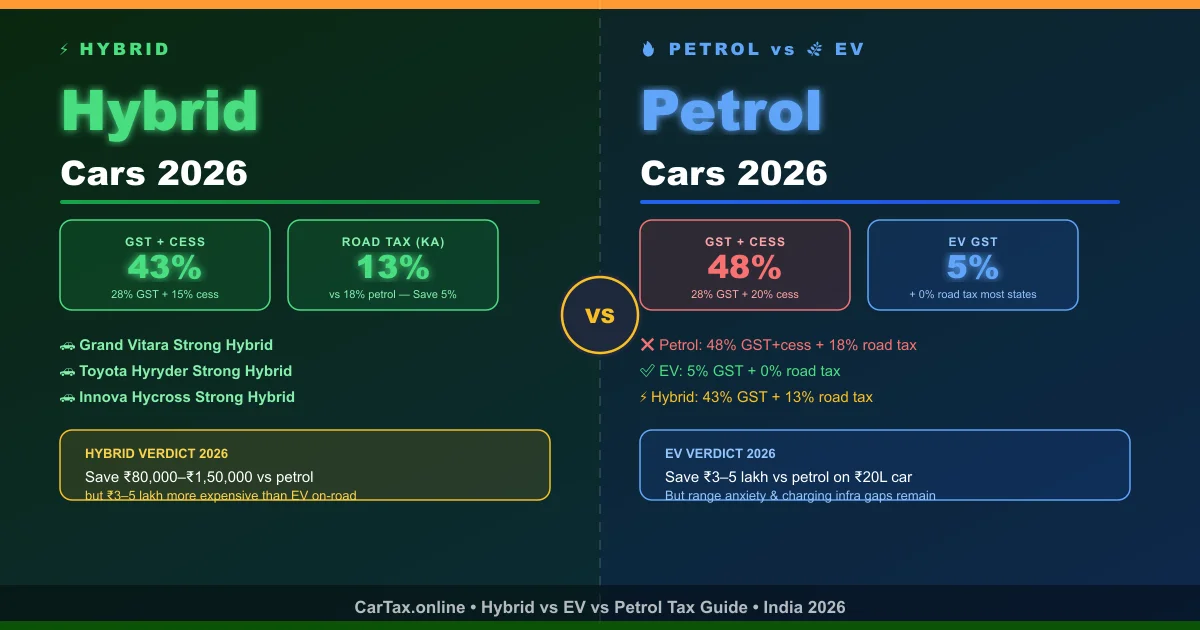
The three-way choice between petrol, hybrid, and electric has never been more confusing — or more financially significant — than in 2026. The tax difference between a petrol car and an equivalent EV can exceed ₹5 lakh on-road. Hybrids sit somewhere in the middle, and depending on where you live and which model you choose, a strong hybrid can either be an excellent middle ground or an expensive mistake.
This guide cuts through the confusion with actual GST rates, state-wise road tax numbers, and full on-road cost comparisons for the three most popular hybrid models in India: the Maruti Suzuki Grand Vitara Strong Hybrid, the Toyota Hyryder Strong Hybrid, and the Toyota Innova Hycross Strong Hybrid.
Understanding the Tax Landscape: Petrol vs Hybrid vs EV
India's GST framework treats petrol, hybrid, and electric cars very differently. Here is the complete tax breakdown:
| Vehicle Type | GST Rate | Cess | Total GST Incidence |
|---|---|---|---|
| Small petrol car (<4m, <1200cc) | 18% | 1% | 19% |
| Petrol car (>4m or >1200cc) | 28% | 20% | 48% |
| Diesel car (>4m or >1500cc) | 28% | 22% | 50% |
| Strong Hybrid (SHEV) | 28% | 15% | 43% |
| Mild Hybrid (MHEV) | 28% | 20% | 48% (same as petrol) |
| Electric Vehicle (BEV) | 5% | 0% | 5% |
Critical distinction: Only strong hybrids (where the car can run on electric power alone for short distances) get the lower 15% cess. Mild hybrids (like the Brezza MHEV or 48V Nexon) get no GST benefit whatsoever and are taxed identically to regular petrol cars. Do not confuse the two when shopping.
Road Tax: Where Hybrids Get Their Real Benefit
The GST difference alone (43% for strong hybrid vs 48% for petrol) is worth roughly ₹60,000–₹1,20,000 on a ₹15–25 lakh car. But the bigger advantage for hybrid buyers in certain states comes from road tax concessions.
| State | Petrol Road Tax | Strong Hybrid Road Tax | EV Road Tax | Hybrid Saving vs Petrol |
|---|---|---|---|---|
| Karnataka | 18% | 13% (concessional) | 0% | ✅ Save 5% = ₹75,000–₹1,25,000 |
| Kerala | 12–14% | 10% (concessional) | 0% | ✅ Save 2–4% = ₹30,000–₹60,000 |
| Maharashtra | 11% | 11% (no concession) | 0% | ❌ No road tax saving |
| Delhi | 7% | 7% (no concession) | 0% | ❌ No road tax saving |
| Tamil Nadu | 13% | 13% (no concession) | 0% | ❌ No road tax saving |
| Gujarat | 7% | 7% (no concession) | 0% | ❌ No road tax saving |
| Haryana | 5% | 5% (no concession) | 0% | ❌ No road tax saving |
The road tax concession for strong hybrids is currently available in Karnataka and Kerala — making the hybrid value proposition significantly stronger for buyers in Bangalore, Mysore, Kochi, and Thiruvananthapuram.
Full On-Road Cost Comparison: Grand Vitara Variants
Let us compare the Maruti Suzuki Grand Vitara across its three powertrain options — mild hybrid petrol, strong hybrid, and (for comparison) the Tata Nexon EV as a comparable size EV:
In Bangalore (Karnataka) — Where Hybrid Gets Maximum Benefit
| Variant | Ex-Showroom | GST Component | Road Tax (KA) | Insurance | Est. On-Road |
|---|---|---|---|---|---|
| Grand Vitara Mild Hybrid (Zeta+) | ₹16,45,000 | included (48%) | ₹2,96,100 (18%) | ₹42,000 | ~₹19,91,000 |
| Grand Vitara Strong Hybrid (Alpha+) | ₹19,99,000 | included (43%) | ₹2,59,870 (13%) | ₹48,000 | ~₹23,15,000 |
| Tata Nexon EV (Max Long Range) | ₹19,49,000 | included (5%) | ₹0 (EV waiver) | ₹45,000 | ~₹20,08,000 |
In Bangalore: the Grand Vitara Strong Hybrid costs ₹3 lakh more on-road than the comparable Nexon EV. The mild hybrid costs ₹1.17 lakh less than the EV on-road — but offers much less fuel savings over time.
In Delhi — Where Hybrid Gets Minimal Benefit
| Variant | Ex-Showroom | Road Tax (Delhi) | Insurance | Est. On-Road |
|---|---|---|---|---|
| Grand Vitara Mild Hybrid (Zeta+) | ₹16,45,000 | ₹98,700 (6%) | ₹42,000 | ~₹17,94,000 |
| Grand Vitara Strong Hybrid (Alpha+) | ₹19,99,000 | ₹1,19,940 (6%) | ₹48,000 | ~₹21,75,000 |
| Tata Nexon EV (Max Long Range) | ₹19,49,000 | ₹0 (EV waiver) | ₹45,000 | ~₹20,08,000 |
In Delhi: the Strong Hybrid costs ₹1.67 lakh more on-road than the Nexon EV (since Delhi gives no road tax concession on hybrids). The EV is clearly cheaper upfront.
Innova Hycross Strong Hybrid: The Premium Segment Exception
The Toyota Innova Hycross is a different story. Its strong hybrid system significantly outperforms competing diesel MPVs in fuel efficiency, and the tax gap is compelling in this segment:
| Variant | Ex-Showroom (Delhi) | Road Tax | Fuel Saving vs Diesel (5yr) | Est. 5yr TCO |
|---|---|---|---|---|
| Innova Crysta Diesel GX (competitor) | ₹19,77,000 | ₹1,38,390 (7%) | Baseline | ~₹28,50,000 |
| Innova Hycross Strong Hybrid G | ₹22,31,000 | ₹1,33,860 (6%) | Save ~₹2,40,000 | ~₹27,80,000 |
| Innova Hycross Strong Hybrid ZX(O) | ₹31,99,000 | ₹1,91,940 (6%) | Save ~₹2,40,000 | ~₹37,50,000 |
Over a 5-year ownership period, the Innova Hycross strong hybrid becomes cost competitive with or cheaper than the diesel Crysta once fuel savings are factored in. In the MPV segment, the hybrid case is strongest.
The Real Hybrid Advantage: Fuel Savings Over Time
The on-road price comparison only tells half the story. Strong hybrids deliver dramatically better fuel efficiency in urban driving — which is where most Indian buyers spend most of their time:
| Model | ARAI Mileage | Real-World (Urban) | Monthly Fuel Cost (1,500 km) | Annual Saving vs Petrol |
|---|---|---|---|---|
| Grand Vitara Mild Hybrid 1.5 | 21.11 kmpl | 14–16 kmpl | ~₹7,000 | Baseline |
| Grand Vitara Strong Hybrid | 27.97 kmpl | 20–24 kmpl | ~₹4,700 | Save ₹27,600/year |
| Tata Nexon EV (home charging) | — | ~17–20 kWh/100km | ~₹1,200 | Save ₹69,600/year |
The strong hybrid saves approximately ₹27,600/year in fuel vs a mild hybrid petrol. The EV saves ₹69,600/year — but requires home charging infrastructure and comes with range limitations. Payback period for the strong hybrid premium over mild hybrid: approximately 4.5–5 years, assuming current petrol prices.
Who Should Buy a Hybrid in 2026?
Based on the complete financial picture, here is a decision framework:
Buy the Strong Hybrid if:
- You live in Bangalore or Kerala (road tax concession + fuel savings make a strong case)
- You drive primarily in the city and cover 1,200–1,800 km/month
- You do not have access to home charging (apartment dweller, no dedicated parking)
- You want the Toyota/Maruti reliability reputation with no range anxiety
- You are buying an Innova Hycross — in the MPV segment, the hybrid clearly wins on 5-year TCO
Buy the EV instead if:
- You have home charging (the cost advantage is overwhelming if you charge at home)
- You live in Delhi, Maharashtra, Tamil Nadu, or other states with no road tax concession for hybrids
- Your daily commute is under 150 km
- You want the absolute lowest on-road price in the ₹15–25 lakh segment
Buy the Mild Hybrid Petrol if:
- Your budget is tight and you want the base-level Grand Vitara or Hyryder
- You drive fewer than 1,000 km/month (the strong hybrid fuel savings take too long to recoup)
- You frequently do highway driving where the hybrid's electric advantage is minimal
Frequently Asked Questions
Is the GST on hybrid cars lower than petrol cars?
Only for strong hybrids (SHEV). Strong hybrid cars attract 28% GST + 15% cess = 43% effective rate. Regular petrol cars above 4m attract 28% GST + 20% cess = 48%. Mild hybrids (48V systems like in the Brezza or base Grand Vitara) receive no GST benefit and are taxed at the full 48% rate.
Is the Grand Vitara Strong Hybrid cheaper than the EV on-road in Bangalore?
No. Despite the 13% road tax concession in Karnataka, the Grand Vitara Strong Hybrid (priced ~₹20 lakh ex-showroom) comes out about ₹2.5–3 lakh more expensive on-road compared to the Tata Nexon EV or similar-priced EVs, which pay 0% road tax. The EV's 0% road tax and 5% GST advantage is too large to overcome purely through the hybrid cess reduction.
Which states give road tax concessions on hybrid cars?
As of April 2026, Karnataka and Kerala offer road tax concessions for strong hybrid vehicles. Karnataka charges 13% road tax on hybrids vs 18% on petrol (saving 5%). Most other states — including Delhi, Maharashtra, Tamil Nadu, and Gujarat — apply the same road tax rate to hybrids and petrol cars.
Does the Innova Hycross get the lower GST rate?
Yes. The Innova Hycross with the strong hybrid powertrain (2.0L petrol + electric) qualifies for the 28% GST + 15% cess = 43% rate. The petrol-only Innova Hycross (2.0L non-hybrid) attracts the higher 28% + 20% = 48% rate. The strong hybrid variants are clearly marked on the Toyota India price list.
Conclusion: The Hybrid Sweet Spot in 2026
Hybrids occupy a genuinely useful middle ground in 2026 — particularly for urban buyers in Bangalore and Kerala who cannot yet commit to an EV. The combination of the reduced 15% cess, state road tax concessions (where available), and genuine 35–45% better fuel efficiency in city traffic makes strong hybrids financially justifiable for mid-to-high usage drivers.
For buyers in Delhi, Maharashtra, and other states with no hybrid road tax concession, the EV is the financially superior choice if home charging is available. If home charging is not an option, the strong hybrid remains the most practical and fuel-efficient alternative to petrol.
Use our India Car Tax Calculator to compare the exact on-road price of any hybrid, EV, or petrol car in your city — including the latest GST rates and state road tax.