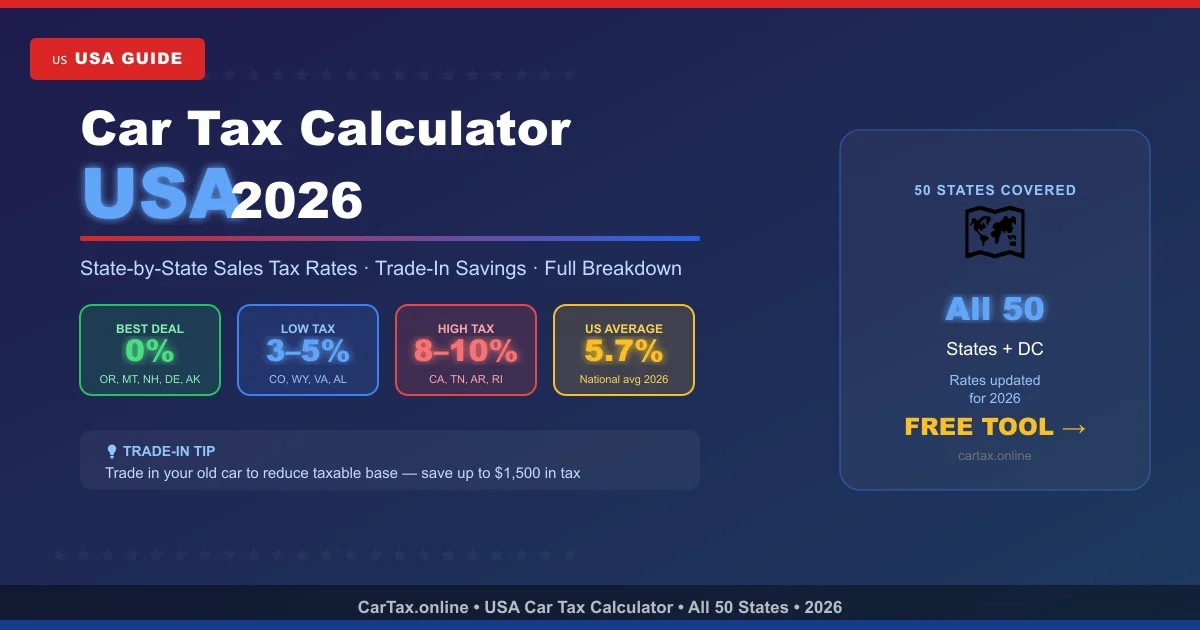
Buying a car in the United States? Before you sign anything, you need to know exactly how much car sales tax you'll owe — because it can add thousands of dollars to your purchase price. Unlike many countries that charge a single national rate, the US leaves vehicle taxation entirely to individual states, meaning your tax bill depends heavily on where you register the car. Use our free US car tax calculator to get an instant, state-specific estimate.
How Car Sales Tax Works in the USA
There is no federal car sales tax in the United States. Instead, each state — and in many cases each county or city — sets its own rate. When you buy from a dealership, the dealer collects the tax at the point of sale and remits it to the state. For private-party purchases, you pay the equivalent use tax directly to your state's DMV when registering the vehicle.
The national weighted average car sales tax is approximately 7.12% in 2026. Rates range from 0% in five states to over 11% when state and local taxes are combined in high-tax jurisdictions.
The Basic Formula
Sales Tax = (Purchase Price − Trade-in Value) × Tax RateThe trade-in deduction is available in 47 of 50 states and is one of the most effective ways to reduce the amount you're taxed on. For more, see our guide: Trade-In Car Tax USA.
Car Sales Tax Rates by State (2026)
Below are the base state rates for the ten most populous US states. Note that county and city add-ons can push the effective rate higher.
| State | State Base Rate | Max with Local Tax | On a $35,000 Car |
|---|---|---|---|
| California | 7.25% | 10.50% | $2,538 – $3,675 |
| Texas | 6.25% | 8.25% | $2,188 – $2,888 |
| Florida | 6.00% | 8.00% | $2,100 – $2,800 |
| New York | 4.00% | 8.875% | $1,400 – $3,106 |
| Illinois | 6.25% | 11.00% | $2,188 – $3,850 |
| Pennsylvania | 6.00% | 8.00% | $2,100 – $2,800 |
| Ohio | 5.75% | 8.00% | $2,013 – $2,800 |
| Georgia | 7.00% | 9.00% | $2,450 – $3,150 |
| Washington | 6.50% | 10.40% | $2,275 – $3,640 |
| Colorado | 2.90% | 11.20% | $1,015 – $3,920 |
For state-specific deep dives, see our guides for California, Texas, and Florida.
County and City Add-On Taxes
In most US states, the state rate is just the floor. Local jurisdictions layer additional taxes on top:
- County tax: Typically 0.5%–2.0% added on top of the state rate
- City/municipal tax: Some cities add a further 0.5%–1.5%
- Special district taxes: Transit authorities and other districts may add small amounts
For example, in Los Angeles County, California, the effective rate is 10.25%: the 7.25% state base rate plus 3.0% in county and district taxes. On a $40,000 vehicle, that's $4,100 in tax alone — before registration, title fees, or dealer charges.
Additional Fees Beyond Sales Tax
Tax is just one component of the total cost of buying a vehicle. You'll also typically pay:
- Title fee: $15–$100 depending on state
- Registration/license plate fee: $30–$300+ based on vehicle weight and state
- Documentation fee (doc fee): $50–$695 charged by the dealer
- Vehicle inspection fee: $10–$35 where required by state law
- Emissions testing: $15–$50 in some states
Always ask the dealer for the complete out-the-door price — this is the only number that includes every tax and fee you'll actually pay at signing.
How to Reduce Your Car Sales Tax
Several legal strategies can significantly reduce the tax you owe when buying a vehicle in the USA:
- Trade in your old car: In 47 states, the trade-in value is subtracted from the purchase price before tax is calculated. On a $40,000 car with a $12,000 trade-in, you only pay tax on $28,000 — saving around $840 at a 7% rate.
- Buy in a low-tax state: If you plan to register the car in a zero- or low-tax state, you can save thousands.
- Buy an EV or hybrid: Several states offer full or partial sales tax exemptions on electric vehicles, including Colorado, New York, and others.
- Negotiate the dealer's doc fee: This fee is not regulated in most states and is often negotiable.
- Consider a private-party purchase: You skip dealer doc fees, though you still pay sales/use tax at registration.
States With Zero Car Sales Tax
Five US states charge no statewide sales tax on vehicle purchases:
- Oregon — 0% statewide; no local car taxes either
- Montana — 0% statewide; no local car taxes either
- Delaware — 0% statewide; no local car taxes either
- New Hampshire — 0% statewide; no local car taxes either
- Alaska — 0% statewide; local boroughs may charge up to 7.5%
Frequently Asked Questions
Do I pay car sales tax to the dealer or directly to the state?
When buying from a licensed dealership, you pay the sales tax to the dealer at the point of sale. The dealer then remits it to the state on your behalf. For private-party purchases, you pay the equivalent use tax directly to your local DMV or state revenue department when you register the vehicle.
Can I deduct car sales tax on my federal income tax return?
Yes — if you itemize deductions rather than taking the standard deduction, you can claim sales tax paid on a vehicle under the SALT (State and Local Taxes) deduction. The combined SALT deduction is capped at $10,000 per year per household.
Is the sales tax rate different for used cars vs new cars?
In most states, the same rate applies to both new and used vehicles. However, a handful of states — including Virginia and New Hampshire — use a different calculation method for used cars, sometimes based on book value rather than sale price.
If I buy a car out of state, which state's tax rate do I pay?
You generally pay the tax rate of the state where you will register and primarily drive the vehicle — your home state — not the state where you purchased it. Most states have reciprocal agreements for this purpose.
Does California have the highest car sales tax in the USA?
California has the highest base state rate at 7.25%, but when local taxes are included, states like Illinois (up to 11%), Louisiana (up to 11.45%), and Tennessee (up to 9.75%) can exceed California's effective rate in certain cities.
Conclusion
Car sales tax in the USA is a patchwork of state, county, and city rates that can vary dramatically from one zip code to the next. On a $40,000 vehicle, the difference between buying in a 0% state and a 10% jurisdiction is $4,000 — money that stays in your pocket with the right planning. Use our US car tax calculator to get an instant, accurate breakdown for your specific state and county.