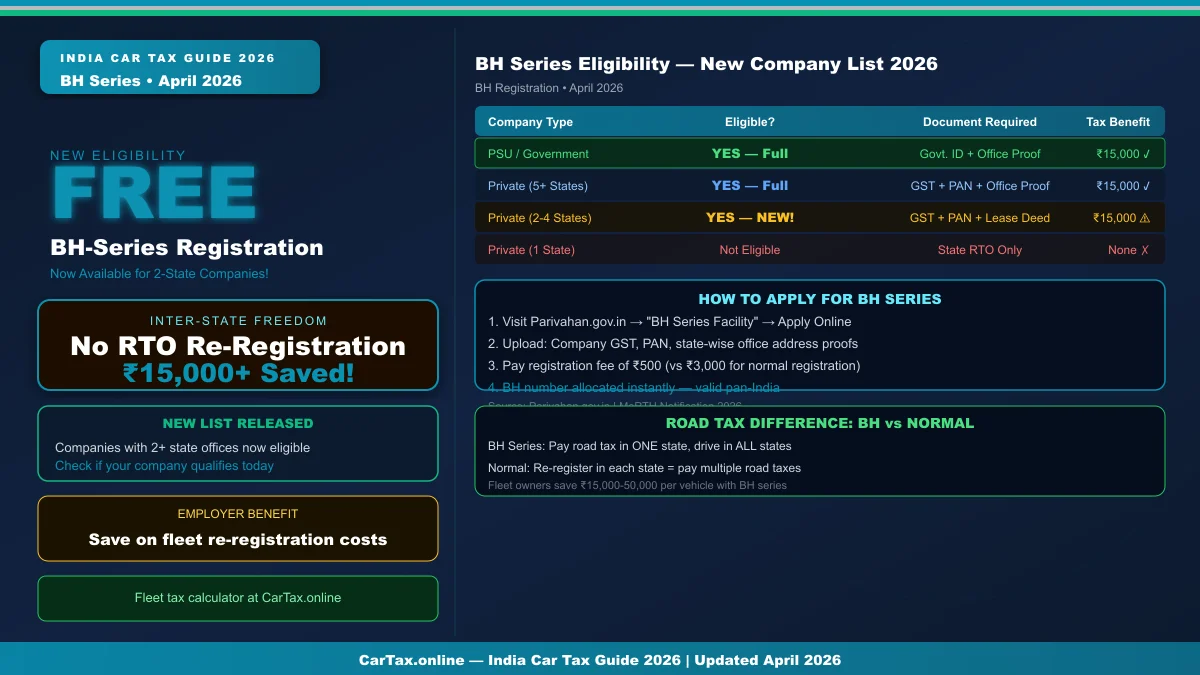
The BH (Bharat) series vehicle registration — which eliminates the need to transfer your vehicle registration every time you move to a new state — has quietly become significantly more accessible as of April 2026. The Ministry of Road Transport and Highways (MoRTH) has expanded the eligibility criteria to include private sector employees whose companies operate in at least two states. This is a material change from the original BH rules, which restricted eligibility primarily to central government employees, state government employees, and public sector employees.
For private sector professionals who relocate frequently — consultants, project managers, field engineers, regional sales heads — the BH series eliminates the Rs3,000-8,000 annual cost of re-registration and the bureaucratic hassle of NOC applications every time a job transfer moves you across state lines. With the new rules effective April 2026, a much larger segment of India's working population can now access this benefit.
Who Is Newly Eligible Under the 2026 BH Series Rules?
The 2026 expansion of BH eligibility focuses on private sector employees with the following criteria:
- Multi-state employer: The employee's company must have offices in at least two states
- HR documentation: A certificate from the employer confirming multi-state operations and the employee's role
- Identity proof: Aadhaar, PAN, and office address verification
- Transfer order or appointment letter: Not always required for initial application, but useful for supporting documentation
The key documentation change in 2026 is that private employees no longer need to demonstrate a pending transfer order to qualify — simply being employed by a company that operates in multiple states is sufficient. This opens BH eligibility to millions of IT professionals, consulting staff, and corporate employees who previously did not qualify. Related: Scrap Your Car Before June 30 and Save 25% Road Tax Under In | 8th Pay Commission Sunday Analysis | 8th Pay Commission Analysis | BH Series Car Tax India 2026.
What BH Series Registration Actually Saves You
The financial case for BH series is straightforward. Without BH, an employee transferring from Bangalore to Pune must: apply for NOC from Bangalore RTO (Rs200-500 fee), wait 15-30 days for processing, pay road tax in Pune for the remaining period of the tax year (Rs3,000-7,000 depending on vehicle), and re-register in Pune (Rs500-2,000 in fees). Total cost per transfer: Rs4,000-10,000 and 1-2 months of administrative hassle.
With BH series, the vehicle is registered under a special BH category valid pan-India. Road tax is paid in 2-year installments (rather than annually in some states), and the vehicle does not require re-registration when you move between states. The total savings over a 10-year period with 2-3 transfers: Rs12,000-30,000 in fees alone — plus the time and stress of navigating RTO offices during transfers.
How to Apply for BH Series in 2026
The application process for BH series has been streamlined significantly. Here is the step-by-step process as of April 2026:
Step 1: Verify your eligibility
Confirm that your employer operates in at least two states. Get an HR certificate on company letterhead stating this fact and confirming your employment.
Step 2: Visit the Parivahan portal or nearest RTO
BH applications can be initiated online via parivahan.gov.in or in person at any RTO. Online applications are faster and reduce the number of visits required.
Step 3: Submit Form 28A and supporting documents
The BH application uses Form 28A, which has been updated for the 2026 eligibility expansion. Required documents: ID proof, address proof, employer certificate, vehicle documents (RC, insurance), and Form 20 (if scrapping an old vehicle for new purchase).
Step 4: Pay 2-year road tax upfront
BH series vehicles pay road tax in 2-year installments rather than annually (in states that charge annual tax). The rate is calculated based on the vehicle's age and category.
Step 5: Receive BH registration number
The BH registration uses the format BH-XX-XXXX-XXXX (state district registration marks with BH prefix). The number is issued within 7-10 working days for complete applications.
Can Old Vehicles Be Converted to BH Series?
Yes — vehicles already registered under a state-specific number can be converted to BH series, though the process involves de-registering the current number and re-registering under BH. The process is most worthwhile for vehicles that are less than 5 years old and have a high likelihood of inter-state transfers in the future. For vehicles over 8 years old, the conversion cost (including de-registration fees, BH registration fees, and road tax for the remaining years) may exceed the savings benefit.
Official Resources: Parivahan Portal | Vahan Road Tax | India GST Portal | FAME-III Scheme
Frequently Asked Questions
Q: Who is newly eligible for BH series registration in 2026?
Private sector employees whose companies operate in at least two states are now eligible for BH series registration as of April 2026. Previously, only government employees and PSU staff qualified.
Q: What documents are required for BH series application?
Required documents include ID proof (Aadhaar/PAN), address proof, employer HR certificate confirming multi-state operations, vehicle RC, insurance, and completed Form 28A.
Q: How much does BH series save on inter-state transfers?
BH series eliminates Rs4,000-10,000 in NOC fees, road tax re-registration, and RTO fees per transfer. Over 2-3 transfers in a vehicle's lifetime, the savings exceed Rs12,000-30,000.
Q: Can old vehicles be converted to BH series?
Yes — vehicles can be de-registered from their current state number and re-registered under BH series. The process is most worthwhile for vehicles under 5 years old with high inter-state transfer probability.
Q: How is road tax paid for BH series vehicles?
BH series vehicles pay road tax in 2-year installments rather than annually in most states, reducing the administrative burden and providing slight cost efficiency.