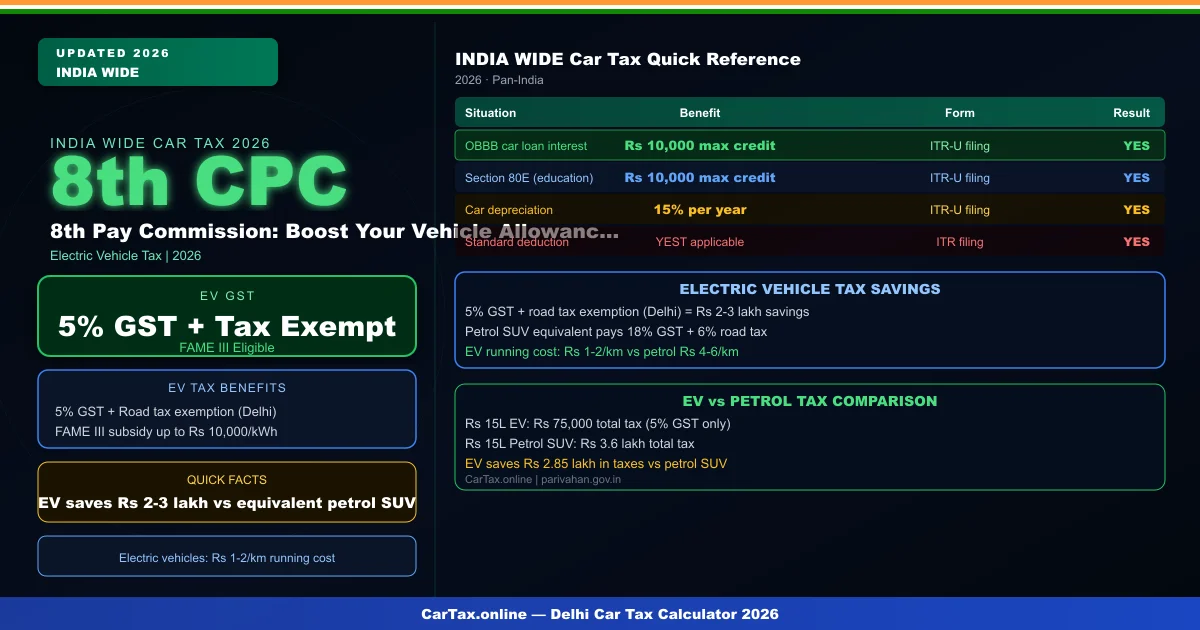
As of April 10, 2026 in India, the 8th Pay Commission has opened its public and employee feedback portal on MyGov (mygov.in) for suggestions on allowances — including the critical Vehicle Allowance and Transport Allowance. This directly affects 1.2 crore central government employees across all pay levels. With the 2.86x fitment factor already creating a salary revolution, this is your chance to formally recommend a higher vehicle allowance before the commission finalises its report. Here is everything you need to know.
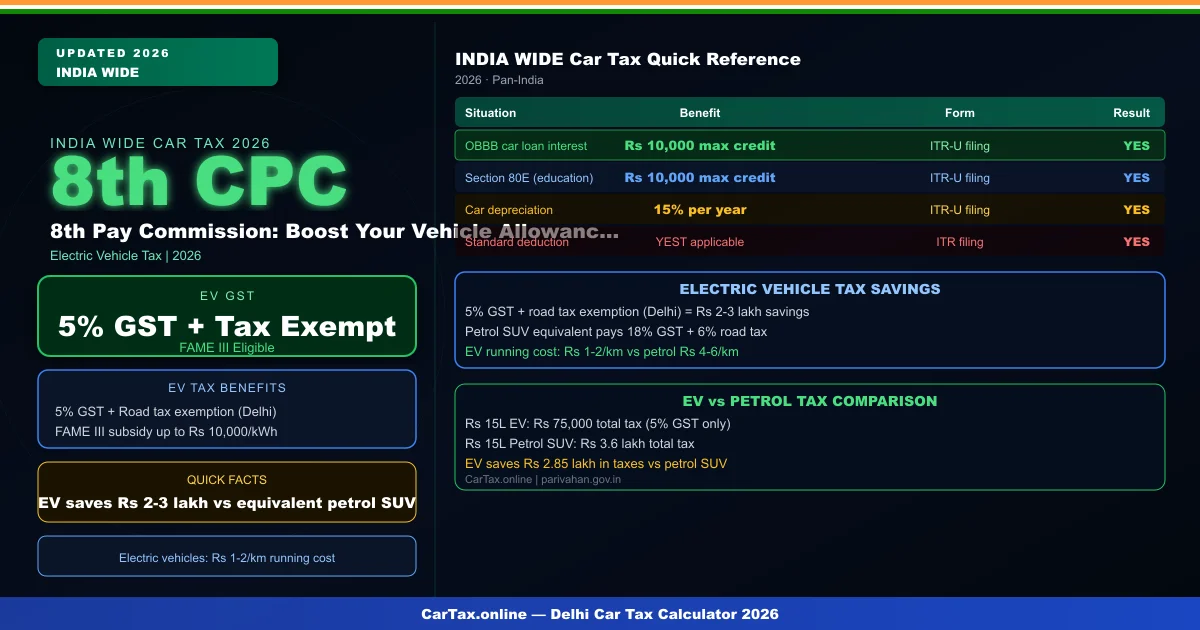
8th Pay Commission Vehicle Allowance — What Is Currently Paid?
Under the 7th Pay Commission structure currently in effect, Transport Allowance (TPTA) is paid to central government employees based on their pay level and posting city. The classification is:
- Level 1–2 (MTS/Group D): ₹1,350/month in A1/A cities, ₹900 in other cities
- Level 3–8 (Clerk to Inspector): ₹3,600/month in A1/A cities, ₹1,800 in other cities
- Level 9 and above (Gazetted Officers): ₹7,200/month in A1/A cities, ₹3,600 in other cities
Separately, a Vehicle Maintenance Allowance is provided to officers above Level 10 who use their personal vehicle for official duty — currently ₹3,200/month for four-wheelers. Both of these figures have not been revised since 2016 and are widely considered inadequate given inflation in fuel prices and vehicle costs.
How the 2.86x Fitment Factor Changes Car Loan Eligibility
The 8th Pay Commission is widely expected to recommend a fitment factor of 2.86x, which would raise basic pay dramatically across all levels. This has a direct impact on car loan eligibility, since banks typically lend up to 25 times the net monthly take-home salary:
- Level 7 employee today: Basic ₹44,900 → After 2.86x: ₹1,28,400/month basic → Car loan eligibility: up to ₹32 lakh
- Level 6 employee today: Basic ₹35,400 → After 2.86x: ₹1,01,240 → Car loan eligibility: up to ₹25.3 lakh
- Level 4 employee today: Basic ₹25,500 → After 2.86x: ₹72,930 → Car loan eligibility: up to ₹18.2 lakh
💰 8th Pay Commission — Car Loan Eligibility Calculator
| Pay Level | Current Basic | After 2.86x | Max Car Loan |
|---|---|---|---|
| Level 4 (LDC) | ₹25,500 | ₹72,930 | ~₹18L |
| Level 6 (UDC/Clerk) | ₹35,400 | ₹1,01,244 | ~₹25L |
| Level 7 (SO/Inspector) | ₹44,900 | ₹1,28,414 | ~₹32L |
| Level 10 (Dy. Secy) | ₹56,100 | ₹1,60,446 | ~₹40L |
How to Submit Your Vehicle Allowance Feedback on MyGov
The 8th Pay Commission has opened a structured feedback form on the official government engagement platform. Here is how to submit your suggestion for higher vehicle and transport allowance:
- Visit mygov.in — log in with your mobile number OTP or Aadhaar-linked account
- Search for the 8th CPC survey — type "8th Pay Commission" in the search bar. The survey titled "Allowances and Perks Feedback" will appear
- Select your Pay Level and posting city category (A1/A city or other)
- Fill the allowance suggestion fields — specifically request an upward revision of Transport Allowance based on current fuel inflation (petrol up 68% since 2016), vehicle running costs, and insurance premium increases
- Submit before April 30, 2026 — the deadline for public and employee feedback on the allowance structure
Tip: Be specific in your suggestion. Mention that fuel costs have risen from ₹72/litre (Delhi, 2016) to ₹96/litre (2026), a 33% increase, while Transport Allowance has been static since 2016. A 2.86x revision in TPTA — matching the salary fitment factor — would be ₹10,300/month for Level 9+ officers, up from ₹7,200.
January 2026 Arrears as Car Down Payment
Many government employees are planning to use their January 2026 salary arrears (the retroactive pay from the date of implementation) as a lump-sum car down payment. Based on the expected 2.86x fitment:
- A Level 7 employee will receive approximately ₹1.8–2.2 lakh in arrears from January 2026 to the notification date
- This can serve as the 10–15% down payment on a car priced between ₹12–18 lakh
- SBI offers a concessional rate of 8.65% for central government employees, compared to 9.15% for the general public
For state government employees, check your state's specific scheme — many states like Kerala, Maharashtra, and Tamil Nadu have separate vehicle advance schemes that allow interest-free loans up to ₹2–3 lakh from the employer itself.
Check the official MyGov portal at mygov.in and the 8th CPC official communications at the Department of Expenditure, Ministry of Finance. Use our India Car Tax Calculator to estimate the exact road tax and on-road price when you are ready to purchase.
Frequently Asked Questions
When will the 8th Pay Commission allowances be implemented?
The 8th Pay Commission is expected to submit its report by December 2025, with implementation likely from January 2026. However, allowance revisions often take a few months after the main salary revision — the transport and vehicle allowances may be revised by April–June 2026 following a separate notification.
Is vehicle allowance taxable for central government employees?
The Transport Allowance (TPTA) up to ₹3,200 per month is exempt from income tax for employees who do not receive a company car. The excess above this threshold is taxable. Vehicle Maintenance Allowance for personal vehicle use is also partially exempt — consult your Pay and Accounts Office for exact figures applicable to your pay level.
Can I get a higher car loan if the 8th Pay Commission is not yet implemented?
Some banks (SBI, PNB) now accept the anticipated revised salary for loan eligibility calculations if the 8th CPC notification has been issued, even before actual disbursement. Check with your bank — you may be able to borrow at the new higher eligibility limit while paying EMI from your current salary until the revision is credited.
Frequently Asked Questions
Q: What is the current road tax rate for cars in India 2026?
Road tax rates in India vary by state and vehicle category. For new cars, GST is charged at 5% for EVs, 18% for hybrids under 1,200cc, and up to 28% for petrol/diesel SUVs. State road tax is charged separately and varies from Rs3,000-15,000 annually depending on the state's slab system. Check your specific state's RTO website for current rates.
Q: How do I calculate my car road tax online in India?
You can calculate your car road tax using online calculators available on state RTO portals and CarTax.online. The calculation considers your vehicle's ex-showroom price, fuel type, engine capacity, and state of registration. Road tax is payable annually or for the vehicle's lifetime depending on your state's rules.
Q: Is GST included in the road tax for new cars in India?
No — GST and road tax are separate charges. GST is a central tax charged by the vehicle manufacturer at the time of purchase. State road tax is a separate annual or one-time charge levied by your state's transport department. Both apply at the time of first registration, and annual road tax continues for subsequent years.
Q: Do electric vehicles get tax benefits in India 2026?
Yes — electric vehicles in India qualify for a reduced GST rate of 5% (down from 28% for petrol cars). Under FAME-III subsidies, EVs may also qualify for additional state-level incentives, reduced road tax, and free registration in many states. The exact benefits vary by state.
Q: What happens if I don't pay my car road tax on time?
If you don't pay road tax, your vehicle's registration can be flagged in the Vahan database, preventing renewal of fitness certificates and creating legal liability during police checks. Penalties range from Rs200-500 per day of default in most states. Road tax is a legal requirement under the Motor Vehicles Act.