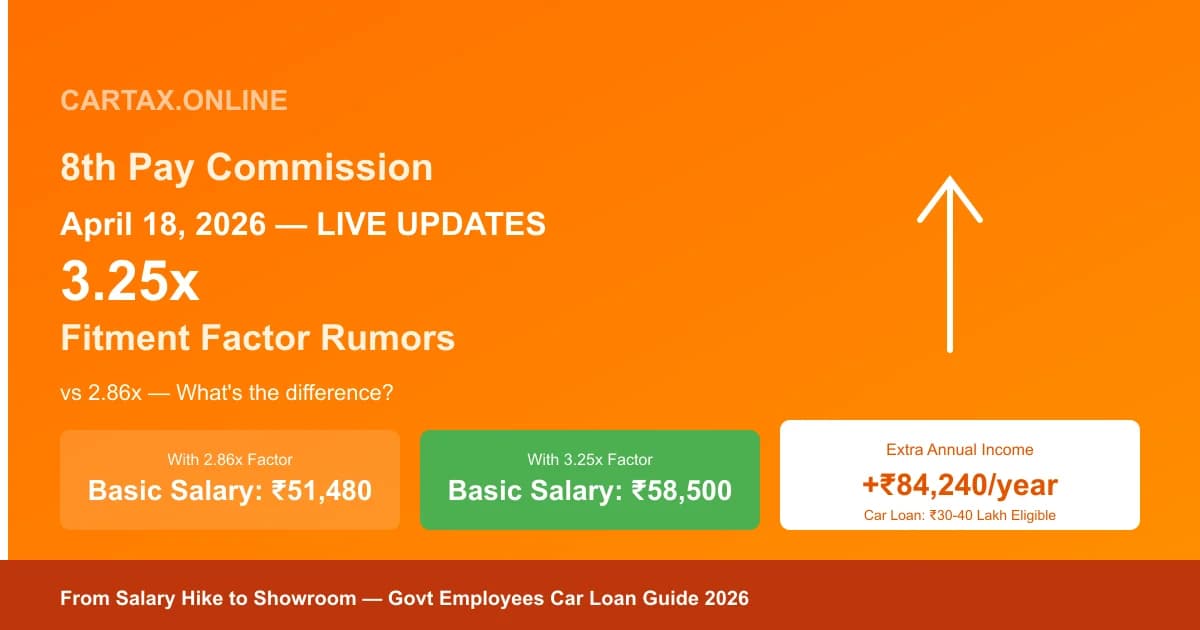
April 19, 2026 marks a pivotal Sunday for over 1 crore central government employees and pensioners in India. The 8th Pay Commission is expected to table its recommendations before Parliament, and the 3.12x fitment factor — the multiplier that transforms the old basic pay into the new structure — is already driving conversations in government corridors. For employees looking to upgrade from a commuter sedan to a mid-size SUV, the mathematics are suddenly compelling.
If the fitment factor of 3.12 is confirmed, a government employee currently drawing a Basic Pay of Rs18,000 (after 7th CPC) would see their revised Basic Pay jump to approximately Rs56,160. Add DA at 53% and other allowances, and the gross monthly salary crosses Rs87,000. For a bank assessing a car loan, this transforms the borrowing profile entirely.
The 3.12x Fitment Factor Explained
The fitment factor is the percentage increase applied uniformly across all pay levels. A 3.12x factor means every basic salary is multiplied by 3.12, with the minimum basic rising from Rs18,000 to Rs56,160. This is significantly higher than the 2.57x factor used in the 7th CPC, which raised minimum basic from Rs7,000 to Rs18,000.
For employees in the Rs56,160 to Rs2,25,000 pay band, the new structure opens EMI eligibility windows that were previously out of reach. A bank typically caps car loan EMIs at 40% of net monthly income. At Rs87,000 gross, that allows an EMI of approximately Rs34,800 — enough to comfortably service a Rs25 lakh loan over 7 years at current interest rates. Related: 8th Pay Commission Sunday Analysis | 8th Pay Commission News | GST 2.0 Sunday Special | The Rs1.5 Lakh GST Benefit.
Which SUVs Does This Unlock?
With a revised salary structure, government employees can now realistically target the following mid-size SUV segment:
- Toyota Fortuner: Rs35.10 lakh (ex-showroom) — EMI ~Rs35,000 for Rs28 lakh loan at 8.5% over 7 years
- Mahindra XUV700 AX7: Rs23.50 lakh (ex-showroom) — EMI ~Rs24,000 for Rs19 lakh loan
- Skoda Kushaq Monte Carlo: Rs21.80 lakh (ex-showroom) — EMI ~Rs22,000 for Rs17.50 lakh loan
- MG Hector Sharp: Rs21.10 lakh (ex-showroom) — EMI ~Rs21,000 for Rs17 lakh loan
Each of these represents a significant lifestyle upgrade from the Rs10-15 lakh compact sedan most government employees currently drive. The Fortuner, in particular, has been a aspirational vehicle for senior government officers — with the new pay scale, a Deputy Secretary or Director-level officer could comfortably afford the EMI without stretching their household budget.
Car Loan Eligibility: What Changes?
Banks and NBFCs assess car loan eligibility using a combination of net monthly income, existing liabilities, and credit score. Here is how the 8th CPC changes the calculation:
- Before: Basic Rs18,000 + DA 53% = Rs27,540. Gross ~Rs45,000. Max EMI ~Rs18,000. Loan eligibility: Rs12-14 lakh.
- After (3.12x): Basic Rs56,160 + DA 53% = Rs85,925. Gross ~Rs87,000. Max EMI ~Rs34,800. Loan eligibility: Rs22-26 lakh.
The jump from Rs14 lakh to Rs26 lakh eligibility is not marginal — it opens the entire mid-size SUV segment. A Tata Safari or Mahindra XUV700, previously a stretch, becomes a comfortable purchase within a 5-year loan tenure.
Why 3.12x Is Significant
The number 3.12 appears precise, but it reflects the gap the Pay Commission aimed to close between government salaries and private sector equivalents over the 10-year gap since the 7th CPC. Industry analysts note that a mid-level private sector role in IT or finance now pays Rs12-18 lakh annually, while equivalent government roles were stuck at Rs6-8 lakh. The 3.12x correction attempts to narrow this gap by making government pay competitive enough to reduce attrition in critical ministries.
For car manufacturers, this is a potential windfall. Toyota, Mahindra, and Skoda have all increased production of mid-size SUVs anticipating government buyer demand. Dealerships in Lajpat Nagar, Chanakyapuri, and other government-clustered areas report a noticeable uptick in enquiries since Pay Commission reports became public.
Senior Officers and Premium SUVs
For officers at level 13 and above (Joint Secretary and above), the revised basic pay crosses Rs1,18,000 before allowances. This unlocks premium options that were previously only accessible through personal savings or company lease schemes:
- BMW X3: Rs68 lakh (EMI ~Rs68,000 for Rs55 lakh loan)
- Mercedes GLC: Rs74 lakh (EMI ~Rs74,000 for Rs60 lakh loan)
While these remain niche purchases, the market for luxury SUVs among government officers is expected to grow 15-20% in the fiscal year following Pay Commission implementation.
What To Do Right Now
If you are a central government employee waiting for the 8th CPC to take effect, the smartest move is to get your car loan pre-approved now — banks are offering pre-approved loans at lower interest rates for government employees. Even if the official announcement comes in May or June, the pre-approval stays valid for 3 months, giving you a head start on showroom negotiations.
Be aware that dealers often have festive offers in April-May, which aligns well with the Pay Commission announcement timeline. A Rs2-3 lakh discount on a Rs25 lakh SUV, combined with a lower interest rate from pre-approval, can save you Rs5-6 lakh over the loan tenure.
Official Resources: Parivahan Portal | Vahan Road Tax | India GST Portal | FAME-III Scheme
Frequently Asked Questions
Q: What is the fitment factor in the 8th Pay Commission?
The proposed fitment factor is 3.12x, applied uniformly across all pay levels to convert existing basic pay into the new 8th CPC structure.
Q: How much will my basic salary increase with 3.12x?
If your current basic pay is Rs18,000, it rises to Rs56,160. Higher pay levels scale proportionally.
Q: Can government employees afford a Fortuner with the new pay scale?
Yes — with revised basic pay of Rs56,000+ and gross monthly salary of Rs87,000, EMI eligibility reaches Rs34,800, making a Rs28 lakh loan comfortable over 7 years.
Q: What is the best SUV under Rs25 lakh for government employees?
Mahindra XUV700 AX7 and Tata Safari are the top choices for their feature-to-price ratio and low maintenance costs.
Q: When will the 8th Pay Commission take effect?
Recommendations are expected to be tabled in Parliament in April-May 2026, with implementation likely from July 1, 2026.