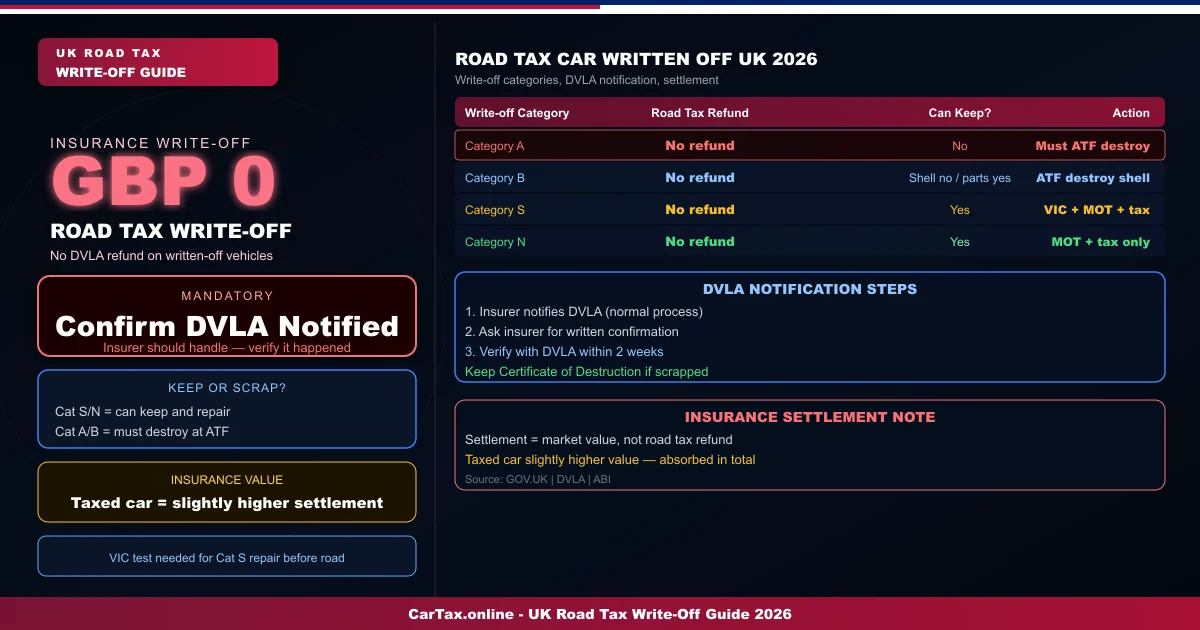
On 22 April 2026, car accidents across the UK are resulting in insurance write-offs. When an insurer declares a vehicle a total loss, the owner faces a cascade of questions: what happens to the months of road tax I have already paid? Who notifies DVLA? Can I keep the car? This guide answers every question about road tax and written-off vehicles.
Write-Off Categories: What They Mean and Why They Matter
UK insurers use a classification system for write-offs, now standardised under four categories:
Category A — the most severe classification. The vehicle must be completely destroyed. No part of the vehicle may be used, and it must be scrapped at an Authorised Treatment Facility (ATF). The shell, components, and fluids are all destroyed. These vehicles can never return to the road.
Category B — the vehicle's shell must be destroyed, but salvageable parts may be stripped before crushing. Stripped parts can be used in other vehicles. The shell must never be returned to the road.
Category S (formerly Category C) — the vehicle has sustained structural damage but is repairable. It can be fixed and returned to the road, but must pass a Vehicle Identity Check (VIC) after repair before being allowed back on the road.
Category N (formerly Category D) — the vehicle has non-structural damage (electrical, mechanical, or cosmetic) and is repairable. It can be repaired without the VIC test requirement, though it still needs a fresh MOT before returning to the road.
The category determines what you can do with the vehicle, how you interact with DVLA, and whether any road tax value is recoverable.
Road Tax and Write-Offs: The Core Rule
DVLA does not refund road tax on written-off vehicles. This is the same rule that applies to scrapped cars and sold cars — road tax is treated as having been consumed for the period paid, and no pro-rata refund is available for unused months.
When your insurer pays out for a write-off, the settlement is based on the market value of the vehicle immediately before the incident. Insurers typically use published market data — similar vehicles sold at auction, dealer valuations, and trade guides — to establish this figure. A vehicle with several months of valid road tax remaining has marginally higher value than an identical vehicle with no road tax, all else being equal. In practice, this means the road tax value is embedded in the settlement figure rather than appearing as a separate credit line.
For example, a vehicle valued at £8,000 with 8 months of road tax remaining at £190 annual rate (£127 credit) might be valued at £8,127 if the road tax value is explicitly factored in. But in most cases, insurers' valuation algorithms do not itemise road tax separately — the settlement encompasses the vehicle's complete value including any remaining tax period.
Who Notifies DVLA After a Write-Off?
The notification of a write-off to DVLA is normally handled by the insurer, who will complete and submit the relevant form as part of their processing of the claim. However, the responsibility ultimately sits with the registered keeper — if the insurer fails to notify DVLA for any reason, the keeper remains on the registration record.
You should confirm with your insurer that DVLA notification has been completed before the claim is settled. Ask for written confirmation of this. Keep a copy of the insurer's notification reference number. Follow up with DVLA directly if you have not received confirmation within a few weeks of the claim settlement.
If you are not claiming on insurance — for example, if you are writing off the vehicle privately due to mechanical failure or age — you must notify DVLA yourself using form SVL30 (available at gov.uk). This removes your name from the registration record and prevents you from being held responsible for the vehicle going forward.
Keeping a Written-Off Vehicle
If you have a Category S or Category N write-off and want to keep and repair the vehicle rather than let the insurer take it, you can do so. The process involves:
- Informing the insurer that you wish to retain the vehicle — they will deduct the salvage value from your settlement offer
- Completing all necessary repairs to road-worthy condition
- Booking a Vehicle Identity Check (VIC) test for Category S vehicles (this checks that the vehicle matches its registration and has not been stolen or cloned)
- Obtaining a fresh MOT certificate
- Taxing the vehicle at DVLA with the VIC certificate (if applicable)
Category A and B vehicles cannot be retained — they must be destroyed and cannot legally be returned to the road under any circumstances.
The cost of the VIC test, repairs, and the reduced settlement from the insurer typically makes keeping a Category S write-off economically unviable except for specialist vehicles where the owner has mechanical skills or sentimental attachment. Most write-off retention cases involve classic cars, project vehicles, or vehicles with specific modifications.
Road Tax Status When Buying a Written-Off Car
Some written-off vehicles are repaired and sold on. If you are buying a repaired Category S or N vehicle, the road tax status will depend on when the vehicle was last taxed. If the previous keeper's road tax had expired during ownership, there may be no road tax credit available.
Always check the vehicle's road tax status at gov.uk/check-vehicle-tax before purchasing a repaired write-off. The vehicle's write-off history will also appear on its MOT and history records — the free DVLA check confirms current tax and MOT status, and third-party services can provide full write-off history.
Summary
DVLA does not refund road tax on written-off vehicles. The road tax value is absorbed into the insurer's settlement, where a taxed vehicle receives a marginally higher valuation. You must ensure DVLA is notified of the write-off — insurers typically handle this, but you should confirm. Category A and B vehicles must be destroyed; Category S and N vehicles can be retained and repaired with appropriate testing. When buying a repaired write-off, always check its road tax and write-off history before committing to the purchase.