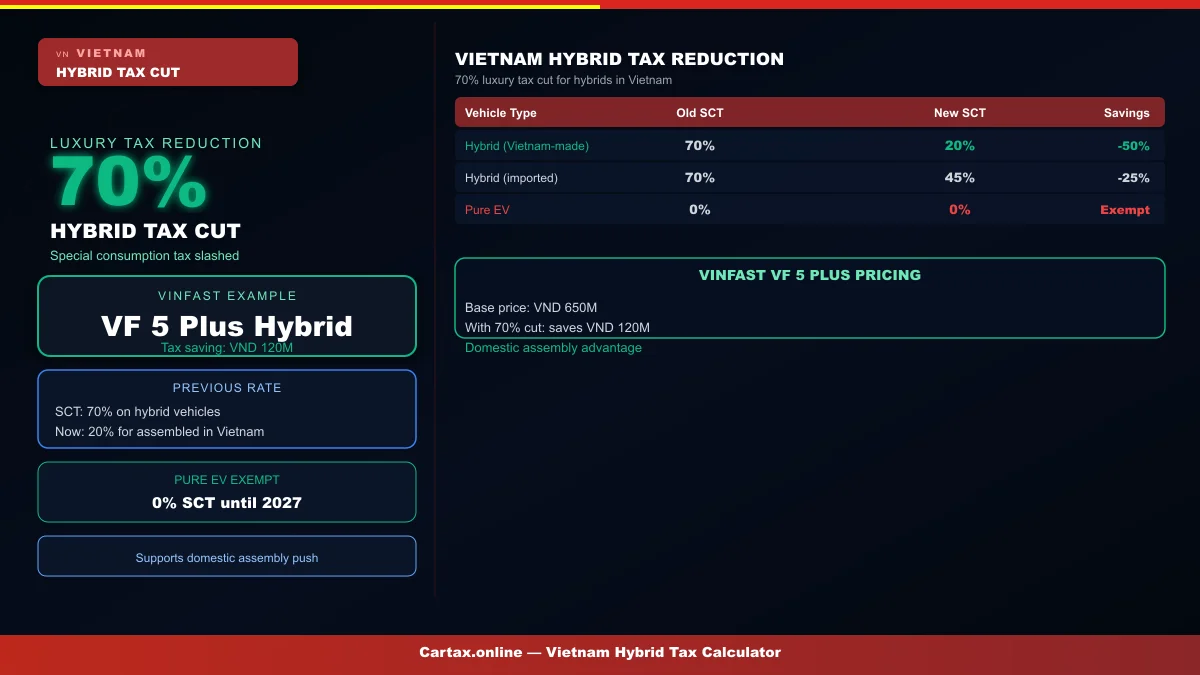
Vietnam has made a dramatic policy shift in 2026, introducing a 70% reduction in luxury consumption tax for hybrid electric vehicles. This strategic move has transformed the Vietnamese automotive market, making self-charging hybrids suddenly cheaper than equivalent petrol vehicles.
Vietnam's Hybrid Tax Policy Explained
The 70% Luxury Tax Reduction
Vietnam's luxury consumption tax (LCT) on vehicles has been restructured for 2026:
- Petrol vehicles: Standard LCT rates (45-150% based on engine size)
- Hybrid vehicles (HEV): 70% reduction in LCT
- Plug-in hybrids (PHEV): 50% reduction in LCT
- Electric vehicles (BEV): 100% LCT exemption
Why Vietnam Supports Hybrids
Vietnam's hybrid-first strategy reflects practical considerations:
- Charging infrastructure remains limited outside major cities
- Grid capacity for mass EV charging is uncertain
- Hybrids reduce fuel consumption without requiring charging
- Domestic Toyota production supports the policy
- Gradual path toward full electrification
Price Comparison: HEV vs Petrol
Toyota Models
Toyota Corolla Altis: Petrol VND 820M vs Hybrid VND 795M — Save VND 25M
Toyota Camry: Petrol VND 1.45B vs Hybrid VND 1.3B — Save VND 150M
Toyota Corolla Cross: Petrol VND 950M vs Hybrid VND 875M — Save VND 75M
Lexus ES300h: Petrol VND 3.2B vs Hybrid VND 2.5B — Save VND 700M
Why HEVs Beat PHEVs
Tax Rate Comparison
Vietnam distinguishes between HEV and PHEV in its tax structure:
- HEV (self-charging): 70% LCT reduction — full benefit
- PHEV (plug-in): 50% LCT reduction — partial benefit
- Reason: HEVs don't require charging infrastructure
Total Cost of Ownership
Comparing 5-year ownership costs for Camry-class vehicles:
- Petrol Camry: VND 1.45B + VND 250M fuel = VND 1.7B total
- HEV Camry: VND 1.3B + VND 150M fuel = VND 1.45B total
- Savings: VND 250M over 5 years
The Bottom Line
Vietnam's 70% hybrid tax cut has made 2026 the year of the HEV. For Vietnamese buyers, self-charging hybrids now offer the best value proposition: lower purchase price than petrol equivalents combined with superior fuel efficiency. The policy successfully redirects consumer interest toward more efficient vehicles without requiring charging infrastructure investments.