Understanding the timeline for vehicle ownership transfer in India helps you plan the process effectively and set realistic expectations. The total duration varies based on whether the transfer is straightforward, involves complications like loans or family transfers, and the specific RTO handling the case. This comprehensive guide covers every stage of the vehicle transfer timeline so you know what to expect and how to plan for 2026.
Overall Vehicle Transfer Timeline Overview
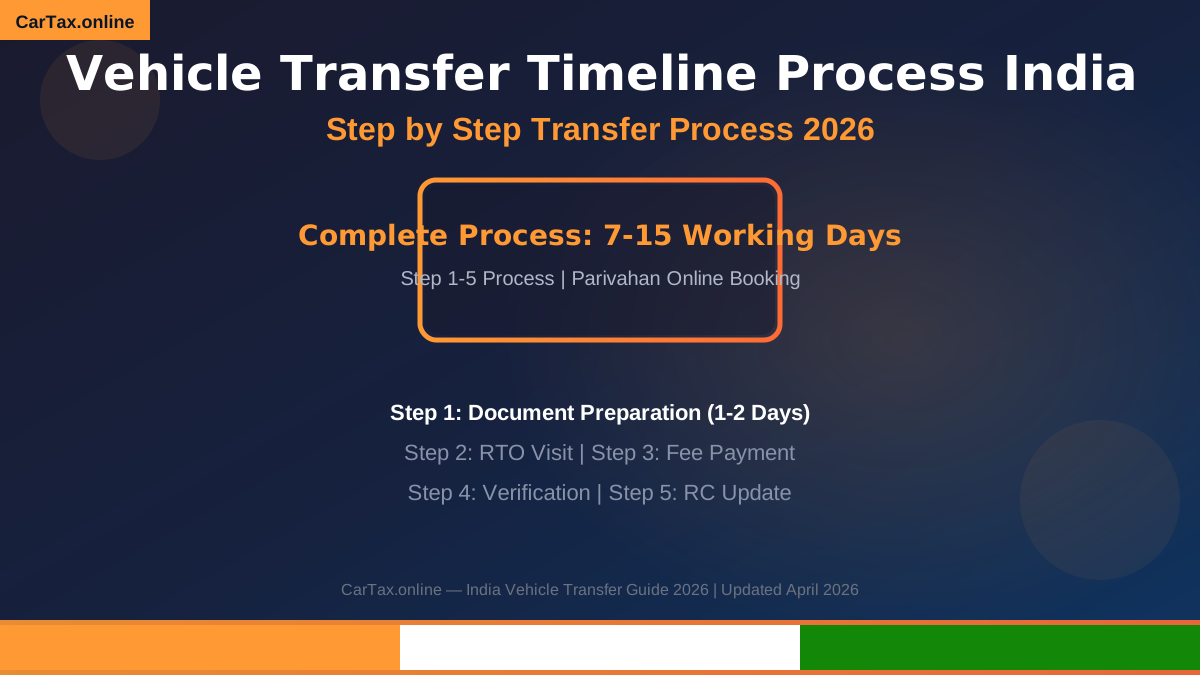
Vehicle ownership transfer in India typically takes 2 to 6 weeks from the date of sale to receiving the updated RC. The timeline breaks down into distinct phases: preparation (1-7 days), RTO visit (1 day), processing (5-15 working days), and RC dispatch (3-7 days). Straightforward transfers within the same city and state usually complete in 2-3 weeks. Transfers with complications — loan clearance, multiple heirs, interstate transfers — extend to 4-6 weeks or longer.
Planning for these timelines helps both sellers and buyers coordinate the handover and ensures legal protection for the seller throughout the process. Understanding each phase also helps identify potential delays before they occur.
Phase 1: Pre-Transfer Preparation (1-7 Days)
Before visiting the RTO, several preparation steps must be completed.
Sale Agreement Preparation (1-2 Days)
The sale agreement on stamp paper can be prepared in 1-2 days. This involves drafting the agreement, purchasing stamp paper of the correct value, and getting it signed by both parties and witnesses. For family transfers, additional documentation for relationship proof may add another 1-2 days.
Form 29 and Form 30 Completion (1 Day)
Forms 29 and 30 can be completed in a few hours once all information is gathered. The forms require accurate vehicle details, party information, and signatures — careful completion prevents rejection and delays later. If any details need verification against the RC, this adds time.
RTO Appointment Booking (2-5 Days)
Booking an RTO appointment through parivahan.gov.in typically requires booking 2-5 days in advance for busy RTOs in major cities. At peak times or for popular RTOs, slots may be available only 7-10 days out. Booking the appointment early helps maintain the overall timeline.
Document Collection (3-7 Days if Not Ready)
If all documents are readily available (RC, insurance, PUC), this phase is minimal. If documents need to be obtained or renewed (expired insurance, expired PUC), this can add significant time. Ideally, all documents should be current and ready before initiating the sale.
Phase 2: RTO Visit and Document Submission (1 Day)
The actual RTO visit for document submission is typically a half-day to full-day activity depending on queue times.
At the RTO Office
At the RTO, the transfer process involves: document submission at the transfer counter, verification by the RTO officer, possible vehicle inspection call, fee payment at the counter, and receiving acknowledgment receipt. The actual processing time at the counter is typically 30 minutes to 2 hours depending on queue length and document complexity.
Vehicle Inspection
If the RTO officer calls for vehicle inspection, this adds 15-30 minutes to the visit. Inspection checks registration plates, chassis number visibility, engine number, and basic roadworthiness. Most transfers do not require inspection, but older vehicles or those with documentation concerns may be called for inspection.
After Submission
Once documents are submitted and fees paid, the RTO issues an acknowledgment receipt. This receipt confirms the application has been received and provides an application number for tracking. The application then moves to processing.
Phase 3: RTO Processing Time (5-15 Working Days)
The bulk of the transfer timeline is the RTO's internal processing.
Document Verification
The RTO officer reviews all submitted documents for accuracy and completeness. This includes verifying vehicle details match the VAHAN database, confirming identity proofs are valid, checking stamp duty has been paid correctly, and validating insurance and PUC status. Document verification typically takes 2-5 working days.
Database Update
Once document verification is complete, the ownership change is entered into the VAHAN database. This updates the registered owner from the seller's name to the buyer's name. The database update is typically done within 1-3 working days of verification completion.
RC Generation and Dispatch
After the database update, the new Registration Certificate is generated and dispatched by post. RC generation takes 1-2 working days, and postal dispatch adds another 3-7 days depending on the delivery location. Digital RC tracking may be available for some RTOs.
Processing Time by RTO Type
- Major city RTOs (Mumbai, Delhi, Bangalore): 10-15 working days
- Medium city RTOs: 7-10 working days
- District RTOs: 5-7 working days
- Online-enabled RTOs: May process faster
Phase 4: Post-Transfer Follow-Up (Parallel to Processing)
While the RTO processes the transfer, both parties should take certain actions.
Seller's Responsibilities
The seller should retain all documents related to the sale, follow up with the RTO after 7-10 days to check processing status, verify on Parivahan after 10-15 days that the transfer has been recorded, and confirm the RC shows the new owner's name before considering liability ended.
Buyer's Responsibilities
The buyer should track the transfer status using the application number, check Parivahan after the expected processing period, ensure updated RC is received at the address provided, and once RC is received, update insurance and any other linked documents.
Timeline for Different Transfer Types
Standard Transfer (Stranger to Stranger)
- Preparation: 3-5 days
- RTO visit: 1 day
- Processing: 5-15 working days
- Total: 2-4 weeks
Family Transfer
- Additional documentation: 1-2 days for relationship proof
- RTO visit: 1 day
- Processing: 5-15 working days
- Total: 2-4 weeks (similar to standard)
Transfer with Loan Pending
- Loan foreclosure: 1-7 days
- Bank NOC issuance: 1-3 days
- Form 35 and hypothecation removal: 5-10 working days
- Ownership transfer: 2-4 weeks
- Total: 4-6 weeks
Death/Succession Transfer
- Death certificate: 1-7 days
- Legal heir certificate: 2-4 weeks
- RTO visit: 1 day
- Processing: 2-4 weeks
- Total: 4-8 weeks
Interstate Transfer
- NOC from original state: 1-2 weeks
- Re-registration in new state: 2-4 weeks
- Road tax adjustment: May take longer
- Total: 4-8 weeks
Factors That Affect Transfer Timeline
Positive Factors (Speed Up Transfer)
- All documents complete and accurate
- Online appointment booking
- Early morning RTO visits
- Less busy RTO locations
- No pending challans or issues
- Vehicle in good condition (no inspection issues)
Negative Factors (Delay Transfer)
- Incomplete or mismatched documents
- Active hypothecation requiring clearance
- Pending traffic challans
- Vehicle inspection required
- Busy RTO with high workload
- Peak periods (month-end, year-end)
- Multiple owners or complex succession
- Form errors requiring fresh submission
How to Speed Up Vehicle Transfer
Preparation Tips
Prepare all documents before initiating the transfer. Verify each document is current and valid. Double-check all form entries against the RC. Clear any pending traffic challans in advance. Book RTO appointment as early as possible.
At the RTO
Visit the RTO early in the day (before 10 AM) to avoid long queues. Arrive at your appointment time — not significantly early or late. Carry all original documents plus one set of photocopies. Be prepared to present the vehicle for inspection if called.
Post-Submission
Follow up with the RTO after 5-7 days using your application number. Check Parivahan after the expected processing period to verify status. If there are issues, address them immediately rather than waiting.
Checking Transfer Status
Using Application Number
On Parivahan, use the 'Know Your Application Status' section. Enter your application or acknowledgment number provided at the RTO. The system shows the current processing stage.
Using Vehicle Registration Number
If you do not have the application number, check the vehicle details on Parivahan using the registration number. If the transfer has been completed, the buyer's name appears as the registered owner. If the seller's name still appears, the transfer is still pending.
What to Do If Transfer Is Delayed
Check Status First
Before taking action, check the status on Parivahan or call the RTO with your application number. The delay may be normal processing time rather than an issue.
Follow Up with RTO
If processing time has exceeded 15 working days, follow up with the RTO. Visit the RTO in person or call the RTO helpline. Provide your application number and ask about the status and any additional requirements.
Escalate if Necessary
If delays persist beyond 3 weeks, escalate to the RTO regional transport officer (RTO) or use the online grievance portal. Document all interactions and keep acknowledgment receipts.
Conclusion
Vehicle ownership transfer in India takes 2 to 6 weeks total, broken into preparation (3-7 days), RTO visit (1 day), and processing (5-15 working days). Standard transfers complete in 2-3 weeks while transfers with complications (loans, death succession) extend to 4-6 weeks or longer. Speed up the process by preparing all documents in advance, booking RTO appointments online, visiting early in the day, clearing pending challans before transfer, and following up after 7 days. Check Parivahan using your vehicle registration number to verify the transfer has been recorded. For transfers with active loans, plan for an additional 3-4 weeks for loan clearance and hypothecation removal before the standard transfer timeline begins.