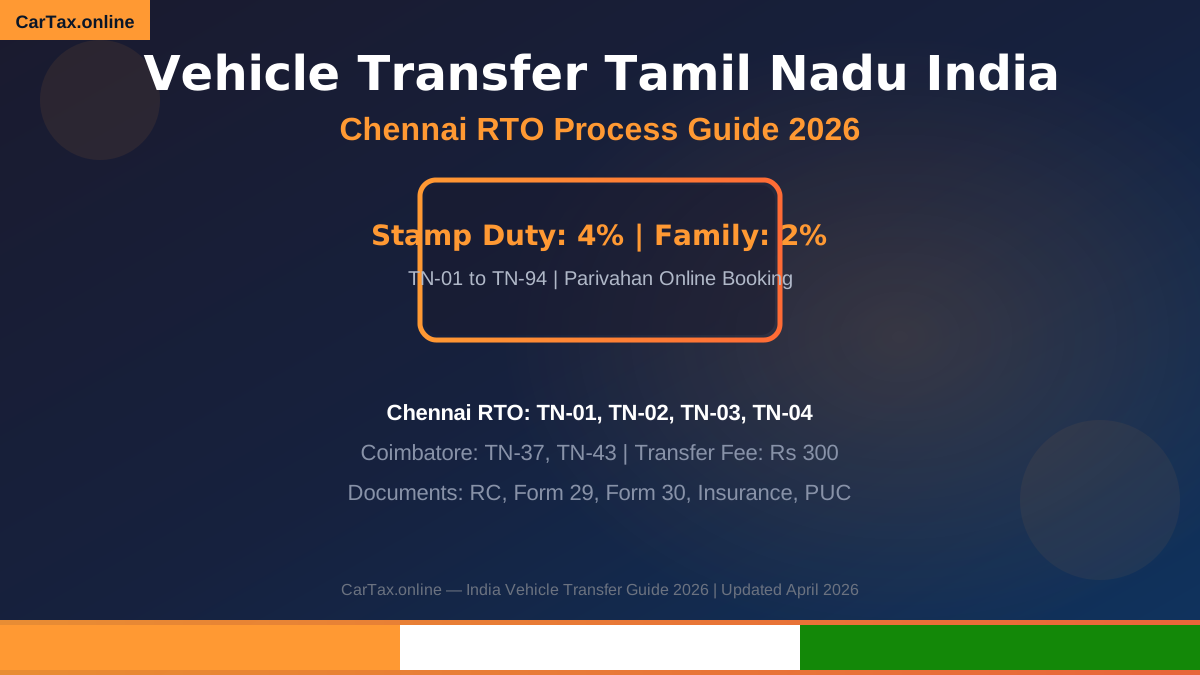
Vehicle transfer in Tamil Nadu follows the standard Indian RTO framework with state-specific requirements around stamp duty and RTO procedures. Chennai, as Tamil Nadu's capital and India's fourth-largest city, has multiple RTO offices serving different zones of the metropolitan area. Understanding Tamil Nadu's specific processes, fee structure, and documentation requirements helps ensure a smooth vehicle ownership transfer. The state has implemented online services to streamline the transfer process, making it more accessible for vehicle owners across Tamil Nadu for 2026.
Overview of Vehicle Transfer in Tamil Nadu
Tamil Nadu has one of India's most extensive RTO networks, with offices across Chennai and all major districts. The Tamil Nadu Transport Department manages vehicle registrations using the TN prefix system with numerical codes for different regions. Tamil Nadu's stamp duty rates for vehicle transfer are among the higher rates in India, making documentation accuracy particularly important to avoid reassessments and additional costs.
The vehicle transfer process in Tamil Nadu involves coordinating between the seller and buyer, arranging stamp paper documentation, completing government-mandated forms, and visiting the appropriate RTO office. Online services have been implemented to reduce wait times and improve accessibility, but understanding the complete process remains essential for successful transfer.
Tamil Nadu RTO Codes and Jurisdiction
Tamil Nadu has RTOs distributed across Chennai and all major districts of the state.
Chennai RTO Offices
Chennai has multiple RTO offices serving different geographic zones:
- TN-01: Guindy and South Chennai
- TN-02: Tondiarpet and North Chennai
- TN-03: Sholinganallur and South-East Chennai (IT corridor)
- TN-04: Kamaraj Nagar and West Chennai
- TN-05: Kundrathur and South-West Chennai
- TN-06: Madhavaram and North-East Chennai
- TN-07: Thiruvottiyur and Harbour area
- TN-09: Anna Nagar and Central-North Chennai
- TN-10: Vadapalani and Central Chennai
- TN-11: Koyambedu and East Chennai
Each Chennai RTO handles transfers for vehicles with its specific registration prefix. You must visit the RTO corresponding to your vehicle's TN code for ownership transfer.
District RTOs Beyond Chennai
Tamil Nadu has district RTOs in all major cities:
- Coimbatore: TN-37, TN-38, TN-66
- Madurai: TN-58, TN-59
- Trichy: TN-45, TN-48
- Salem: TN-27, TN-30, TN-47
- Tirunelveli: TN-72, TN-73
- Vellore: TN-19, TN-77
- Erode: TN-36, TN-56
Stamp Duty for Vehicle Transfer in Tamil Nadu
Tamil Nadu has higher stamp duty rates compared to many other Indian states, making accurate valuation important.
Standard Stamp Duty Rates
The stamp duty rates for vehicle transfer in Tamil Nadu are:
- Four-wheelers (cars, SUVs, vans): 4% of declared value
- Two-wheelers (motorcycles, scooters): 2% of declared value
- Three-wheelers: 2% of declared value
- Commercial vehicles: Variable rates based on category
Stamp duty is calculated on the higher of the declared consideration and the government's fair market value for the vehicle type. This prevents undervaluation for tax purposes.
Family Transfer Stamp Duty Reduction
Tamil Nadu provides a 50% reduction for transfers to immediate family members:
- Cars to family: 2% (reduced from 4%)
- Two-wheelers to family: 1% (reduced from 2%)
Immediate family includes spouse, children (son/daughter), parents, and siblings (brother/sister). Documentation establishing the relationship is required to claim the reduction — acceptable documents include Aadhaar cards showing same family name or address, school records, ration cards, or self-declaration.
Stamp Paper Requirements
The sale agreement or gift deed must be executed on stamp paper of the applicable value. Purchase stamp paper from licensed vendors in Tamil Nadu. The document must include vehicle details, sale price, parties' complete names and addresses, date, and declarations. Sign in the presence of two witnesses who also sign the document.
Online Services for Tamil Nadu Vehicle Transfer
Tamil Nadu Transport Department offers online services through multiple platforms.
Parivahan Portal
Visit parivahan.gov.in and select Tamil Nadu as the state. Navigate to 'Online Services' and choose 'Vehicle Related Services'. Select 'Transfer of Ownership' and enter vehicle registration number. Choose your preferred TN RTO office. Select an available date and time slot. Pay the booking fee online and download the acknowledgment.
Tamil Nadu Transport Department Portal
The Tamil Nadu Transport Department also has its own portal providing similar services. Access it through tn.gov.in or the transport department's website. The portal offers appointment booking, status tracking, and downloadable forms.
Slot Availability at Chennai RTOs
Slots at popular Chennai RTOs like TN-01 (Guindy), TN-02 (Tondiarpet), and TN-03 (Sholinganallur) fill quickly. Book at least 5-7 days in advance for Chennai RTOs. Consider nearby RTOs if your preferred slot is unavailable. Check daily for cancellations if you need an earlier appointment.
Documents Required for Tamil Nadu Vehicle Transfer
Organize all required documents before your RTO visit for Tamil Nadu transfer.
- Original Registration Certificate (RC)
- Form 29 — Notice of Transfer (seller's signature)
- Form 30 — Application for Transfer (both parties' signatures)
- Valid insurance certificate
- Valid PUC certificate
- Buyer's Aadhaar card
- Buyer's address proof
- Buyer's PAN card (mandatory for vehicles above INR 4 lakh)
- Sale agreement on stamp paper with applicable duty paid
- Two passport-size photographs of buyer
- RTO appointment acknowledgment (if booked online)
- Form 35 and bank NOC (if vehicle has active loan)
- Family relationship documents (for family transfer reduction)
Step-by-Step Transfer Process in Tamil Nadu
Step 1: Prepare Sale Agreement
Draft the sale agreement on stamp paper with applicable stamp duty (4% for cars, 2% for two-wheelers — or reduced rates for family). Include all vehicle details, sale price, parties' names and addresses, date, and declarations. Sign in the presence of two witnesses who also sign the document.
Step 2: Complete Form 29 and Form 30
Form 29 is completed and signed by the seller. Form 30 is completed and signed by both seller and buyer. Ensure all entries exactly match the RC — any discrepancy causes delays or rejection.
Step 3: Book RTO Appointment
Book your appointment through Parivahan for your vehicle's specific TN RTO. Select the correct RTO based on the vehicle's registration prefix. Choose an available slot and pay the booking fee.
Step 4: Visit RTO with Documents
Arrive at the RTO with all original documents and photocopies. Submit documents at the transfer counter. The officer reviews the application, may call for vehicle inspection, and processes the transfer.
Step 5: Vehicle Verification
The RTO officer may require vehicle inspection to verify the vehicle matches RC records. Present the vehicle at the inspection bay. Verification checks registration plates, chassis number, engine number, and basic roadworthiness.
Step 6: Pay Applicable Fees
Pay the transfer fee (INR 300 for cars, INR 200 for two-wheelers), RC book fee (INR 200-400), and applicable stamp duty. Retain all payment receipts.
Step 7: Receive Updated RC
After processing, receive an acknowledgment receipt. The updated RC with the new owner's name is dispatched by post. Check Parivahan after 7-10 days to verify the transfer has been recorded.
Fees and Costs in Tamil Nadu
Tamil Nadu's transfer costs include government fees and stamp duty.
- Transfer fee (cars): INR 300
- Transfer fee (two-wheelers): INR 200
- New RC book fee: INR 200-400
- Stamp duty (TN cars): 4% of value (2% for family)
- Stamp duty (TN two-wheelers): 2% of value (1% for family)
- Online appointment booking: INR 50-200
- Example: INR 5 lakh car to stranger: Approximately INR 22,800-24,000
- Example: INR 5 lakh car to family: Approximately INR 12,800-14,000
Tamil Nadu-Specific Considerations
Chennai Traffic and Congestion
Chennai has heavy traffic, particularly during peak hours. Plan your RTO visit outside rush hours — early morning slots (9-10 AM) typically have shorter processing times. The Sholinganallur RTO (TN-03) serving the IT corridor may have different traffic patterns than central Chennai RTOs.
Tamil Nadu's Strong Legal Framework
Tamil Nadu has robust enforcement of vehicle documentation. RTO checks are common, and vehicles with incomplete transfer documentation face penalties. Complete the transfer promptly and always carry updated documentation.
Regional Language Considerations
Tamil Nadu government offices primarily communicate in Tamil. While forms are available in English, having a basic understanding of Tamil or a translator available can help in some RTO interactions. Most RTO staff speak English and Hindi in addition to Tamil.
Common Issues and Solutions in Tamil Nadu
Stamp Duty Reassessment
If the RTO disputes the declared value as too low, they may reassess stamp duty based on the government's fair market value. For high-value vehicles, declare a reasonable market value to avoid delays. The TN government's vehicle valuation rates are available for reference.
Chennai's Vehicle Density
Chennai has extremely high vehicle density. RTO wait times can be long even with appointments. Arrive early at your appointment time and be prepared for possible delays. Consider less busy RTOs in suburban Chennai if convenient.
TN Vehicle Standards
Tamil Nadu follows all India motor vehicle standards. Ensure your vehicle meets current emission standards (BS-VI) for registration validity. Older vehicles with pre-BS-IV standards may face restrictions.
District RTO Transfer Process
Transferring vehicles registered in Tamil Nadu districts (outside Chennai) follows the same process.
District RTO Requirements
District RTOs typically have shorter wait times than Chennai offices. Online booking is available at all major RTOs. The same documentation and fee structure applies regardless of whether the transfer is in Chennai or a district town.
Coimbatore and Industrial Areas
Coimbatore (TN-37, TN-38) is a major vehicle registration hub due to the region's industrial activity. Transfers at Coimbatore RTOs follow standard TN procedures with similar timelines and costs.
Conclusion
Vehicle transfer in Tamil Nadu requires executing a stamp paper agreement with 4% stamp duty for cars (2% for family transfers), completing Form 29 and Form 30 with all details matching the RC, booking an RTO appointment online at parivahan.gov.in or the TN Transport portal, visiting the RTO corresponding to the vehicle's TN registration prefix with all documents, paying transfer fee of INR 300 for cars and applicable stamp duty, completing vehicle verification if required, and receiving updated RC within 5-10 working days. Tamil Nadu's stamp duty rates are among India's higher rates, but family transfers provide significant savings. Verify the transfer on Parivahan after 10 days to confirm ownership has been recorded in the VAHAN database.