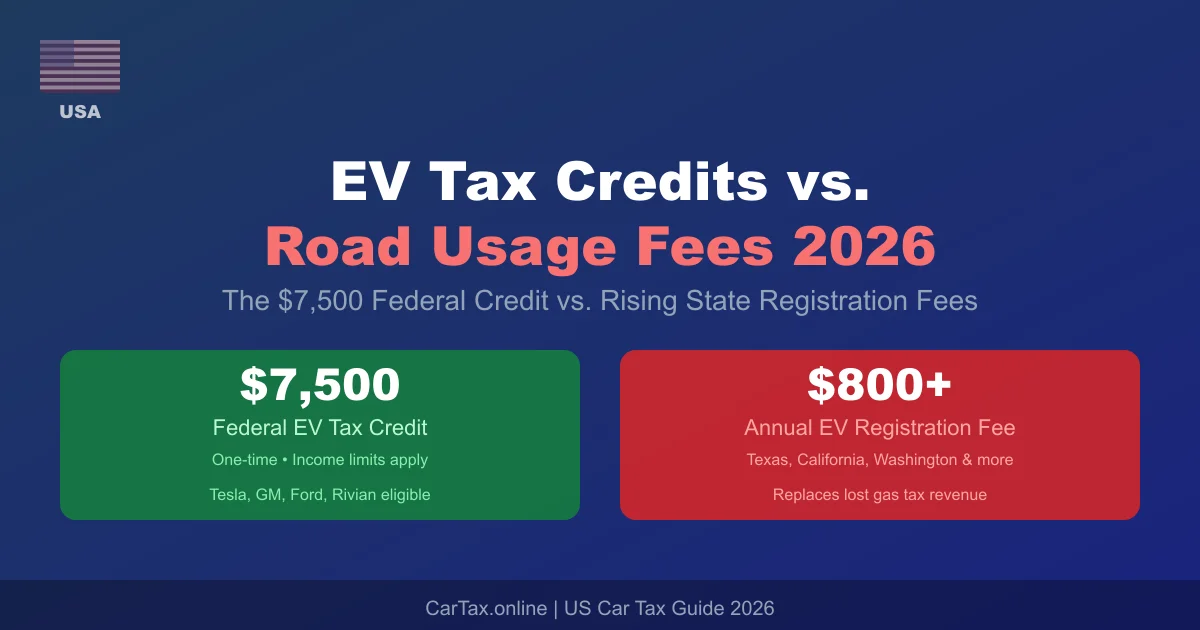
April 28, 2026 in Austin, Texas, USA — The federal electric vehicle tax credit of up to $7,500 has been one of the most powerful financial incentives for buying an EV in the United States. But a quieter revolution is happening at the state level: registration fees for electric vehicles are climbing sharply across the country, with some states now charging $400 to $800 per year above the standard registration cost.
The result? The gap between what EVs cost to own and operate compared to petrol vehicles is narrowing — and in some cases, disappearing entirely. This guide breaks down the real math of EV ownership in 2026, state by state.
The $7,500 Federal EV Tax Credit: Still Alive, But Complicated
Despite repeated attempts to eliminate or reduce it, the federal EV tax credit under Internal Revenue Code Section 30D remains one of the largest consumer incentives for electric vehicle adoption in the world. However, the credit comes with significant restrictions:
| Credit Amount | Eligibility |
|---|---|
| Full $7,500 | New EVs meeting battery domestic content requirements; income below limits; vehicle under price cap |
| Partial credit ($3,750-$7,500) | VEHs meeting partial domestic battery content threshold |
| No credit | Foreign-manufactured batteries, income above cap, vehicle above price cap |
The credit is non-refundable, meaning it reduces your tax liability but you will not receive a cheque if the credit exceeds what you owe. It is also only available for new vehicles — used EVs do not qualify under Section 30D (though a separate used EV credit of up to $4,000 exists under Section 25E).
The State Registration Fee Trap: How EV Fees Are Eroding the Credit
While the federal government offers a one-time credit, states are quietly chipping away at the long-term savings with annual registration surcharges. Here is the full picture of state EV registration fees in 2026:
| State | Standard Annual Fee | EV Extra Surcharge | Total EV Annual Fee | 5-Year Extra Cost |
|---|---|---|---|---|
| Wyoming | $30 | $400 | $430 | $2,000 |
| Texas | $51 | $400 | $451 | $2,000 |
| California | $48 | $300-$600 | $348-$648 | $1,500-$3,000 |
| Washington | $48 | $150+$150 pilot | $348 | $1,740 |
| Illinois | $48 | $100 | $148 | $500 |
| Colorado | $46 | $50 | $96 | $250 |
| Georgia | $47 | $0 | $47 | $0 |
| Florida | $46 | $0 | $46 | $0 |
| New York | $52 | $100 | $152 | $500 |
| Michigan | $55 | $0 | $55 | $0 |
States like Wyoming and Texas justify these fees as necessary replacements for gas tax revenue. The average petrol car in Texas pays approximately $250-$300 per year in federal and state gas taxes. Since EVs pay $0 in gas tax, the $400 surcharge roughly compensates for 1.5 to 2 years of road-use contributions.
The Real Cost Comparison: 5-Year EV vs. Petrol Ownership
Let us compare the total cost of ownership for a Tesla Model 3 RWD vs. a Toyota Camry in Texas over 5 years, factoring in every relevant cost:
Tesla Model 3 RWD (Texas)
- Purchase price: $38,990
- Federal tax credit: -$7,500 (net price: $31,490)
- Texas registration (5 years): $451 × 5 = $2,255
- Fuel (12,000 miles/year, 4 miles/kWh, $0.12/kWh home): $1,440/year × 5 = $7,200
- Maintenance (brake pads last longer, no oil changes): ~$800 × 5 = $4,000
- Insurance: ~$2,200/year × 5 = $11,000
- Total 5-Year Cost: $31,490 + $2,255 + $7,200 + $4,000 + $11,000 = $55,945
Toyota Camry LE (Texas)
- Purchase price: $28,400
- Federal tax credit: $0
- Texas registration (5 years): $51 × 5 = $255
- Fuel (12,000 miles/year, 32 mpg, $3.50/gallon): $1,313/year × 5 = $6,563
- Maintenance (oil changes, tires, brakes): ~$1,200 × 5 = $6,000
- Insurance: ~$2,000/year × 5 = $10,000
- Total 5-Year Cost: $28,400 + $255 + $6,563 + $6,000 + $10,000 = $51,218
Verdict for Texas:
The Tesla Model 3 is approximately $4,727 more expensive over 5 years despite the $7,500 federal credit — primarily because the higher purchase price and EV registration surcharge offset the fuel and maintenance savings. However, this calculation does not include the time value of money, resale value differences, or the environmental benefit.
California: The Most Complex EV Math
California presents the most complicated EV ownership equation in the US. The state has the highest EV adoption rate in the country — and also one of the most aggressive fee structures. California's Road Improvement and Reform (RIRe) package charges:
- Zero-emission vehicles (ZEVs): $300 annual registration surcharge
- ZEVs valued over $60,000: Additional $300 (total $600/year)
- Clean Vehicle Rebate (CVR): $2,000-$7,500 depending on income (separate from federal credit)
- Clean Fuel Reward: $750-$1,500 at point of sale
For a high-income buyer in California purchasing a $50,000 EV, the total federal + state incentive could reach $11,500 — but the annual registration cost is also the highest in the nation at $600 for premium EVs.
The Mileage-Based User Fee (MBUF) Trend
Perhaps the most significant threat to EV economics is the emerging mileage-based user fee (MBUF) trend. Several states are piloting programmes that charge drivers per mile driven, regardless of fuel type:
Washington State: The Pioneer Pilot
Washington's voluntary pilot programme allows EV owners to pay 2.4 cents per mile instead of the $400 annual EV surcharge. For drivers covering 10,000 miles per year, this is $240 — saving $160 over the fixed surcharge. For 20,000-mile drivers, it is $480 — potentially more expensive than the flat fee.
Oregon: OReGO Programme
Oregon's OReGO programme charges 1.7 cents per mile for registered participants. EV owners in Oregon have the option to join instead of paying the standard $110 EV registration fee.
Federal MBUF Studies
The US Department of Transportation has been studying a national mileage-based fee since 2022. A pilot programme covering 10 states is expected to launch by 2027, with results informing potential federal legislation. Industry analysts expect a federal mileage tax of 2-5 cents per mile to be introduced by 2030 if gas tax revenues continue to decline.
States Where EVs Still Win Big
In states with low EV fees and high gas prices, the math still strongly favours electric vehicles:
| State | Gas Price (avg April 2026) | EV Extra Registration Fee | EV Advantage |
|---|---|---|---|
| Georgia | $3.40/gallon | $0 extra | Strong EV market, low fees |
| Florida | $3.30/gallon | $0 extra | Strong EV market, low fees |
| Nevada | $3.65/gallon | $0 extra | Good EV economics |
| Arizona | $3.50/gallon | $0 extra | Good EV economics |
The Battery Electric vs. Plug-In Hybrid Question
For buyers concerned about total cost of ownership, plug-in hybrids (PHEVs) present a middle ground. They qualify for a reduced federal credit (typically $3,750-$7,500 depending on battery size) while still paying standard registration fees in most states. A PHEV like the Toyota RAV4 Prime ($7,500 credit available) combines EV commuting capability with petrol backup — and avoids the full EV registration surcharge in states like Texas and Wyoming.
How to Calculate Your EV Break-Even Point
Use this formula to determine if an EV makes financial sense for your situation:
- Calculate your annual fuel cost: (Miles driven ÷ Your car's MPG) × Current gas price
- Calculate equivalent EV charging cost: (Miles driven ÷ EV efficiency in miles/kWh) × Your electricity rate
- Subtract the fuel savings: Annual petrol cost - Annual EV cost = Annual savings
- Add your state EV surcharge: Annual savings - Your state's EV registration surcharge
- Divide your net premium by annual savings: (EV purchase price - Federal credit) ÷ Net annual savings = Years to break even
Example: If your EV premium after credit is $5,000, you save $800/year in fuel, and your state EV surcharge is $400/year, your net annual saving is $400. Break-even: $5,000 ÷ $400 = 12.5 years.
Conclusion: Is Your EV Still Worth It?
The answer is: it depends heavily on where you live, how much you drive, and how long you keep your car. In states like Wyoming and Texas, the $400 annual registration surcharge means the federal $7,500 credit covers only about 3 years of the fee differential. In states like Georgia and Florida with $0 EV surcharges, the credit provides pure savings.
Regardless of where you live, EVs offer significant advantages in fuel cost and maintenance that should be weighed against purchase price premiums and registration fees. Use our US Car Tax Calculator to compare total costs for your specific vehicle, state, and annual mileage. And check our Blog for ongoing coverage of EV tax policy changes.
Disclaimer: Costs and tax credits in this article are based on rates available as of April 2026. Federal and state EV incentives, registration fees, and fuel prices are subject to change. Confirm current rates with your state DMV and IRS before making purchase decisions.
Sources: IRS EV Tax Credit | FHWA | EIA Gas Prices