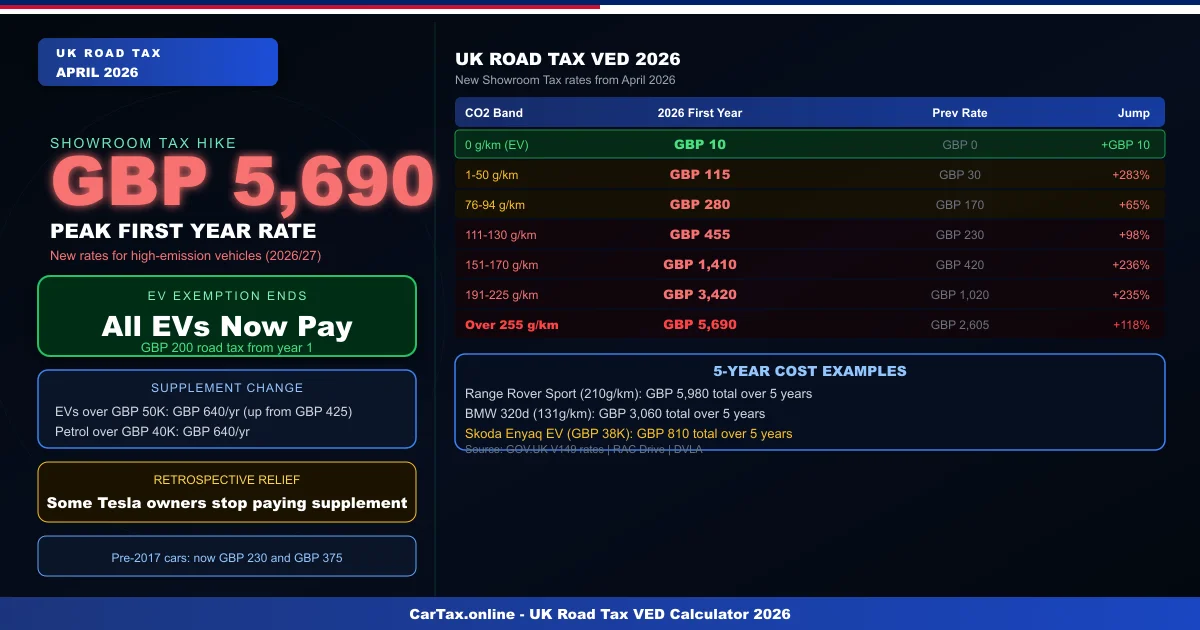
On April 22, 2026, UK drivers face the biggest shake-up in road tax rules in years. The standard Vehicle Excise Duty rate jumps to GBP 200, the first-year Showroom Tax for petrol and diesel cars rockets to as high as GBP 5,690 for high-emission models, electric vehicles lose their zero-rate exemption, and the threshold for the luxury car supplement changes for EVs. Whether you drive a petrol family hatchback, a hybrid SUV, or a brand-new Tesla, your road tax bill is changing.
What Is VED and the Showroom Tax?
Vehicle Excise Duty, commonly called road tax, is a mandatory annual fee every UK vehicle owner must pay to legally drive on public roads. The revenue funds the National Roads Fund, covering highway maintenance across England, Scotland, Wales, and Northern Ireland.
VED has two components for new car buyers: a one-time first-year Showroom Tax based on CO2 emissions, followed by an annual flat-rate VED from year two onwards. This two-part structure means new buyers pay significantly more in year one, especially for high-emission vehicles. The 2026/27 tax year introduced dramatically higher first-year rates as part of the government push to accelerate EV adoption.
VED affects all UK drivers:
- New car buyers pay first-year Showroom Tax based on emissions (now up to GBP 5,690)
- All owners pay annual road tax from year 2 onwards
- EV owners previously exempt now pay standard rates
- Vehicles over GBP 40,000-50,000 attract the Expensive Car Supplement
VED Rates From April 1, 2026: The New Showroom Tax
Annual Standard Rate (Year 2 Onwards)
The flat annual VED rate for cars registered after April 2017 rises from GBP 190 to GBP 200 per year. This applies to all fuel types equally - petrol, diesel, hybrid, and electric vehicles now share the same annual road tax burden.
First-Year Showroom Tax by CO2 Emissions (2026/27 Rates)
New car buyers pay a one-time first-year Showroom Tax based on CO2 output. The 2026/27 rates are significantly higher than previous years for higher-emission vehicles:
- Zero emissions (0g/km CO2): GBP 10 first year
- 1-50g/km CO2: GBP 115 first year
- 51-75g/km CO2: GBP 155 first year
- 76-90g/km CO2: GBP 280 first year
- 91-100g/km CO2: GBP 300 first year
- 101-110g/km CO2: GBP 340 first year
- 111-130g/km CO2: GBP 455 first year
- 131-150g/km CO2: GBP 600 first year
- 151-170g/km CO2: GBP 1,410 first year
- 171-190g/km CO2: GBP 1,940 first year
- 191-225g/km CO2: GBP 3,420 first year
- 226-255g/km CO2: GBP 4,755 first year
- Over 255g/km CO2: GBP 5,690 first year - the new Showroom Tax peak
Key Change: The Showroom Tax for high-emission vehicles has increased dramatically. A large petrol SUV emitting 200g/km CO2 now pays GBP 3,420 in year one - up from GBP 1,020. This is the government clearest signal yet that internal combustion engine vehicles will become increasingly expensive to own.
Electric Vehicles: End of the Road Tax Holiday
EVs Now Pay Standard VED
Zero-emission vehicles previously enjoyed free road tax. From April 1, 2026, that exemption ends. EVs now pay GBP 10 in their first year and GBP 200 annually from year two. This applies to fully electric cars, hydrogen fuel cell vehicles, and any zero-emission model registered on or after the new deadline.
Expensive Car Supplement for EVs
Here is the significant change for premium EVs: the government raised the threshold for the Expensive Car Supplement to GBP 50,000 for zero-emission vehicles. Previously, it was GBP 40,000 for all vehicles. This means:
- EVs under GBP 50,000 list price: Pay only GBP 200/year from year 2
- EVs over GBP 50,000 list price: Pay GBP 200 + GBP 440 supplement = GBP 640/year
- Supplement duration: Applied for the first 5 years of registration
Retrospective EV Threshold Change - Good News for Some Tesla Owners
From April 2026, the GBP 50,000 threshold for EVs is retrospective. This means someone who bought a GBP 45,000 EV in 2024 or 2025 - and was previously paying the GBP 425 supplement because the old threshold was GBP 40,000 - will stop paying the supplement from April 2026. If you bought a Model 3 or Model Y Standard Range under the old GBP 40k threshold, your road tax bill drops by GBP 440/year. This is a concrete financial benefit that will spread on social media and forums.
Vehicles That Still Avoid the Supplement
Some popular EVs under the GBP 50,000 threshold include the MG4, Skoda Enyaq, Volkswagen ID.3, and Nissan Leaf. Models like the Tesla Model Y Long Range, BMW iX, and Mercedes EQS priced above GBP 50,000 pay the full GBP 640 annual road tax from year two onwards.
Petrol and Diesel Cars: Unchanged Supplement Rules
Standard GBP 40,000 Threshold Remains
For petrol and diesel vehicles, the Expensive Car Supplement threshold stays at GBP 40,000. If your petrol car costs more than this, you pay GBP 200 + GBP 440 = GBP 640 annually for the first 5 years. After that, you revert to the standard GBP 200 rate.
Most Family Cars Stay Under the Threshold
Mainstream petrol and diesel cars typically cost between GBP 20,000 and GBP 35,000. The GBP 40,000 supplement mainly affects executive saloons, large SUVs, and premium brands. Most Ford, Vauxhall, and Volkswagen owners will not be affected by the supplement.
UK Luxury Car Tax 2026: What High-Emission Vehicles Pay
For buyers of high-end performance cars and large SUVs, the 2026 Showroom Tax reaches eye-watering levels. A BMW X5 M with 290g/km CO2 emits enough to trigger a GBP 5,690 first-year bill under the new UK luxury car tax 2026 rates. Even a Mercedes GLE 350d at 205g/km pays GBP 3,420 in year one. These figures represent a stark increase from previous years and will factor heavily into TCO calculations for premium vehicle purchases.
The UK luxury car tax 2026 changes have made the economics of choosing a high-emission vehicle significantly less attractive, pushing buyers toward lower-CO2 alternatives or fully electric models.
Older Cars Registered Before April 2017
2026 Rate Increases for Pre-2017 Vehicles
Cars first registered before April 1, 2017 follow a different VED structure based on engine size rather than CO2 emissions. These rates have also increased for 2026:
- Under 1,549cc engine: GBP 230 per year (up from GBP 200)
- Over 1,549cc engine: GBP 375 per year (up from GBP 345)
If your pre-April 2017 car had a list price over GBP 40,000 when new, you may also be liable for the Expensive Car Supplement. Many owners of older high-value vehicles are unaware they still face this obligation.
Salary Sacrifice Schemes: EV Advantage Deepens
Company car salary sacrifice schemes have become one of the most tax-efficient ways to drive an EV in the UK. In 2026, the Benefit-in-Kind (BIK) tax rate for fully electric company cars is just 4% of the vehicle list price. This means a GBP 50,000 Tesla Model Y through salary sacrifice costs far less in tax than a comparable petrol vehicle at the standard 20% BIK rate.
Combined with the new road tax rules - where that same GBP 50,000 Tesla no longer triggers the expensive car supplement since April 2026 - the total cost of EV ownership through a salary sacrifice scheme is compelling. Use our UK Salary Sacrifice Calculator to compare your take-home pay and tax liability with an EV versus a petrol company car.
How to Calculate Your Road Tax
Step 1: Identify Your Vehicle Type
Determine whether your car was registered before or after April 2017. This single factor changes the entire calculation methodology.
Step 2: Find Your CO2 Emissions
Check your V5C registration document or log into your account at gov.uk to view your vehicle details. CO2 figures are listed in g/km.
Step 3: Check the List Price
For the Expensive Car Supplement, the list price is the recommended retail price before options or discounts. Your insurer can also confirm the valuation methodology.
Step 4: Use the DVLA Calculator
Visit gov.uk/check-vehicle-tax, enter your registration number and the date you bought the vehicle, and the tool will show your exact annual road tax obligation.
Real Examples: What UK Drivers Are Paying in 2026
Example 1: Ford Puma 1.0 Hybrid (GBP 26,000)
- CO2 emissions: 120g/km
- First-year VED: GBP 455 (111-130g/km band)
- Year 2 onwards: GBP 200 (under GBP 40k threshold, no supplement)
- Total over 5 years: GBP 1,255 (was GBP 1,130 under old rates)
Example 2: Tesla Model Y Long Range (GBP 55,000)
- First-year VED: GBP 10 (0g/km CO2)
- Years 2-5: GBP 640/year (GBP 200 standard + GBP 440 EV supplement)
- Year 6 onwards: GBP 200/year
- Total over 5 years: GBP 2,660
Example 3: BMW 320d M Sport (GBP 47,000)
- CO2 emissions: 131g/km
- First-year VED: GBP 600 (131-150g/km band)
- Years 2-5: GBP 640/year (GBP 200 standard + GBP 440 supplement, GBP 40k petrol threshold)
- Year 6 onwards: GBP 200/year
- Total over 5 years: GBP 3,060
Example 4: Skoda Enyaq 80 (GBP 38,000)
- First-year VED: GBP 10 (0g/km CO2)
- Years 2-5: GBP 200/year (under GBP 50k EV threshold, no supplement)
- Year 6 onwards: GBP 200/year
- Total over 5 years: GBP 810
Example 5: Range Rover Sport 3.0L (GBP 85,000, 210g/km CO2)
- First-year VED: GBP 3,420 (191-225g/km band - the UK luxury car tax peak in action)
- Years 2-5: GBP 640/year (GBP 200 standard + GBP 440 supplement)
- Total over 5 years: GBP 5,980
Is It Worth Switching to an EV Now?
Road Tax Comparison
Comparing a GBP 35,000 petrol family SUV to a GBP 35,000 electric equivalent over 5 years:
- Petrol SUV total VED: GBP 1,255 over 5 years
- Electric equivalent total VED: GBP 810 over 5 years
- Savings with EV road tax: GBP 445 over 5 years
The EV road tax savings have widened with the new Showroom Tax rates. However, the bigger financial argument for EVs in 2026 comes from the 4% BIK rate through salary sacrifice schemes, lower fuel costs, and reduced maintenance. The road tax difference is one factor in a much larger equation.
What Happens If You Do Not Pay VED?
Penalties and Enforcement
Driving without paying road tax is an offence. The DVLA uses automatic number plate recognition cameras to identify untaxed vehicles. If you are caught driving without valid road tax:
- Immediate penalty: GBP 80 fixed fine
- Reduced penalty: GBP 40 if paid within 21 days
- Court prosecution: For persistent non-payment, fines can reach GBP 1,000
- Vehicle clamping: Your car can be clamped and removed
The DVLA also immobilises untaxed vehicles parked on public roads, meaning you cannot even leave your car without a valid tax disc.
The Bottom Line
UK road tax changes from April 2026 affect every driver. The standard rate rising to GBP 200 is a modest increase for most, but the Showroom Tax increases for high-emission petrol and diesel vehicles are dramatic. EVs losing their exemption is significant, though the retrospective GBP 50k threshold change is good news for mid-range EV buyers. Premium EV buyers should budget an extra GBP 440 per year for the supplement. Most mainstream petrol and diesel car owners will see their first-year bills rise substantially, especially if they drive high-emission SUVs.
Use the gov.uk vehicle tax checker to confirm your exact liability and budget accordingly for your next vehicle purchase.
Official Resources: Check your vehicle tax at GOV.UK | Official VED rates V149 from GOV.UK | RAC VED guide
Disclaimer: This article is for informational purposes only and does not constitute financial or legal advice. Road tax rates are subject to change. Consult the official DVLA website or a qualified professional for your specific situation.