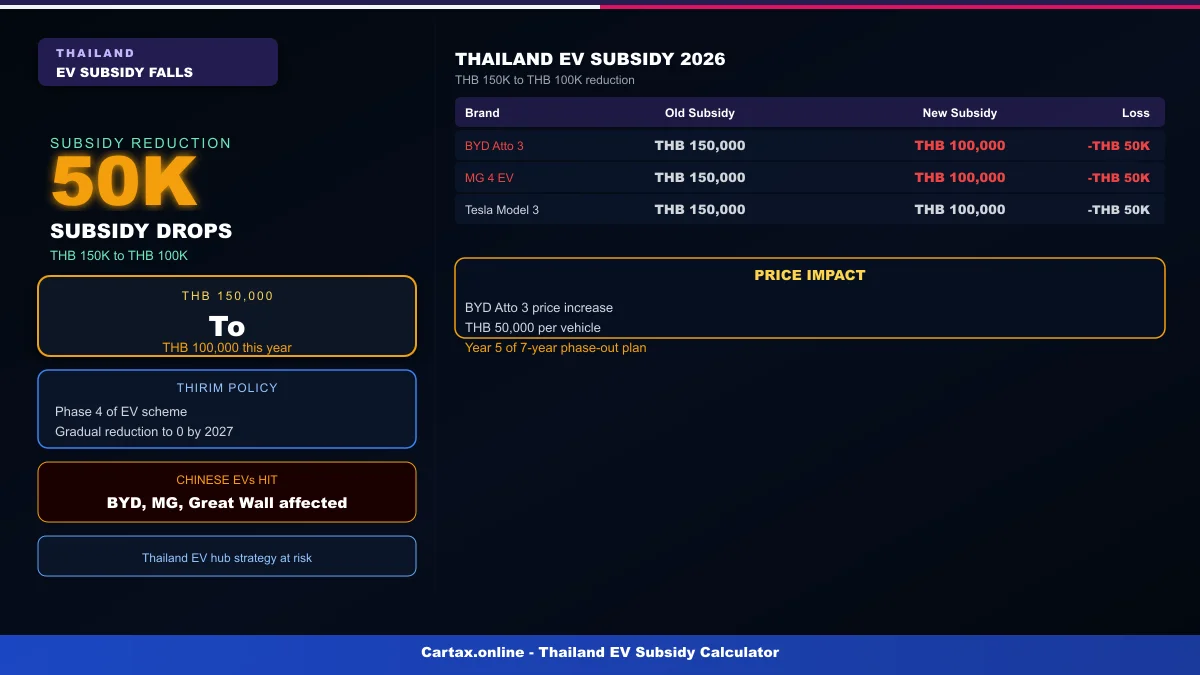
Thailand's popular EV 3.5 subsidy programme has entered its final phase, with subsidies dropping from 150,000 THB to 100,000 THB. This reduction marks a significant change for the Thai EV market, which has grown rapidly under the incentive programme. For buyers considering an electric vehicle, now represents the last opportunity to capture substantial government support before rates decline further.
Thailand's EV Subsidy Phases
Programme Evolution
- EV 3.0 (2022-2024): Up to 150,000 THB subsidy — now expired
- EV 3.5 (2024-2026): Up to 100,000 THB subsidy — current phase
- EV 3.6 (2027-2030): Continued but reduced incentives
- Post-2030: Commercial viability expected without subsidies
Why Thailand Supports EVs
Thailand aims to become ASEAN's electric vehicle hub:
- Attract international EV manufacturers
- Develop domestic EV supply chain
- Reduce oil dependency
- Meet emissions targets
Current EV 3.5 Subsidy Details
Eligibility Requirements
Local assembly: Required
Maximum price: 2,000,000 THB
Battery capacity: Minimum 10kWh
Maximum subsidy: 100,000 THB
Qualifying Models
- BYD Dolphin: 700,000 THB — subsidy 100,000 THB
- BYD Seal: 1,150,000 THB — subsidy 100,000 THB
- MG 4 EV: 890,000 THB — subsidy 100,000 THB
- Nissan Leaf: 1,050,000 THB — subsidy 100,000 THB
Buying Now vs Waiting
Subsidy Comparison
Buy Now (EV 3.5):
- Subsidy: 100,000 THB (about $2,800)
- Local content: 40% required
- Available models: Multiple established options
Wait (EV 3.6, 2027):
- Expected subsidy: 50,000-70,000 THB
- Higher local content requirement
- Fewer models may qualify
- Vehicle prices may decrease
The Bottom Line
Thailand's EV 3.5 subsidy represents a narrowing window for maximum government support. With rates declining each phase, buyers who are ready for an EV should consider acting now. The 100,000 THB subsidy translates to approximately $2,800 USD — a substantial incentive that will only decrease in future phases.