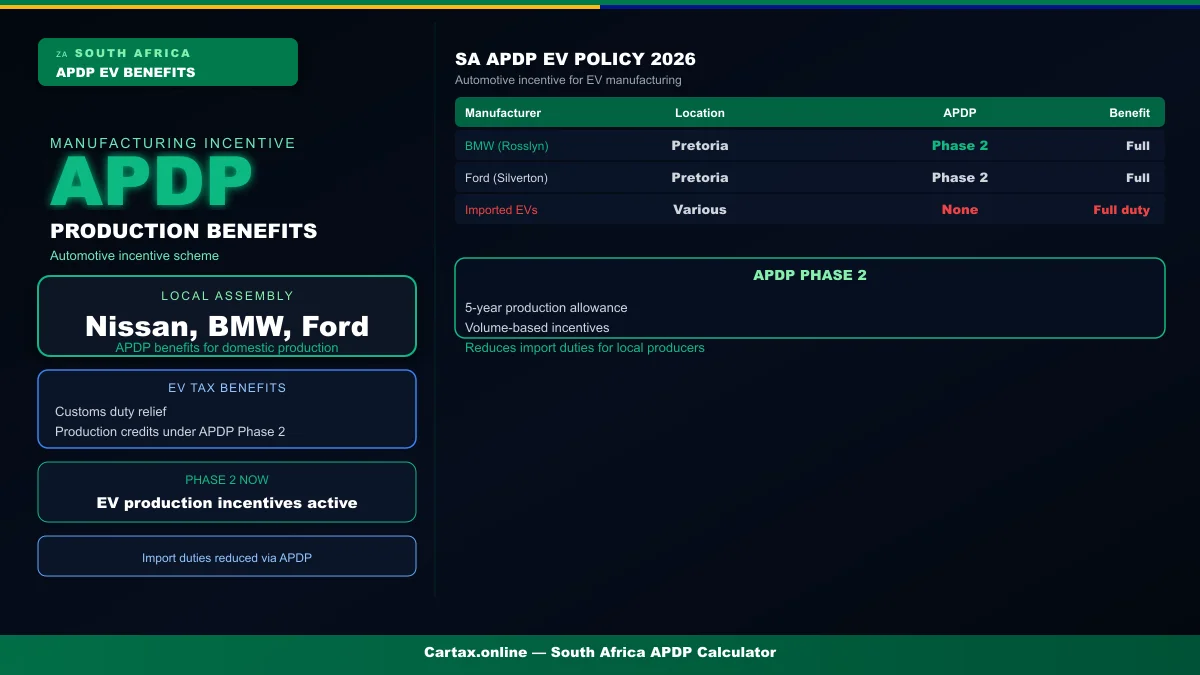
South Africa EV policy has evolved to support local manufacturing through APDP (Automotive Production and Development Programme). As of 2026, locally assembled electric vehicles receive significant excise duty rebates and import duty reductions, creating a meaningful cost advantage for South African buyers.
Understanding South Africa's APDP
The Automotive Production and Development Programme
APDP is South Africa's primary automotive support policy, designed to:
- Increase local vehicle production
- Develop automotive component industry
- Support employment in the sector
- Integrate South Africa into global automotive supply chains
EV-Specific Provisions
APDP includes special provisions for electric vehicles:
- Excise duty rebates for qualifying EVs
- Import duty reductions on components
- Local assembly incentives
- Production investment credits
2026 Duty Structure for EVs
Excise Duty Rebates
Locally Assembled EV: 20% excise rate with 35% rebate = 13% net rate
Imported EV (CBU): 20% excise rate with 0% rebate = 20% net rate
Imported Hybrid (CBU): 20% excise rate with 10% rebate = 18% net rate
Cost Comparison: Local vs Import
Savings Example
R800,000 Electric SUV (pre-rebates)
Locally Assembled:
- Base price: R800,000
- Excise duty (13% after rebate): R104,000
- Total cost: R904,000
Fully Imported:
- Base price: R800,000
- Excise duty (20%): R160,000
- Total cost: R960,000
SA Advantage: R56,000
Local Content Requirements
Current Requirements
To qualify for APDP benefits, EVs must meet local content thresholds:
- Current minimum: Assembly activities in South Africa
- Planned increase: 35% local content by 2028
- Long-term target: 50%+ local content including battery production
What Counts as Local Content
- Vehicle assembly operations
- Component manufacturing (wiring, interiors, chassis)
- Battery pack assembly (once established)
- Research and development activities
- Training and workforce development
Future Outlook
South Africa's EV Ambitions
South Africa has set ambitious targets for its EV industry:
- Establish battery manufacturing by 2030
- Achieve 50% local content on EVs by 2035
- Become primary EV exporter to African markets
- Support 100,000+ automotive jobs through EV transition
The Bottom Line
South Africa's APDP creates meaningful advantages for locally assembled EVs, with savings of R50,000-200,000 compared to fully imported vehicles. As local content requirements increase, the benefit for South African manufacturing investments will grow. For buyers, choosing a locally-assembled EV not only saves money but also supports the development of South Africa's automotive industry and associated employment.