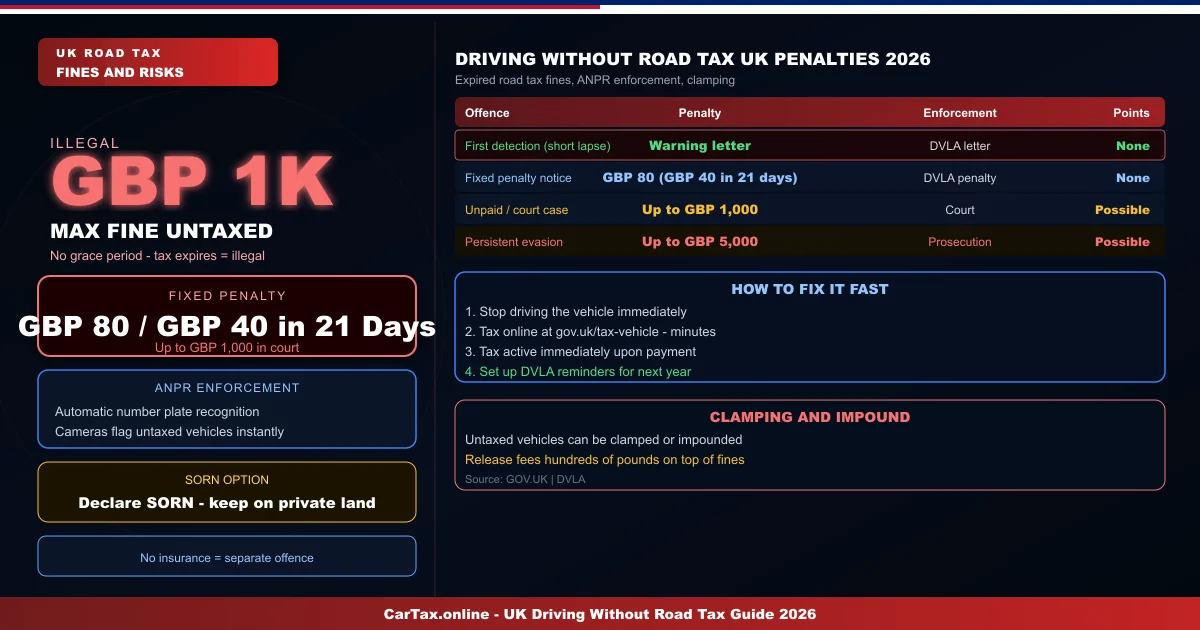
On 22 April 2026, across the UK, vehicles are being driven on public roads every minute. Some of those vehicles are untaxed — some accidentally, some deliberately. The consequences are real and can escalate quickly. This guide covers everything about driving with expired road tax: the legal rules, the penalties, and exactly what to do if your tax has lapsed.
The Law: Road Tax Is Not Optional
Vehicle Exercise Duty (road tax) is a legal requirement for keeping any vehicle on a public road in the UK. The law is unambiguous under the Vehicle Excise and Registration Act 1994: a vehicle must be taxed at all times unless it is off the road (SORN — Statutory Off Road Notification) or being used in a specific exempt circumstance.
There is no grace period. The moment your road tax expires, the vehicle is illegally on the road if driven. DVLA's enforcement is automated and aggressive — automatic number plate recognition (ANPR) cameras on roads and at petrol stations cross-reference vehicle registrations against DVLA's database in real time.
The Exemptions: When You Can Legally Be Untaxed
The only circumstances in which a vehicle can be kept on a public road without road tax are:
Statutory Off Road Notification (SORN): If you declare a vehicle SORN, you are declaring it is not in use on the public road. A SORN vehicle must be kept on private land — it cannot be driven or kept on a road. The moment you move a SORN vehicle on a public road, road tax is required.
Driving to MOT: An unlicensed vehicle can be driven to a pre-booked MOT test appointment at a designated test centre. This exception requires the vehicle to have a valid MOT and to be driven directly to the nearest appropriate MOT station. Even so, the vehicle must be road-taxed for this exception to apply — an untaxed vehicle without MOT cannot legally move at all.
Recovery: A vehicle being recovered by a licensed breakdown service or transporter is exempt from road tax requirements during the recovery journey.
Beyond these specific exceptions, there is no circumstance in which a vehicle can be driven on a public road without road tax.
The Penalties: What Happens if You Are Caught
DVLA's enforcement process follows a graduated scale:
First detection: In many cases, the first time an untaxed vehicle is detected, DVLA sends a warning letter rather than an immediate fine — particularly for short-term lapses where the vehicle is quickly taxed. This is at DVLA's discretion.
Fixed Penalty Notice: If a fine is issued, the standard fixed penalty for an untaxed vehicle is £80. Pay within 21 days and it is reduced to £40. Do nothing and the full £80 applies. Ignore that and DVLA escalates.
Court prosecution: If the fixed penalty is unpaid or the case involves deliberate evasion, DVLA refers the case to the Vehicle Licensing Criminal evaders team. Courts can impose fines of up to £1,000 per offence. In serious cases of persistent evasion, fines can reach £5,000.
Vehicle seizure and clamping: DVLA and the DVLA's contracted enforcement agents (Towie, Gladstone, etc.) actively target untaxed vehicles. Clamping and impoundment are common outcomes, and releasing a clamped or impounded vehicle involves significant fees — often hundreds of pounds on top of any fines.
What To Do If Your Road Tax Has Expired
First: stop driving the vehicle. Every additional mile driven increases the risk of detection and potential escalation of penalties.
Second: tax the vehicle immediately. Go to gov.uk/tax-vehicle and complete the transaction. You will need your V5C reference number and valid motor insurance. Payment can be made by debit or credit card. The tax activates the moment payment is confirmed — there is no waiting period.
Third: if the vehicle needs to be moved to a safe location, arrange a transporter or recovery service. Many breakdown providers offer short-distance vehicle movement for a fixed fee. This costs money but is far cheaper than the fines and fees associated with being caught driving untaxed.
Fourth: if you do not intend to use the vehicle again, declare a SORN immediately. This is free and can be done at gov.uk/sorn-vehicle. As long as the vehicle stays on private land, no further action is required.
Can You Accidently Drive Untaxed?
Yes — and it happens more often than people realise. Common scenarios include:
- Forgetting to renew after moving house and not receiving the reminder
- Buying a car from a private seller and assuming the tax transfers (it does not)
- Believing that MOT renewal automatically renews road tax (it does not)
- Financial difficulty leading to deliberate non-renewal while continuing to drive
DVLA has no exemption for accidental non-payment. The law treats deliberate and accidental non-payment identically. The best defence is always to set up reminders and check your status regularly at gov.uk/check-vehicle-tax.
Setting Up Reminders to Avoid Lapse
DVLA's free reminder service sends email and text alerts before your road tax expires. Register at gov.uk/log-in-v11-vehicle-tax-reminder to receive notifications 2 weeks and 1 week before expiry. This is the simplest way to avoid accidental lapse — the reminders are reliable and free.
Some insurers also embed road tax renewal reminders in their policy communications. Check your insurer's customer portal for this feature.
The Bottom Line
Driving without road tax is never worth the risk. The penalties escalate from £40 to £1,000. The enforcement is automated and comprehensive. The solution takes minutes and costs the same as it would have before expiry. If your tax has lapsed, tax it now before driving it anywhere.