On 22 April 2026, car owners across the UK are renewing road tax — some manually, some with a growing backlog of tasks that keep pushing it to the bottom of the to-do list. One of the simplest quality-of-life improvements for car ownership is setting up direct debit renewal for your vehicle tax. This guide explains exactly how it works, what it costs, and why it is worth doing.
How Road Tax Direct Debit Works
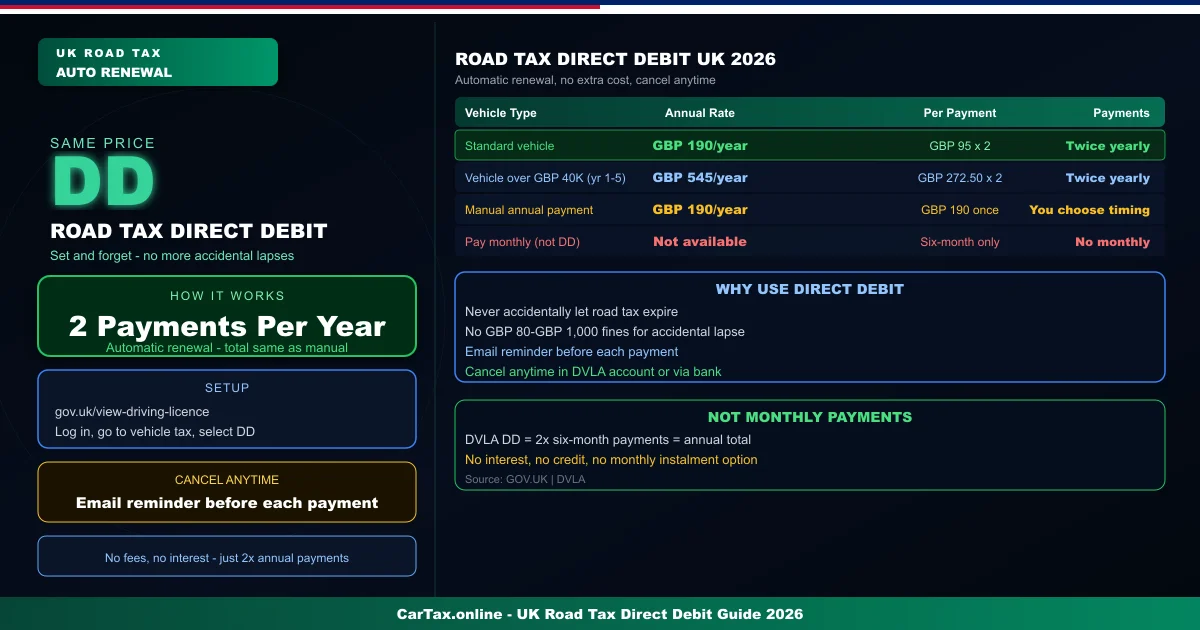
DVLA's direct debit arrangement for annual vehicle tax splits the annual payment into two equal instalments — one debited on your renewal date and one approximately 6 months later. Unlike some other payment schemes, this is not true monthly payment — it is a split annual payment. The total amount paid per year is identical to the manual annual payment.
Once set up, the renewal happens automatically each year. You receive an email notification before each payment is taken, which gives you the opportunity to cancel or amend the arrangement if needed. If your vehicle is sold or you want to change payment method, you cancel the direct debit before the next renewal.
Setting Up Direct Debit: Step by Step
You need a DVLA online account to set up direct debit. If you do not already have one:
- Go to gov.uk/view-driving-licence
- Create an account using your driving licence number and National Insurance number
- Once logged in, navigate to the Vehicle Tax section
- Select the option to set up direct debit for your vehicle
- Enter your UK bank account details
- Confirm the direct debit instruction with your bank
The process takes approximately 10 minutes for first-time setup. Once confirmed, the direct debit is active for your next renewal cycle.
The Cost: Same as Manual Payment
Direct debit does not cost more or less than manual annual payment. The two instalments together equal the standard annual road tax rate for your vehicle:
- Standard vehicle: £190 per year — two payments of £95 each
- Vehicle over £40,000 (years 1-5): £545 per year — two payments of £272.50 each
- Pre-April 2017 vehicle: rates vary by CO2 band — typically £275 to £600 per year
There is no setup fee, no administration charge, and no interest. The direct debit is simply a payment convenience, not a credit product.
Managing and Cancelling the Direct Debit
You can cancel the direct debit at any time through your DVLA online account or by contacting your bank directly using the standard direct debit cancellation process. Cancelling does not cancel your road tax — it simply means you must manually renew each year. You remain responsible for ensuring the vehicle is taxed at all times, regardless of payment method.
DVLA's advance email notification gives you a window before each automatic payment to cancel if needed. For example, if you are selling the vehicle, you can cancel the direct debit before the next payment date to avoid paying for a vehicle you no longer own.
Direct Debit vs Manual Renewal: Which Is Better?
Direct debit is better for most drivers because it eliminates the risk of accidentally letting road tax lapse. An untaxed vehicle can result in fines of £80 to £1,000 — a cost that vastly outweighs any minor inconvenience of manual renewal. The automatic reminder emails from DVLA give you advance notice before each payment, so you are never surprised by a direct debit.
Manual renewal suits drivers who prefer to review their payment each year or who want to cancel their tax when selling a vehicle before the renewal date. If you sell cars frequently or want maximum control over your payment timing, manual renewal gives you that flexibility.
Summary
Road tax direct debit is free to set up, costs the same as manual payment, and removes the risk of accidental lapses that result in £80 to £1,000 fines. Set it up once via your DVLA online account and let it run — you will receive advance email notification before each payment, and you can cancel at any time.