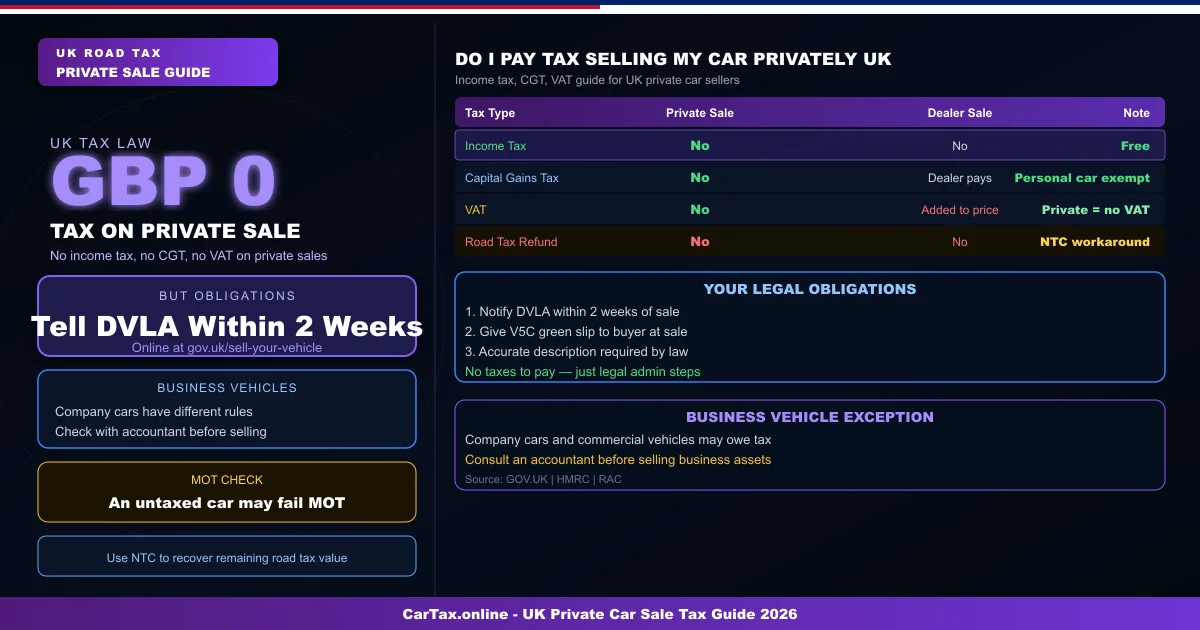
On 22 April 2026, hundreds of UK residents are negotiating private car sales with friends, neighbours, and strangers they found online. One question comes up repeatedly: do I pay tax when selling my car privately? The answer involves several different taxes, and the nuance matters — income tax, Capital Gains Tax, VAT, and road tax each have different rules. This guide covers all of them.
Income Tax on Private Car Sales: The Short Answer
No — you do not pay income tax when selling your personal car privately in the UK. HMRC's position is clear: a privately owned vehicle used for personal transportation is not a revenue-generating asset subject to income tax rules. Whether you sell for £500 or £15,000, the proceeds are not taxable income in the same way that wages, rental income, or business revenue are taxable.
The reason is straightforward: cars are consumable assets that depreciate over time. Most private sellers sell their cars for less than they paid, making any tax question moot. HMRC has no expectation that individuals report private car sale proceeds on a tax return unless the sale falls within specific commercial or business contexts.
Capital Gains Tax: Also No for Personal Vehicles
Capital Gains Tax (CGT) applies when you sell an asset that has increased in value. But personal vehicles — defined as cars and light commercial vehicles used for personal purposes — are specifically exempt from CGT under HMRC's rules. This exemption covers the vast majority of private car sellers.
The 2026-27 tax year brings a personal CGT allowance of £3,000 per year. Even if you somehow sold a private car for more than you paid (an unusual outcome given car depreciation), any taxable gain would need to exceed £3,000 before CGT becomes relevant. In practice, this means private car sellers never encounter CGT.
The exemption is specifically for cars, not for all vehicles. Motorhomes, caravans, and certain other vehicle types may be treated differently. If you are selling something other than a standard car, check HMRC's specific guidance for that vehicle type.
VAT on Private Car Sales: Not Applicable
VAT (Value Added Tax) is a business tax collected by registered businesses on their sales. Private individuals are not VAT registered and cannot — and should not — charge VAT on a private sale. The price you agree with a private buyer is the total price you receive.
This is a useful point to understand when buying, too. If a private seller claims to be adding VAT to the sale price, that is incorrect. Only VAT-registered businesses — car dealers, dealerships, and commercial sellers — are required to charge VAT, and they do so on their advertised prices openly.
Some buyers are confused when a dealer advertises a price ex-VAT — a commercial arrangement common in trade vehicle sales where dealers sell to other businesses. For private buyers purchasing from dealers, the full VAT-included price is the relevant figure.
Business Vehicles: The Important Exception
The tax rules change significantly if the vehicle you are selling has been used for business purposes. A company car — one owned by a limited company and made available for personal use — is treated differently from a private vehicle. The disposal of a business asset triggers different tax considerations:
Company cars and Capital Gains Tax: If you own the company that owns the car, selling the vehicle may trigger CGT or corporation tax considerations depending on the sale price versus the company's book value of the asset.
Benefit in kind implications: Company cars used for private purposes have been subject to benefit-in-kind tax during the period of ownership. When disposing of the asset, the tax treatment is different from a purely personal vehicle.
Hire and rental vehicles: Cars used in commercial hire or rental operations are business assets. The proceeds from their sale may be taxable as business income.
If your car has any business use history — even partial use for commuting — it is worth consulting an accountant before the sale. The tax implications can be complex and vary based on the nature and extent of the business use, how the vehicle was funded (company purchase, lease, loan), and your personal tax situation.
Road Tax: The One That Causes Confusion
Road tax (Vehicle Exercise Duty) is frequently confused with income-related taxes. Sellers often ask whether they can claim back road tax as part of their tax obligations — the answer is no, for the reasons covered in our road tax refund guide. But road tax is completely separate from income tax, CGT, and VAT.
When selling privately, you do not pay road tax on the sale. You do not receive a road tax refund from DVLA. And you do not need to account for any road tax payment in your tax return. Road tax is a vehicle usage charge — not a transaction tax on car sales.
The Legal Obligations That Actually Apply to Private Sellers
While you do not pay income tax or CGT on a private car sale, you do have legal obligations that are often confused with tax requirements:
Notify DVLA within 2 weeks: This is the most important obligation. Failure to do so can result in fines of £80 to £1,000. Use the online service at gov.uk/sell-your-vehicle. This is not a tax — it is a vehicle registration requirement.
Complete the V5C logbook section 8: Give the green slip to the buyer immediately at the point of sale. This formally transfers ownership. You keep section 9 for your records.
NTC certificate for road tax credit: If the car has remaining months of road tax, apply for an NTC certificate from Post Office or DVLA before the sale. This allows you to negotiate the credit value into the sale price, as covered in our road tax transfer guide.
Accurate advertisement and description: Under consumer protection law, you must not make false statements about the vehicle. Misrepresenting the road tax status, MOT result, mileage, or condition can constitute an offence.
Selling to a Dealer vs Private Sale: Tax Differences
It is worth noting the contrast between private sales and dealer transactions:
When you sell to a dealer, the dealer will typically offer you a trade-in price that is lower than the private sale value. The dealer factors in their resale costs, warranty obligations, and margin — and they will deal with the road tax, MOT, and administrative overhead themselves. From a tax perspective, the dealer has their own VAT and business tax obligations, but these do not flow back to you as the seller.
Private sales give you more money but require more effort. You handle the advertisement, respond to enquiries, arrange viewings, negotiate the price, and complete the administrative steps yourself. The tax obligations are simpler — there are none, essentially — but the legal obligations around DVLA notification and accurate description are yours to manage.
Do You Need an Accountant for a Private Car Sale?
For the vast majority of private car sellers — those selling a personal vehicle used purely for private transport — there is no need to involve an accountant. The transaction has no tax implications.
The only scenarios where professional advice is warranted are:
- The vehicle has been used for business purposes (company car, self-employed use, hire vehicle)
- The vehicle was purchased as an investment or has been renovated and resold commercially
- The sale is part of a larger asset disposal programme that might trigger CGT concerns
- The vehicle is unusual (classic car, imported vehicle, modified vehicle with unusual tax classification)
For standard private sales of personal vehicles, the process is tax-free. Focus your energy on getting a fair price, completing the DVLA paperwork correctly, and ensuring the buyer has what they need to tax and register the vehicle in their name.
Summary
No income tax, no Capital Gains Tax, and no VAT apply to private car sales in the UK for personal vehicles. Your only financial obligations as a seller are the costs you choose to incur preparing the car for sale and any advertising fees. Your legal obligations are DVLA notification within two weeks and accurate description of the vehicle. Road tax is not refunded but can be partially recovered via an NTC certificate before the sale. Business vehicles are the exception — if your car has business use history, consult an accountant before selling.