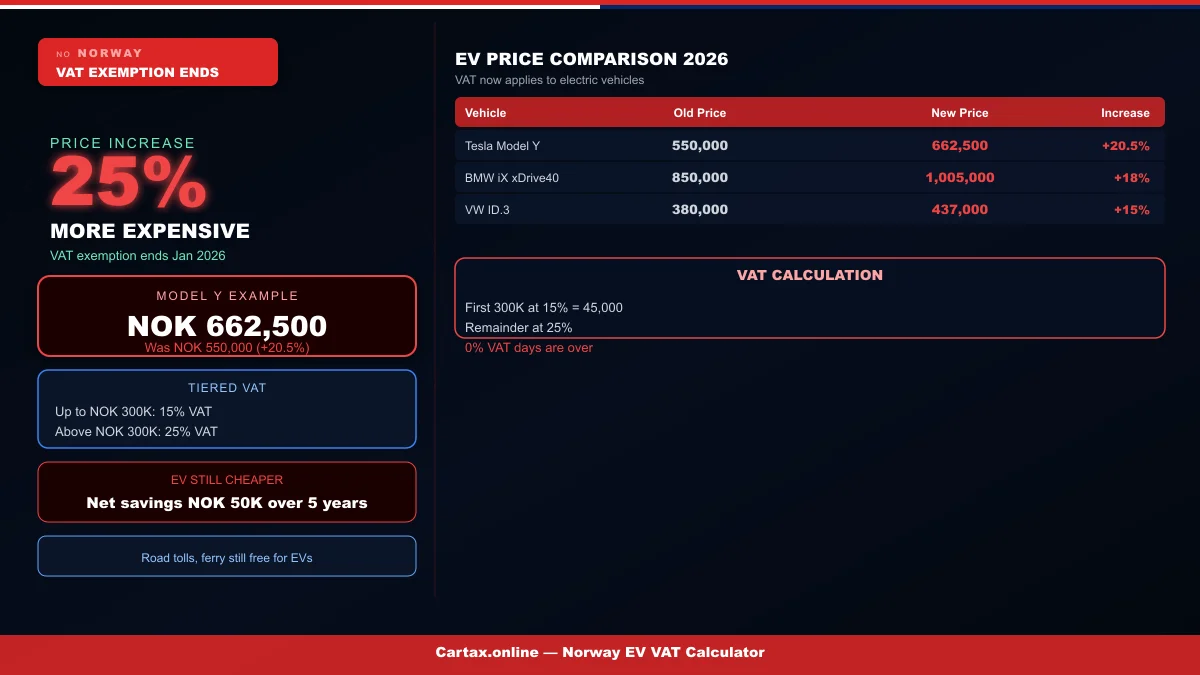
Norway, the world's leading electric vehicle market, has introduced significant changes to its EV taxation policy from January 2026. The era of VAT-free electric vehicle purchases has ended, with a new tiered VAT system replacing the complete exemption. For buyers of premium EVs like Tesla, the impact is substantial — with some models increasing by 20-30% in price.
Understanding Norway's EV VAT Change
The End of VAT Exemption
For over a decade, Norway exempted electric vehicles from the standard 25% Value Added Tax, making EVs dramatically cheaper than equivalent combustion vehicles. This policy transformed Norway into the world's EV leader, with over 80% of new car sales now being electric.
The New Tiered VAT System
From January 2026, Norway applies VAT to EVs with a tiered structure:
- Up to NOK 300,000: 15% VAT
- Above NOK 300,000: 25% VAT
- Registration tax: Weight-based, not emission-based (still favourable for EVs)
Price Impact Examples
Tesla Models
Tesla Model Y Long Range
- Previous price (VAT exempt): NOK 550,000
- New price calculation:
- First NOK 300,000 × 15% = NOK 45,000
- Remaining NOK 250,000 × 25% = NOK 62,500
- New effective price: NOK 662,500
- Price increase: NOK 112,500 (20.5%)
Tesla Model S Plaid
- Previous price (VAT exempt): NOK 1,200,000
- New price calculation:
- First NOK 300,000 × 15% = NOK 45,000
- Remaining NOK 900,000 × 25% = NOK 225,000
- New effective price: NOK 1,470,000
- Price increase: NOK 270,000 (22.5%)
Premium European EVs
| Vehicle | Old Price | New Price | Increase |
|---|---|---|---|
| BMW iX xDrive40 | NOK 850,000 | NOK 1,005,000 | NOK 155,000 (18%) |
| Mercedes EQS 450+ | NOK 1,100,000 | NOK 1,345,000 | NOK 245,000 (22%) |
| Audi e-tron GT | NOK 950,000 | NOK 1,130,000 | NOK 180,000 (19%) |
More Affordable EVs
- VW ID.3: Was NOK 380,000 → Now NOK 437,000 (+15%)
- Nissan Leaf: Was NOK 320,000 → Now NOK 368,000 (+15%)
- Skoda Enyaq: Was NOK 400,000 → Now NOK 460,000 (+15%)
Are EVs Still Good Value in Norway?
Remaining Advantages
Despite the VAT change, EVs retain significant advantages:
- Weight-based registration tax: EVs pay based on weight, not CO2 — significantly lower than equivalent combustion vehicles
- Road toll exemptions: Many Norwegian cities still exempt EVs from road tolls
- Bus lane access: EVs retain access to bus lanes in most areas
- Ferry discounts: Reduced ferry costs still apply to EVs
- Free municipal parking: Many municipalities still offer free parking for EVs
- Lower running costs: Electricity vs fuel savings remain substantial
Total Cost Comparison
Despite the VAT increase, an EV like the Tesla Model Y remains competitive:
- 5-year ownership comparison (vs BMW X3 equivalent):
- Purchase price difference: NOK 80,000 more for Tesla
- Fuel savings (electricity vs petrol): NOK 60,000
- Registration tax savings: NOK 45,000
- Road toll savings: NOK 25,000
- Net 5-year difference: Approximately NOK 50,000 cheaper for EV
The Bottom Line
Norway's EV market has undergone a significant transformation with the introduction of VAT on electric vehicles. The 20-25% price increases for premium EVs like Tesla will inevitably slow adoption at the high end of the market. However, with favourable registration tax treatment, road toll exemptions, and significantly lower running costs, electric vehicles remain the sensible choice for Norwegian car buyers.
The era of dramatically subsidised EVs may be ending, but Norway's electric vehicle revolution appears durable. The market will simply transition from being artificially cheap to being naturally competitive.