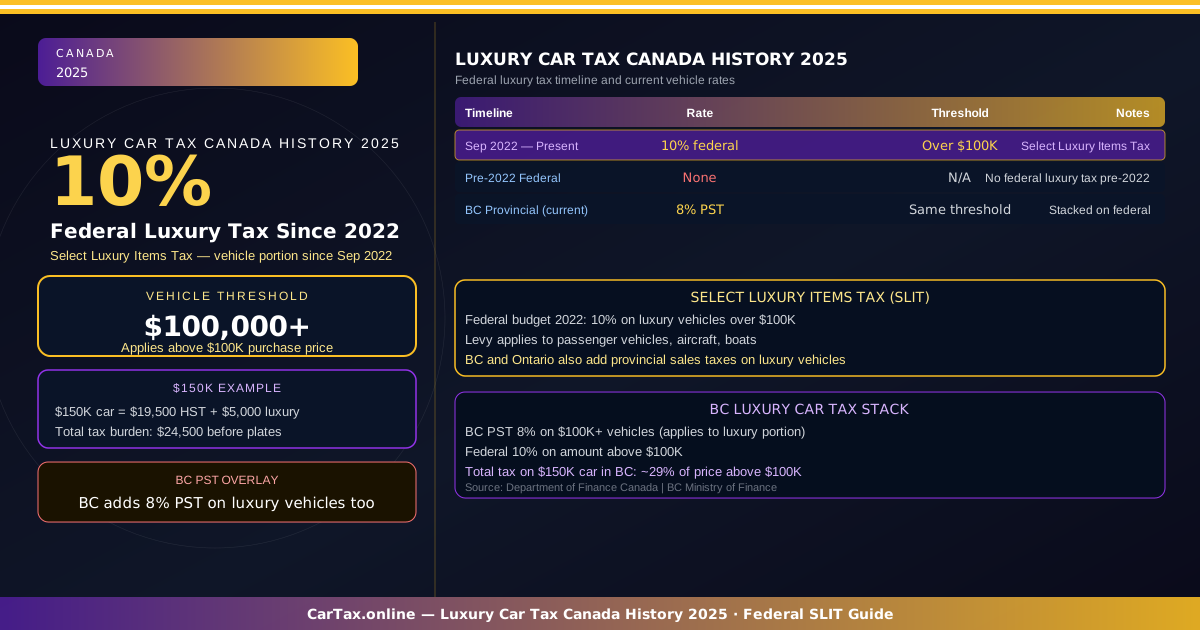
Canadas federal luxury car tax has been in effect since 2022, significantly impacting buyers of high-end vehicles across the country. Understanding when the luxury car tax was introduced and how it has evolved helps contextualize current vehicle purchasing decisions.
When Was the Luxury Car Tax Introduced?
Canadas federal luxury car tax was introduced on September 1, 2022 under the federal government's Budget Implementation Act. The tax was part of a broader effort to address wealth inequality and generate revenue from high-value asset purchases.
The tax applies to passenger vehicles with a retail price exceeding $100,000, encompassing both new and used vehicle purchases.
Luxury Car Tax Details — 2025
Canada Luxury Car Tax — Since September 2022
| Aspect | Details |
|---|---|
| Effective date | September 1, 2022 |
| Threshold | $100,000 (retail price before taxes) |
| Tax rate | 10% of the amount exceeding $100,000 |
| Applies to | New AND used passenger vehicles |
| Exempt vehicles | SUVs, minivans, trucks with GVWR above 3,856 kg |
| Provincial application | Applies uniformly in all provinces and territories |
How the Luxury Car Tax Is Calculated
The luxury car tax is calculated on the retail price before GST/HST/PST. The formula is:
Luxury Tax = (Retail Price - $100,000) x 10%
On top of this, buyers pay their provincial sales tax (GST+PST, HST, or GST+QST depending on province).
Examples of Luxury Car Tax Impact
Luxury Car Tax Examples — Canada 2025
| Vehicle | Price | Luxury Tax | Total Taxes (BC) |
|---|---|---|---|
| BMW 530i Sedan | $95,000 | $0 | $11,400 |
| BMW 740i Sedan | $150,000 | $5,000 | $23,000 |
| BMW X7 SUV (exempt) | $150,000 | $0 | $18,000 |
| Porsche 911 Turbo | $250,000 | $15,000 | $45,000 |
SUV Exemption — The Most Important Loophole
The luxury car tax exempts vehicles with a Gross Vehicle Weight Rating (GVWR) exceeding 3,856 kilograms (approximately 8,500 pounds). Most full-size luxury SUVs exceed this threshold, making them exempt regardless of price.
This creates a significant financial advantage for buyers choosing luxury SUVs over equivalent sedans. A $175,000 Mercedes GLE saves $15,000 in luxury tax compared to a $175,000 Mercedes-AMG GT sedan.
Is There Still a Luxury Tax on Cars?
Yes. As of 2025, the federal luxury car tax remains in effect. It applies to all passenger vehicles purchased above the $100,000 threshold, whether new or used, and regardless of the province of purchase.
There have been no announced changes to the luxury car tax rate or threshold for 2025.
History of Luxury Taxes on Vehicles in Canada
Prior to 2022, Canada did not have a specific federal luxury tax on vehicles. The 2022 introduction marked a significant change in federal taxation of high-value consumer goods. The tax was modelled partially on similar provisions in Australia and the UK, which also impose luxury vehicle taxes.
Disclaimer: This article is for informational purposes only. Luxury car tax rules and rates may change. Verify current information at Canada Revenue Agency or consult a tax professional.