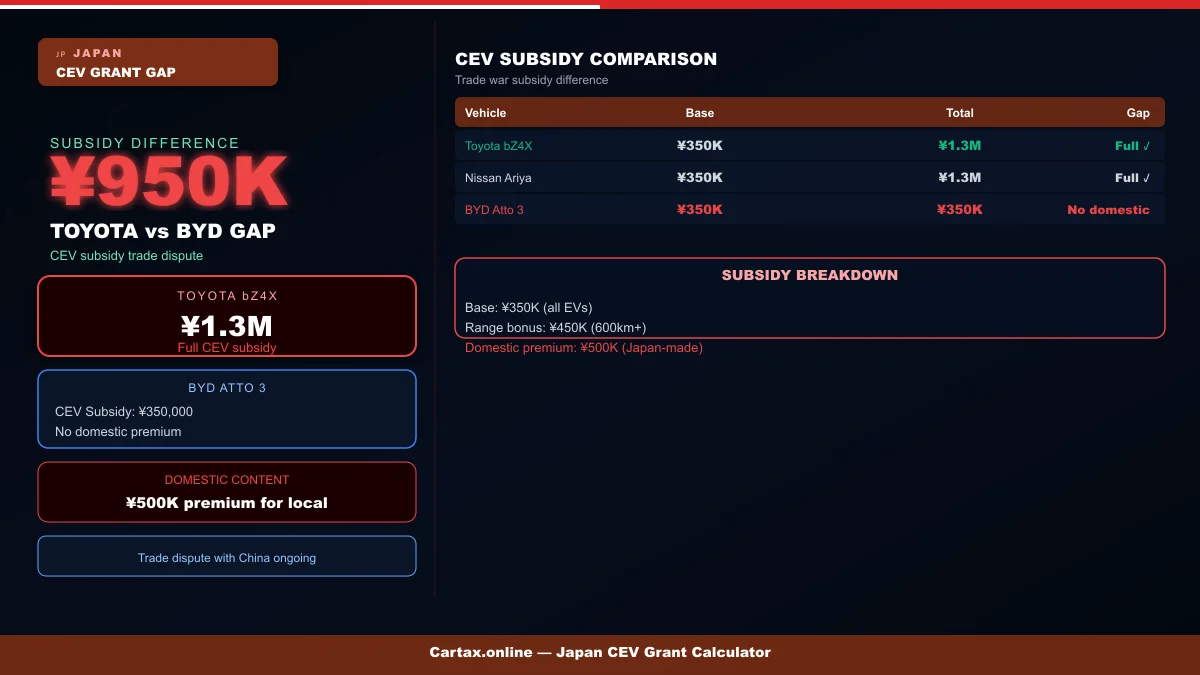
Japan's CEV (Clean Energy Vehicle) subsidy programme has become the centre of a trade dispute with China. While Toyota and other domestic manufacturers' EVs qualify for subsidies up to ¥1.3 million, Chinese brands like BYD receive only ¥350,000 — a difference of ¥950,000. This substantial gap reflects Japan's industrial policy aimed at supporting domestic automakers against increasing competition from Chinese EV manufacturers.
Understanding Japan's CEV Subsidy Programme
How CEV Subsidies Work
Japan's CEV subsidy provides direct purchase incentives for electric vehicles:
- Base subsidy: ¥350,000 for all qualifying EVs
- Extended range bonus: Up to ¥450,000 for vehicles over 600km range
- Domestic content premium: Up to ¥500,000 for domestically manufactured vehicles
- Maximum total: ¥1,300,000 for qualifying domestic vehicles
The Domestic Content Premium
The key differentiator is the domestic content premium:
- Requires significant Japanese manufacturing content
- Applies to battery, motor, and power electronics components
- Only vehicles meeting domestic sourcing thresholds qualify
- Foreign manufacturers typically cannot meet these requirements
Subsidy Comparison: Toyota vs BYD
Specific Vehicle Examples
| Manufacturer | Vehicle | Base | Range Bonus | Domestic | Total |
|---|---|---|---|---|---|
| Toyota | bZ4X | ¥350,000 | ¥450,000 | ¥500,000 | ¥1,300,000 |
| Toyota | bZ3 | ¥350,000 | ¥450,000 | ¥500,000 | ¥1,300,000 |
| Nissan | Ariya | ¥350,000 | ¥450,000 | ¥500,000 | ¥1,300,000 |
| BYD | Atto 3 | ¥350,000 | ¥0 | ¥0 | ¥350,000 |
| BYD | Seal | ¥350,000 | ¥0 | ¥0 | ¥350,000 |
| Gap | — | Same | ¥450k difference | ¥500k difference | ¥950,000 |
Real-World Price Impact
When Subsidies Are Applied
Toyota bZ4X (¥5,400,000 MSRP)
- Less CEV subsidy: ¥1,300,000
- Effective price: ¥4,100,000
- Monthly payment (5-year loan): approximately ¥68,300
BYD Atto 3 (¥4,500,000 MSRP)
- Less CEV subsidy: ¥350,000
- Effective price: ¥4,150,000
- Monthly payment (5-year loan): approximately ¥69,167
The Irony
Despite the ¥950,000 subsidy advantage, Toyota bZ4X and BYD Atto 3 end up at nearly identical effective prices. This demonstrates that the subsidy gap offsets the underlying price difference, rather than creating an unfair advantage for Toyota in the market.
The Trade Dispute Context
Chinese Response
China has criticised Japan's CEV policy as discriminatory:
- Requests for equal subsidy access for Chinese manufacturers
- WTO consultation requests filed
- Counter-measures threatened on Japanese goods
- Statements emphasising fair competition principles
Japan's Position
Japan defends its domestic content requirements:
- Industrial policy to protect employment
- Supply chain security considerations
- Consumer choice argument (subsidies reduce prices)
- Standard trade policy tool
The Bottom Line
Japan's CEV subsidy programme creates a ¥950,000 gap between Toyota and BYD buyers, yet paradoxically results in similar effective prices due to underlying cost differences. The policy has sparked trade tensions with China and raised questions about fair competition in the EV market.
For buyers, the practical impact is minimal — both vehicles end up similarly priced after subsidies. However, the policy has broader implications for market competition and international trade relations that extend well beyond individual purchase decisions.