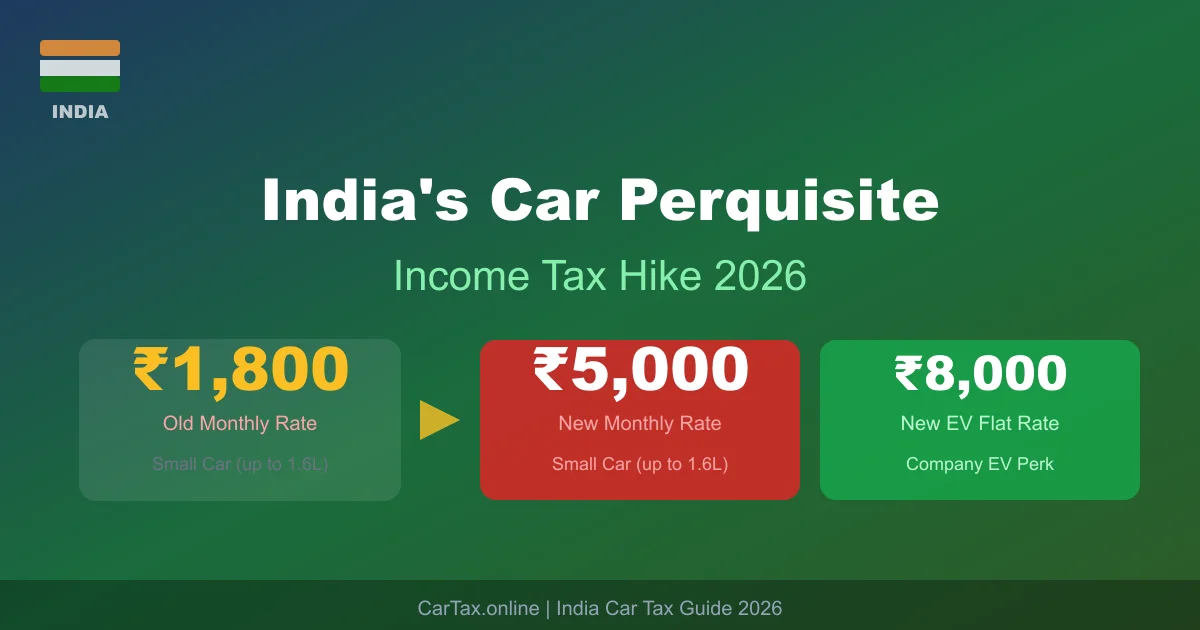
April 28, 2026 in New Delhi, India — In one of the most significant changes to employee benefit taxation in recent years, India's Ministry of Finance has overhauled the taxable value of company-provided car perquisites. Effective from Assessment Year 2026-27 (Financial Year 2025-26), the monthly taxable value for a small car — defined as a vehicle with engine capacity up to 1.6 litres — has jumped from ₹1,800 to ₹5,000 per month. This represents a 178% increase in the taxable perquisite value.
For millions of salaried employees across India who receive company cars as part of their compensation package, this change will directly reduce take-home pay unless employers choose to absorb the additional tax burden.
What Is a Car Perquisite?
A car perquisite (commonly called a "company car" or "company car benefit") is a non-cash benefit provided by an employer to an employee. Under Section 17(2) of the Income Tax Act, 1961, the value of this benefit must be added to the employee's taxable income.
The taxable value is not the cost of the car or the lease rental — it is a standardised figure set by the CBDT (Central Board of Direct Taxes) based on the vehicle's engine capacity and type. This standardised valuation has been revised significantly for 2026.
The Old vs. New Taxable Values: Complete Breakdown
| Vehicle Category | Old Monthly Value | New Monthly Value | Increase | Annual Tax Impact (30% bracket) |
|---|---|---|---|---|
| Small Car (up to 1.6L) | ₹1,800 | ₹5,000 | +₹3,200 (+178%) | ₹11,520 extra/year |
| Large Car (above 1.6L) | ₹2,400 | ₹7,000 | +₹4,600 (+192%) | ₹16,560 extra/year |
| Electric Vehicle | ₹1,800 | ₹8,000 (flat) | +₹6,200 (+344%) | ₹22,320 extra/year |
Note: Annual tax impact calculated at 30% income tax bracket. Actual impact varies by individual's applicable tax slab.
Why Did the Government Raise These Rates?
The CBDT last revised car perquisite values in 2017. Since then, new car prices have increased substantially — with average prices rising over 45% across segments due to BS7 emission norm implementation, safety feature mandates, and general inflation. The existing ₹1,800 monthly valuation for small cars had become significantly misaligned with current market realities.
The Finance Ministry's rationale includes:
- Alignment with current vehicle prices: The standardised perquisite value no longer reflected the market value of the benefit being provided.
- Revenue generation: The revision is expected to add approximately ₹3,200 crore annually to the income tax kitty from the approximately 2.8 million salaried employees who receive car perquisites.
- Promoting EVs: The flat ₹8,000 rate for EVs is designed to signal that EVs are premium benefits — while also discouraging employers from providing high-end EVs as salary sacrifice items.
How This Affects Your Take-Home Pay
Let us walk through several real-world examples to illustrate the impact of the new car perquisite rules.
Example 1: Mid-Level Manager (20% Tax Bracket)
A mid-level manager in Bengaluru receives a company-provided Maruti Swift Dzire (1.2L, small car). Under the old rules:
- Monthly taxable perquisite: ₹1,800
- Annual additional tax: ₹1,800 × 12 × 20% = ₹4,320
Under the new rules:
- Monthly taxable perquisite: ₹5,000
- Annual additional tax: ₹5,000 × 12 × 20% = ₹12,000
- Net increase in annual tax: ₹7,680
Example 2: Senior Director (30% Tax Bracket)
A senior director in Mumbai receives a company Toyota Camry (2.5L, large car). Under the old rules:
- Monthly taxable perquisite: ₹2,400
- Annual additional tax: ₹2,400 × 12 × 30% = ₹8,640
Under the new rules:
- Monthly taxable perquisite: ₹7,000
- Annual additional tax: ₹7,000 × 12 × 30% = ₹25,200
- Net increase in annual tax: ₹16,560
Example 3: Tech Employee with EV Perk (30% Tax Bracket)
A tech company provides a Tata Nexon EV Max to an employee. Under the new flat rate:
- Monthly taxable perquisite: ₹8,000
- Annual additional tax: ₹8,000 × 12 × 30% = ₹28,800
- Note: Even though the EV costs less than a comparable petrol car, the flat rate of ₹8,000 means a higher taxable value than the ₹7,000 for a large petrol car.
What About the Driver's Salary?
If your employer provides a driver for your company car, the driver's salary is also treated as a taxable perquisite in your hands — regardless of whether you use the driver for personal or official travel. The taxable value of the driver is calculated based on the actual salary paid to the driver, reduced by any contribution you make.
For 2026, if the employer's total expenditure on the driver (salary + provident fund + bonus) is, say, ₹3,00,000 per year, this entire amount is added to your taxable income. At a 30% bracket, this could mean an additional ₹90,000 in annual taxes.
How Employers Are Responding
Indian companies are adopting several strategies in response to the perquisite hike:
Salary Restructuring
Many employers are adjusting the cash component of salaries to compensate for the increased tax burden. This is particularly common in IT, financial services, and consulting firms where car perquisites are standard for mid-to-senior roles.
Fuel Card vs. Company Car
Some employers are switching from providing a company car to offering a fuel card or travel allowance. While fuel cards are also taxable, they offer employees more flexibility in how the benefit is used.
Electric Vehicle Leasing
A growing number of employers are offering EV leasing programmes where the employee leases the vehicle through a salary sacrifice scheme. The tax treatment of EV leasing varies and should be reviewed with a tax advisor.
Transportation Allowance
Several companies have replaced company cars with a fixed monthly transportation allowance. This is added to the salary but may be partially exempt under Section 10(14) of the Income Tax Act for certain categories of employees.
Claiming Deductions on Car-Related Expenses
If you use your personal car for official purposes (and your employer reimburses you), the reimbursement may be treated as a taxable allowance. Keep detailed records of:
- Kilometres driven for official purposes
- Fuel receipts
- Maintenance invoices
- Parking and toll charges
Standard mileage rates set by the IT department for reimbursement purposes are updated annually and can help you calculate the taxable component of any reimbursement.
The Bottom Line: Planning Your Tax in 2026
The car perquisite revision is one of several changes in the FY 2025-26 tax amendments. Salaried employees with company cars should:
- Update tax projections: Factor the new perquisite values into your quarterly tax estimates and adjust your tax-saving investments accordingly.
- Review your lease agreement: If your employer provides a leased vehicle, check whether the lease terms are being renegotiated.
- Explore salary restructuring: Discuss with your HR team whether a cash allowance in lieu of a company car makes financial sense given the new tax rates.
- Consider total cost of ownership: If you are buying a car personally to replace a company car, compare the after-tax cost of each option using our India Car Tax Calculator.
Frequently Asked Questions
Does the new rule apply retroactively?
No. The new perquisite values apply from Assessment Year 2026-27, corresponding to Financial Year 2025-26. The changes will appear in your Form 16 and tax filings from April 2026 onwards.
Is there any exemption for physically disabled employees?
Yes. Employees who are orthopaedically handicapped, blind, or mentally challenged are exempt from the perquisite valuation rules for vehicles provided for their medical needs. The employer must obtain a medical certificate from a recognised specialist.
What if my employer provides a car for less than a month?
The perquisite value is calculated on a monthly basis. If the car is provided for part of a month, the taxable value is prorated accordingly.
Can I negotiate my company car with my employer?
Yes. Many employers allow employees to choose between different vehicle options. Choosing a smaller, more fuel-efficient car can reduce the employer's cost (which may translate to a better overall compensation package) while also minimising the taxable perquisite value.
Conclusion
India's car perquisite revision is a significant change that will affect millions of salaried employees. The jump from ₹1,800 to ₹5,000 per month for small cars means an additional tax burden of ₹960–₹1,440 per month depending on your tax bracket. For high earners in the 30% bracket with large cars, the annual tax increase could exceed ₹16,500.
The key is to proactively review your compensation structure, discuss options with your employer, and factor the new perquisite values into your annual tax planning. Use our India Car Tax Calculator to compare car ownership costs, and stay updated with the latest India tax changes on our Blog.
Disclaimer: Tax rates and perquisite values are based on the Finance Act 2025 provisions. Always consult a qualified chartered accountant or tax advisor for advice specific to your situation. Confirm current rates with the official CBDT circulars before filing returns.
Official Resources: Income Tax Department India | CBDT | GST Portal