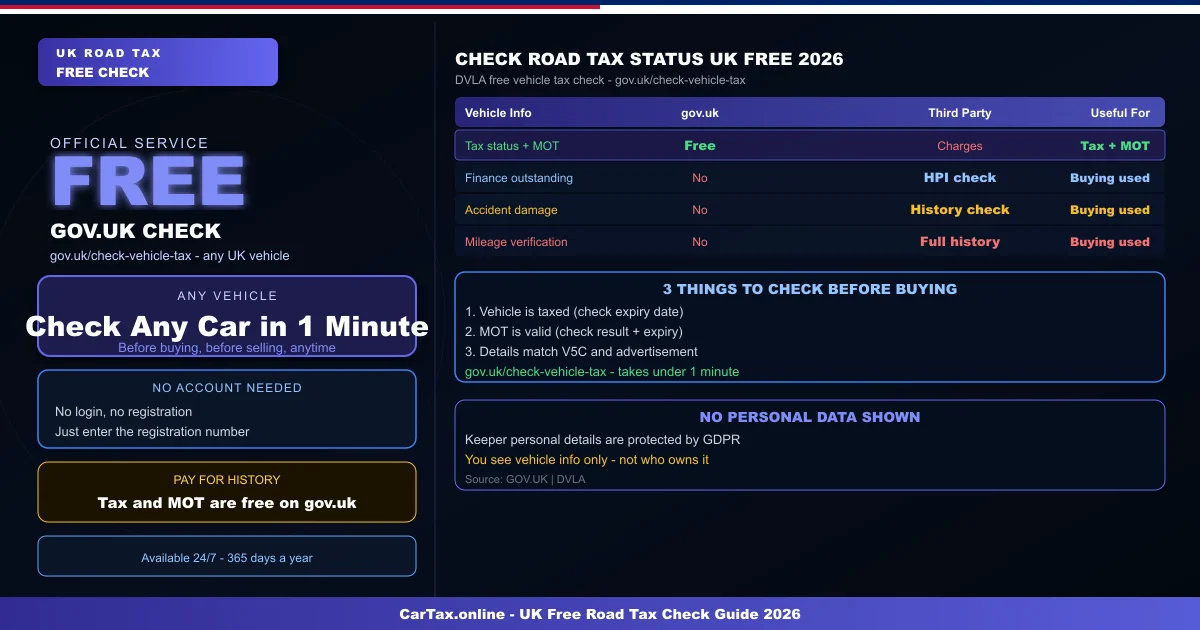
On 22 April 2026, across the UK, car buyers are checking vehicles before purchase, sellers are verifying their own status before listing, and drivers are confirming their renewal dates. The gov.uk/check-vehicle-tax service handles thousands of enquiries every day. This guide explains exactly how to use it, what it shows, and how to interpret the results.
The Official Free Check: gov.uk/check-vehicle-tax
The only official and free way to check a vehicle's road tax status in the UK is via the government service at gov.uk/check-vehicle-tax. This is operated directly by DVLA and provides the authoritative record of a vehicle's tax status. No registration, no login, no fee — just enter a registration number and get the answer.
The service is available 24 hours a day, 7 days a week. It works on mobile phones, tablets, and desktop computers. You can check any UK-registered vehicle — your own, a vehicle you are considering buying, or a vehicle a seller claims has road tax remaining.
How To Run the Check
Navigate to gov.uk/check-vehicle-tax and follow these steps:
- Enter the vehicle's registration number — exactly as it appears on the number plate, with no spaces
- The service will display the vehicle's details and confirm the current tax status
- You will see the tax expiry date if the vehicle is currently taxed
- The MOT result and MOT expiry date are also shown
That is all there is to it. The check takes less than a minute and provides the complete picture of a vehicle's legal status on the road.
What the Results Tell You
Taxed: The vehicle has valid road tax. You will see the expiry date. If you are buying, check whether the expiry is soon — a car with tax expiring in 2 weeks is effectively untaxed for practical purposes.
Untaxed: No valid road tax is in place. The vehicle cannot legally be on a public road. If you are buying, factor in the cost of immediate taxation into your offer price.
MOT: The MOT result shows whether the vehicle passed or failed its most recent test, and the next MOT due date. A vehicle without a valid MOT cannot be legally driven on public roads.
The combined picture of tax and MOT tells you whether the vehicle is genuinely road-ready. A taxed car with a failed or expired MOT is not legal to drive.
Why Third-Party Checks Charge — and Why You Should Not Use Them
Numerous commercial websites offer "comprehensive vehicle history checks" that include road tax status alongside other data. These services charge anything from £5 to £30 per check. They are not providing any information that is not available for free from gov.uk — they are scraping the same DVLA data and wrapping it in additional reports.
The additional information these services provide — such as previous ownership history, accident damage records, and mileage verification — can be genuinely useful and worth paying for. But the road tax and MOT status is freely available on gov.uk and should never be paid for separately.
Checking Before You Buy a Used Car
Before completing any used car purchase — whether from a dealer or a private seller — run the DVLA check yourself. Do not rely on the seller's word about the vehicle's tax and MOT status.
What to verify:
- Confirm the registration number matches the V5C logbook
- Check the vehicle is taxed and confirm the expiry date
- Confirm the MOT is valid and check any advisories from the most recent test
- Note the vehicle details — make, model, colour, fuel type — to confirm they match what the seller has advertised
Any discrepancy between the DVLA record and the seller's description is a red flag that requires investigation before proceeding.
What the Check Does Not Show
The DVLA road tax check is comprehensive for tax and MOT status but does not show everything relevant to a vehicle purchase. Specifically, it does not include:
- Outstanding finance on the vehicle — HPI check or similar required
- Previous accident damage — full history check required
- True mileage — requires checking MOT history records over time
- Insurance write-off status — requires a separate check
For a comprehensive vehicle history, a paid service from HPI, the AA, or RAC provides the additional data needed for a confident purchase. But for tax and MOT, gov.uk is definitive.
Summary
Use gov.uk/check-vehicle-tax — it is free, instant, and available for any UK vehicle. Check before buying, check before selling, and check your own vehicle regularly to avoid accidental lapse. Never pay for the basic DVLA information that is freely available.