Focus keyword: Ghana car tax calculator
Ghana Car Tax Calculator 2026
Last Updated: April 15, 2026
Calculate your estimated car tax and total on-road price in Ghana. This page includes location-specific rates, detailed tax breakdown, and practical tips for smarter budgeting.
Instant Car Tax Calculator
Results update automatically as you type
Enter a price to see your tax breakdown
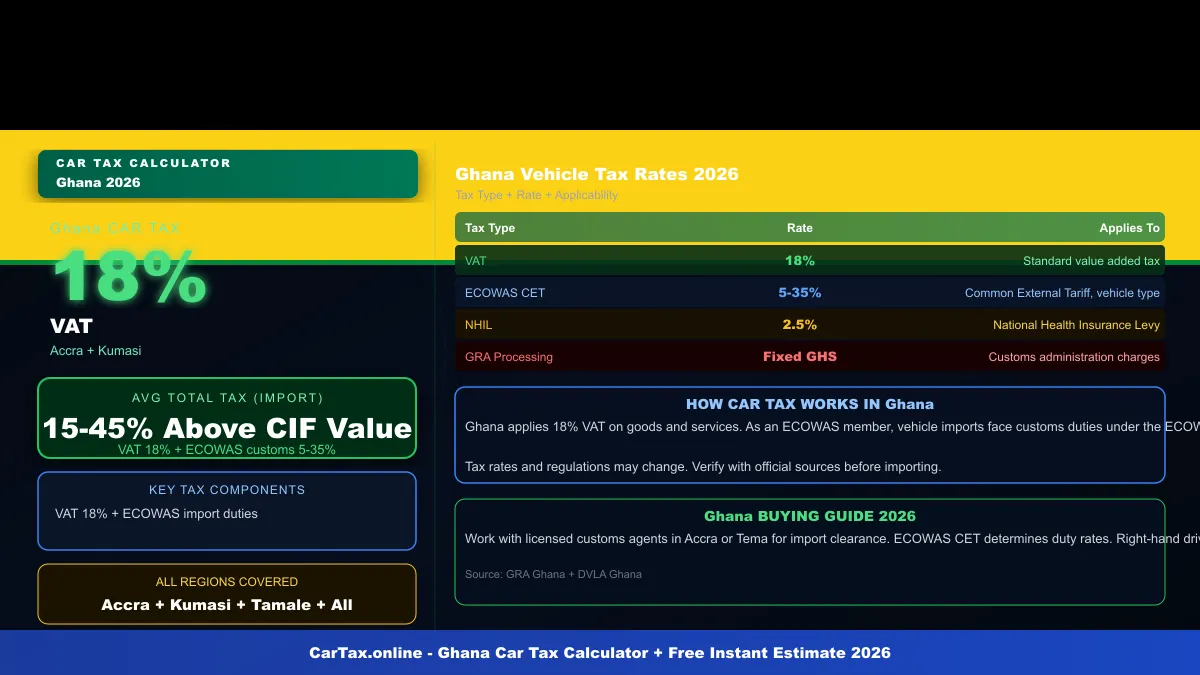
Ghana operates one of the largest vehicle markets in West Africa, with Accra and Kumasi serving as the primary hubs for vehicle imports and registrations. The Ghanaian tax system applies 18% VAT on goods and services along with ECOWAS Common External Tariff duties ranging 5-35% depending on vehicle type. The NHIL of 2.5% also applies to vehicle imports. Whether you are buying in Accra, Kumasi, or Tamale, understanding these layered taxes is essential for accurate budgeting.
This Ghana car tax calculator provides accurate estimates for buyers across all regions. Whether you are importing through the port of Tema, purchasing from a local dealer in Accra, or buying a vehicle for regional use, the calculator covers VAT, ECOWAS customs duties, NHIL, and processing fees to give you a complete on-road price estimate.
How Car Tax Works in Ghana
Understanding VAT, ECOWAS tariffs and NHIL
Ghana applies 18% VAT on goods and services including vehicles, collected by the Ghana Revenue Authority (GRA). For imported vehicles, customs duties are calculated under the ECOWAS Common External Tariff at rates ranging from 5% to 35% depending on vehicle type and classification.
Vehicle imports into Ghana typically arrive through the port of Tema near Accra. Importers must work with licensed customs agents who handle the complex declaration process through the GRA system.
Ghana Vehicle Tax Rates and Brackets
Current VAT, ECOWAS and NHIL for 2026
The standard VAT rate of 18% applies to all vehicle purchases including those imported through customs. For imported vehicles, ECOWAS CET customs duties are applied on the CIF value at rates ranging from 5% for some commercial categories to 35% for luxury vehicles and large-engine SUVs.
Registration of vehicles in Ghana is handled at the DVLA offices in Accra and regional centres. Annual vehicle tax is based on vehicle type and engine capacity, with rates set by the DVLA.
Import Vehicle Costs and Customs Calculations
What to expect when bringing a vehicle into Ghana
Most vehicles imported into Ghana arrive through the port of Tema, with shipping routes from the United Kingdom being particularly common due to established trade relationships and compatible driving configuration. Japanese vehicles imported through UK suppliers are also very popular.
Right-hand drive vehicles from the UK are the most common imports due to Ghana's left-hand traffic and Commonwealth heritage. Used Japanese imports from UK dealers are particularly popular for their reliability and value.
Budgeting for Your Ghana Vehicle Purchase
Planning your total on-road cost
A practical approach to budgeting for a vehicle purchase in Ghana is to estimate the total tax burden at 15-45% above the CIF value for an imported vehicle, covering ECOWAS customs duties, VAT, NHIL, and processing fees. For locally purchased vehicles from dealers, the VAT is typically included in the quoted price.
When comparing vehicle prices between Accra and Kumasi dealers, factor in that the capital region may have more competitive pricing due to higher dealer concentration and import volume. Pre-owned vehicle imports from the UK have become increasingly popular, offering good value despite the import tax burden.
Compliance Checklist for Vehicle Registration
Documents and steps for legal vehicle ownership
To register a vehicle in Ghana, you will need the customs clearance certificate with duty payment receipt, Bill of Lading, commercial invoice, your national identification (Ghana Card) or company documents, vehicle specification certificate, and proof of Ghanaian address. Registration is completed at the DVLA office in Accra or regional centres, with the process typically taking one to two weeks to complete.
Vehicle insurance is mandatory in Ghana and must be purchased from licensed Ghanaian insurers before registration can be completed. Third-party liability insurance is the minimum legal requirement, with comprehensive cover available.
Why This Ghana Car Tax Calculator Is Essential
Get accurate on-road price estimates before you buy
With Ghana's vehicle market operating within the ECOWAS trade framework, tax calculations are consistent and predictable across import sources. This calculator breaks down each tax component separately, so you can see exactly how much ECOWAS customs duty, VAT, and NHIL contribute to the total on-road price.
The tool is regularly updated to reflect any changes in VAT rates, ECOWAS customs duty schedules, NHIL rates, or registration fee structures. For the most accurate estimate, enter the vehicle's pre-tax price in Ghana Cedis or US Dollars and select the appropriate vehicle category.
Ghana Car Tax FAQs
What is the current VAT rate on vehicles in Ghana?
The standard VAT rate in Ghana is 18%, which applies to all vehicle purchases including imported vehicles. This is collected by the Ghana Revenue Authority and is typically included in the on-road price quoted by dealers for locally purchased vehicles.
How are ECOWAS customs duties calculated on imported vehicles?
ECOWAS CET customs duties are calculated on the CIF value at rates ranging from 5% to 35% depending on vehicle type and classification. The NHIL of 2.5% is also applied to the customs value. Your customs agent will calculate the exact amount based on current tariff schedules.
Can I use this calculator for vehicles in all Ghanaian regions?
Yes. While registration is handled at the DVLA in Accra and regional offices, the VAT rate, ECOWAS CET duty rates, and NHIL are set nationally. This means the calculator applies to all Ghanaian regions including Greater Accra (Accra), Ashanti (Kumasi), and Northern (Tamale).
Do electric vehicles get tax benefits in Ghana?
Electric vehicles are extremely rare in Ghana due to limited charging infrastructure. There are currently no specific preferential tax treatments for electric vehicles in Ghana, though this may evolve as the country develops its electricity infrastructure and considers environmental policies.
Is vehicle insurance mandatory for registration?
Yes. Third-party liability vehicle insurance is mandatory and must be purchased from licensed Ghanaian insurers before vehicle registration can be completed. Comprehensive cover is optional but recommended, especially given the road conditions and traffic patterns in major cities.
How often must road tax be renewed in Ghana?
Annual road tax in Ghana is based on vehicle type and engine capacity, with rates set by the DVLA. The tax is payable annually and must be renewed during the vehicle registration renewal process. Proof of tax payment and valid insurance are required during any traffic stop or inspection.
Related Car Tax Calculators
More Car Tax Calculators
⚠ Financial & Legal Disclaimer
All information provided in this article is for educational and informational purposes only. The content is synthesized based on verbal communications, extensive internet research, and official government website data as of the date of publishing. Tax laws and insurance policies are subject to frequent changes by the authorities. We strive for accuracy, but we recommend that you consult a qualified professional (CA, CPA, or Tax Consultant) before making any financial decisions. For personalized assistance, you can also connect with our in-house experts through our Contact Us page.