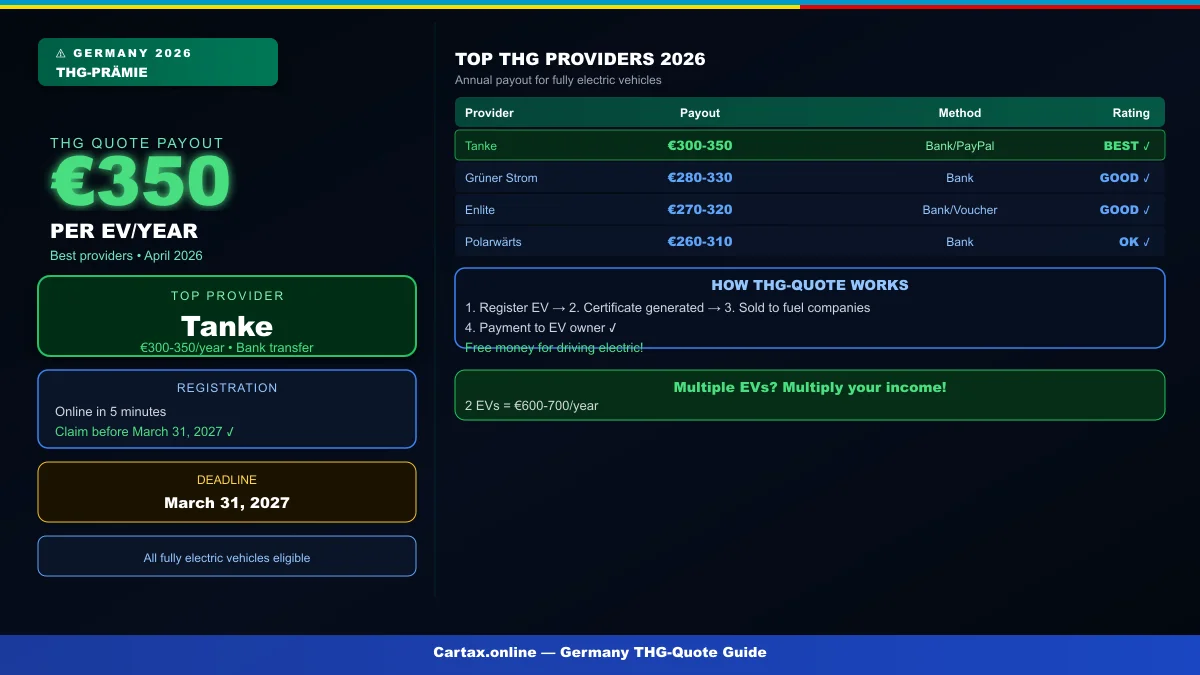
Germany's Treibhausgasquote (THG-Quote) — the climate quota system that turned electric vehicle ownership into a source of passive income — has evolved significantly in 2026. What started as generous payouts of €400-500 per year has matured into a more competitive market where the best providers offer €300-350 annually. For German EV owners, understanding how to maximise THG income remains an important part of electric vehicle ownership economics.
Understanding THG-Quote: How It Works
The THG-Quote is Germany's mechanism for decarbonising the transport sector. Fuel companies — petrol and diesel producers — must ensure that a growing percentage of their fuels come from renewable or low-emission sources. They can meet this requirement by buying THG certificates from electric vehicle owners, who effectively certify that their EV driving avoided CO2 emissions.
The Basic Mechanism
- EV owners register their vehicle with a THG provider
- The provider verifies ownership and generates THG certificates
- Certificates are sold to fuel companies needing to meet quotas
- Revenue is passed back to EV owners as the THG-Prämie
- The process repeats annually for each eligible EV
This system creates a direct financial benefit for driving electric, funded by the fossil fuel industry. It's been described as a carbon offset scheme in reverse — where clean drivers get paid rather than paying.
THG-Quote 2026: Market Update
Why Payouts Have Decreased
The THG-Quotepreise (quota prices) have fallen from their 2022-2023 peak due to market maturation:
- Market saturation: More EVs means more THG certificates, increasing supply and reducing prices
- Quotapflichtige compliance: Many fuel companies have secured multi-year contracts, reducing demand
- Regulatory changes: Annual quota requirements have stabilised, affecting certificate value
- Provider margins: Competition has squeezed provider margins, reducing owner payouts
Current Market Rates
| Provider | Annual Payout | Payment Method | Registration |
|---|---|---|---|
| Tanke | €300-€350 | Bank transfer / PayPal | Online, 5 minutes |
| Grüner Strom | €280-€330 | Bank transfer | Online, quick verification |
| Enlite | €270-€320 | Bank transfer / Voucher | App-based registration |
| Polarwärts | €260-€310 | Bank transfer | Online registration |
| EMOVEG | €250-€300 | Multiple options | App and web |
Payouts vary based on current quota prices, provider operating costs, and promotional offers. New customers often receive introductory bonuses that boost first-year payouts.
How to Maximise Your THG Income
1. Register Immediately After EV Purchase
Each calendar year is a separate THG claim. If you buy a new EV mid-year, you should register for THG-Quote immediately. The certificate value is calculated for the full year, so even registering in December still earns a full annual payout.
2. Compare Providers Annually
THG market conditions change throughout the year. Before each calendar year ends, compare providers to ensure you're with the best payer. Switching is typically free and takes only minutes online.
3. Look for New Customer Bonuses
Providers regularly offer sign-up bonuses of €20-50 for new customers. These promotions change throughout the year, so timing your switch to coincide with a bonus can significantly boost your annual income.
4. Register All Eligible EVs
Each registered EV generates a separate THG certificate. If you have multiple EVs in your household, register each one separately. Company EVs can also be registered if your employer doesn't already claim the THG benefit.
The THG-Quote Timeline
Key Dates for 2026
- January 1, 2026: New THG certificate year begins
- Throughout 2026: EV owners can register for 2026 THG certificates
- December 31, 2026: Deadline to switch providers for 2026 certificates
- March 31, 2027: Deadline to claim 2026 THG certificates
Eligibility Requirements
Who Can Claim THG-Quote?
To claim THG-Quote in Germany, you must:
- Own or lease a fully electric vehicle registered in Germany
- Have a valid vehicle registration (Zulassungsbescheinigung)
- Be the registered keeper of the vehicle
- Not have transferred the THG claim to another party (such as your employer)
Which Vehicles Qualify?
- Fully electric vehicles (BEV): Yes — all major providers accept BEVs
- Plug-in hybrids (PHEV): Generally no — must be fully electric
- Electric scooters and motorcycles: Yes — many providers accept these
- Company EVs: Yes — if employer hasn't claimed the benefit
Company Cars and THG-Quote
Company car drivers face a particular challenge: if your employer provides the company EV, they may be entitled to claim the THG-Quote benefit. Check with your employer before registering separately — claiming THG when your employer is also claiming could result in duplicate claims being rejected.
If your employer doesn't claim THG-Quote, you may be entitled to claim it yourself, particularly for any private usage portion of your company car.
The Future of THG-Quote
2027 and Beyond
The THG-Quote system is scheduled to continue through 2030 at minimum. However, the trajectory suggests that:
- Annual payouts will continue to decline as the market matures
- The system may eventually be replaced by direct EV subsidies
- New vehicle types may become eligible as regulations evolve
- Additional climate bonuses may supplement THG income
For current EV owners, the key is to claim THG-Quote every year without fail. Even at €300 per year for a single EV, over five years that's €1,500 — a meaningful contribution to your EV ownership costs.
The Bottom Line
THG-Quote remains a valuable benefit for German electric vehicle owners, even if the payouts have moderated from their peak. The best providers are currently offering €300-350 per EV annually, and with minimal effort required to register and claim, the return on investment is excellent.
The most important actions are: register immediately after purchasing an EV, compare providers annually to ensure you're getting the best rate, look for new customer bonuses, and ensure you claim before each year's March 31 deadline. With these steps, you can maximise the financial benefit of your electric vehicle ownership in Germany.