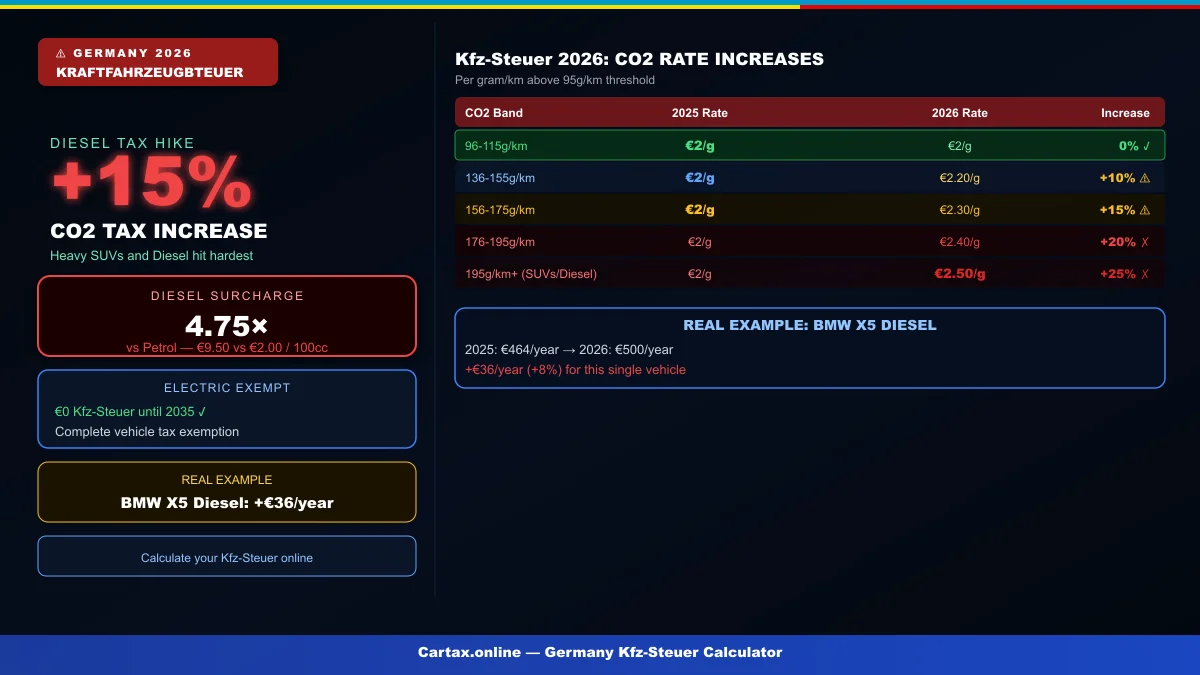
Germany's Kraftfahrzeugsteuer (Kfz-Steuer) has undergone significant changes in 2026, and for diesel vehicle owners and drivers of heavy SUVs, the impact on your annual vehicle costs is substantial. The government has adjusted the CO2-based taxation component, leading to increases of up to 15% for high-emission vehicles. If you drive a diesel in Germany, understanding these changes is essential for accurate budgeting.
Understanding Germany's Kfz-Steuer System in 2026
Germany's vehicle tax combines two components: engine displacement tax and CO2 emissions tax. The displacement component has been in place for decades, while the CO2 element was introduced as part of Germany's climate policy in 2021. For 2026, both components have seen adjustments that particularly affect diesel vehicles.
The Engine Displacement Component
The base Kfz-Steuer rate depends on your vehicle's engine size:
- Petrol engines: €2.00 per 100cc of cylinder capacity
- Diesel engines: €9.50 per 100cc of cylinder capacity (diesel surcharge)
This means a 2,000cc petrol engine pays €40 annually in displacement tax, while the same capacity diesel pays €190 — nearly five times more. This diesel surcharge has always existed but becomes more significant as engine sizes increase.
The CO2 Emissions Component
In addition to displacement tax, vehicles pay based on their CO2 emissions:
- Threshold: €2 per gram CO2 per km above 95g/km
- Example: A vehicle emitting 150g/km pays tax on (150-95) = 55g/km × €2 = €110/year in CO2 tax
The 2026 Increase: What's Changed
CO2 Band Adjustments
The 2026 changes primarily affect the CO2 taxation structure. The government has tightened the thresholds and increased rates for higher-emitting vehicles to encourage the transition to cleaner transportation.
| CO2 Emissions | 2025 Rate | 2026 Rate | Increase |
|---|---|---|---|
| 96-115g/km | €2/g | €2/g | No change |
| 116-135g/km | €2/g | €2/g | No change |
| 136-155g/km | €2/g | €2.20/g | +10% |
| 156-175g/km | €2/g | €2.30/g | +15% |
| 176-195g/km | €2/g | €2.40/g | +20% |
| Above 195g/km | €2/g | €2.50/g | +25% |
Real Examples: How Much More Will You Pay?
Example 1: BMW X5 xDrive30d (Diesel SUV)
- Engine: 2,993cc diesel
- CO2: 185g/km
- 2025 Kfz-Steuer:
- Displacement: 29.93 × €9.50 = €284
- CO2: (185-95) × €2.00 = €180
- Total 2025: €464/year
- 2026 Kfz-Steuer:
- Displacement: 29.93 × €9.50 = €284
- CO2: (185-95) × €2.40 = €216
- Total 2026: €500/year
- Increase: €36/year (+8%)
Example 2: Mercedes GLE 350d
- Engine: 2,925cc diesel
- CO2: 192g/km
- 2025 Kfz-Steuer: €440/year
- 2026 Kfz-Steuer: €520/year
- Increase: €80/year (+18%)
Example 3: Porsche Cayenne Diesel
- Engine: 2,967cc diesel
- CO2: 209g/km
- 2025 Kfz-Steuer: €524/year
- 2026 Kfz-Steuer: €658/year
- Increase: €134/year (+26%)
Why Diesel Vehicles Are Hit Hardest
Diesel vehicles face a double disadvantage in Germany's tax system:
The Diesel Surcharge
Diesel engines pay €9.50 per 100cc compared to €2.00 for petrol — a 4.75× multiplier. This surcharge was introduced because diesel fuel contains more carbon than petrol, resulting in higher CO2 emissions per kilometre for equivalent engine sizes.
Higher CO2 Emissions
Diesel vehicles typically emit 15-20% more CO2 than equivalent petrol models due to the energy density of diesel fuel and the weight of diesel engine components. This places them in higher CO2 tax bands, compounding the displacement surcharge.
2026 CO2 Increases
With the 2026 CO2 rate increases hitting hardest in the higher bands where most diesel vehicles fall, the cumulative effect is significant for diesel owners.
Electric Vehicles: Complete Exemption Continues
Fully electric vehicles remain completely exempt from Kfz-Steuer until at least December 2035. This means:
- €0 annual vehicle tax: Regardless of battery size
- No CO2 component: Zero-emission vehicles have no taxable emissions
- No displacement component: Electric motors don't use cylinder displacement
The government has made this exemption deliberately generous to accelerate the transition to electric mobility. For owners of high-emission diesel vehicles, switching to electric could save €500-700 annually in vehicle tax alone.
How to Calculate Your Kfz-Steuer
Quick Formula
For Petrol Vehicles:
Kfz-Steuer = (CC ÷ 100) × €2.00 + max(0, (CO2-95) × €2.XX)
For Diesel Vehicles:
Kfz-Steuer = (CC ÷ 100) × €9.50 + max(0, (CO2-95) × €2.XX)
Where to Find Your Vehicle's Data
- Vehicle registration document (Zulassungsbescheinigung Teil I): Fields for engine displacement and CO2
- Manufacturer's CO2 figure: WLTP combined cycle figure is used for taxation
- Online calculators: Use the Cartax.online Germany car tax calculator for instant results
Tips for Reducing Your Kfz-Steuer
Switch to Electric
The most effective way to eliminate Kfz-Steuer is to switch to a fully electric vehicle. With complete exemption until 2035 and lower running costs overall, the financial case for electric vehicles strengthens with each annual tax increase on combustion vehicles.
Choose Lower Displacement
When purchasing a new vehicle, consider smaller engine variants. A 1,500cc petrol engine pays €30 annually in displacement tax compared to €95 for a 2,500cc petrol engine.
Consider Petrol Alternatives
If switching to electric isn't immediately feasible, choosing a petrol variant over an equivalent diesel saves significantly. The same model with a petrol engine typically costs €150-200 less annually in Kfz-Steuer.
The Bottom Line
The 2026 Kfz-Steuer increases in Germany disproportionately affect diesel vehicle owners and drivers of heavy SUVs. With increases of 10-25% in CO2 tax rates for higher-emitting vehicles, annual vehicle tax bills have risen substantially.
For diesel owners, the message is clear: the financial burden of combustion vehicles continues to increase. Between rising fuel prices, higher insurance premiums, and now increased vehicle tax, the total cost of diesel ownership in Germany is approaching levels that make electric alternatives increasingly attractive.
If you're considering a vehicle purchase in Germany in 2026, factor in the Kfz-Steuer implications. A petrol hybrid or full electric vehicle could save you hundreds of euros annually in vehicle tax alone, on top of fuel savings and the environmental benefits of cleaner transportation.