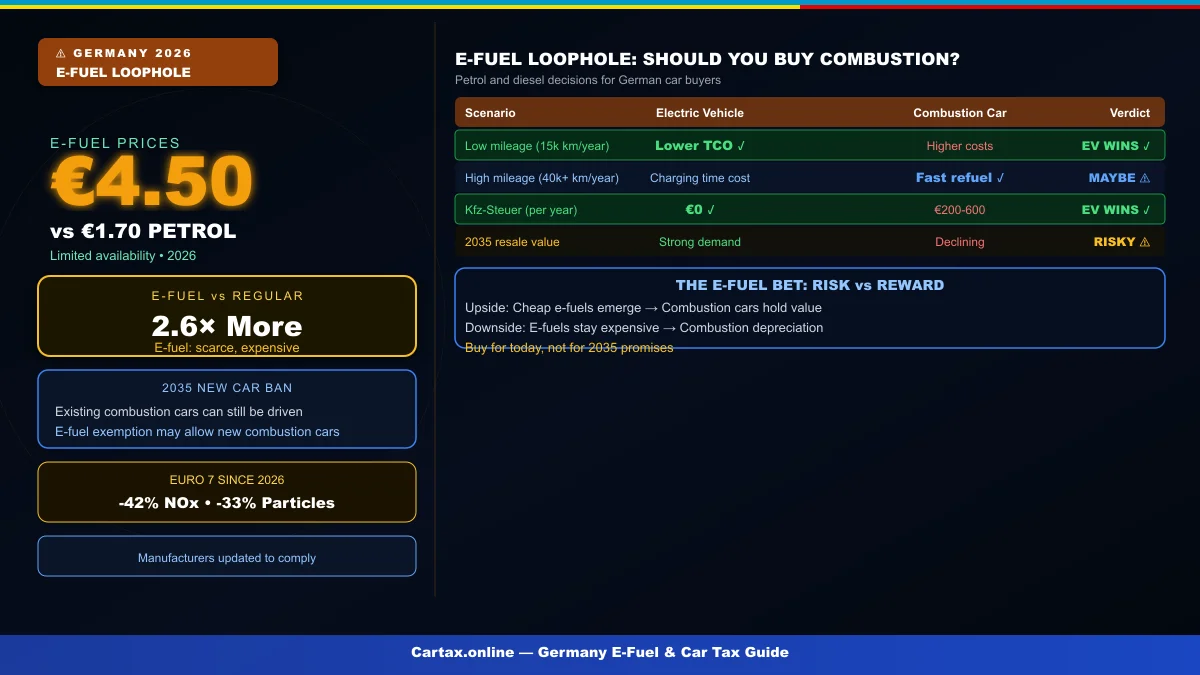
Germany has positioned itself as Europe's strongest advocate for e-fuels (synthetic fuels), creating a potential loophole for combustion engine vehicles that could operate well beyond traditional phase-out timelines. As 2026 unfolds, German car buyers face a complex decision: embrace electric vehicles now, or take a chance on the combustion engine's extended future through e-fuels?
Understanding the E-Fuel Exception
Germany negotiated a significant concession during EU emissions negotiations: vehicles running exclusively on e-fuels (also called synthetic fuels or power-to-liquid fuels) could potentially avoid the 2035 ban on new combustion engine sales. This exception acknowledges that e-fuels are carbon-neutral when produced using renewable energy and captured CO2.
What Are E-Fuels?
E-fuels are synthetic fuels produced by combining:
- Green hydrogen: Electrolysis using renewable electricity splits water into hydrogen and oxygen
- Captured CO2: Either from the atmosphere or industrial point sources
- Synthesis: The Sabatier process or similar converts H2 and CO2 into liquid hydrocarbons
The resulting e-fuels — e-petrol, e-diesel, and e-kerosene — are chemically identical to conventional fuels and can power existing combustion engines without modification.
The Current State of E-Fuels in Germany
Availability
E-fuel availability remains extremely limited in Germany:
- Pilot projects: A few select petrol stations in Bavaria and Schleswig-Holstein offer e-petrol
- Prices: €3.50-5.00 per litre for e-petrol vs €1.60-1.80 for conventional petrol
- Volumes: Production is tiny — measured in millions of litres annually versus billions for conventional fuels
- Certification: Only certified e-fuels qualify for the exemption status
Production Capacity
Germany and Chile are investing in e-fuel production facilities. However, current global e-fuel production capacity is measured in tens of millions of litres — a fraction of the billions needed to fuel Germany's vehicle fleet. Even optimistic projections suggest e-fuels will remain a niche product through the 2020s.
Euro 7 Standards: Impact on New Combustion Cars
What Euro 7 Requires
Euro 7 emission standards, effective from 2026, impose significantly stricter limits:
| Emission | Euro 6 Limit | Euro 7 Limit | Change |
|---|---|---|---|
| CO (petrol) | 1.0 g/km | 0.8 g/km | -20% |
| NOx (petrol) | 60 mg/km | 35 mg/km | -42% |
| Particles (petrol) | 4.5 mg/km | 3.0 mg/km | -33% |
| NOx (diesel) | 80 mg/km | 35 mg/km | -56% |
Manufacturer Response
Most manufacturers have successfully updated their engines to meet Euro 7:
- Volkswagen: All new petrol and diesel models comply with Euro 7
- Mercedes: Updated engine management systems across the range
- BMW: Euro 7 compliance achieved for all combustion models
- Stellantis: Mix of compliant combustion and expanded EV lineup
The Resale Value Question
Combustion Car Resale Values Post-2035
The resale value of petrol and diesel cars in Germany depends on several factors:
Factors Supporting Resale Value
- Continued legality: No ban on owning or selling existing combustion cars after 2035
- Limited supply: No new combustion cars means existing examples become rarer
- Classic potential: Low-mileage, well-maintained examples may become collectible
- Rural necessity: Areas without EV infrastructure will still need combustion vehicles
Factors Reducing Resale Value
- Narrowing buyer pool: Only used car buyers who can't or won't switch to EV
- Operating costs: Higher Kfz-Steuer, potential fuel price increases
- Perception: Social pressure against combustion vehicles may grow
- Maintenance: Ageing combustion technology may face parts availability issues
Should You Buy a New Combustion Car in Germany 2026?
Buy Combustion If:
- You drive over 30,000 km annually and need quick refuelling
- You live in an area without reliable home charging
- You need a specific combustion vehicle not available as EV (vans, certain 4x4s)
- You're buying a performance vehicle where combustion is still preferred
- You plan to keep the car for 10+ years beyond the 2035 deadline
Choose Electric If:
- You drive under 25,000 km annually
- You have home charging capability
- You want the lowest total cost of ownership
- You value the latest technology and driver assistance systems
- You want the best resale value through the 2020s and 2030s
The E-Fuel Bet: Risk Assessment
Buying a combustion car today in anticipation of e-fuels becoming viable is a speculative bet:
Upside Scenario
If e-fuel production scales dramatically and prices drop to €2-2.50 per litre, combustion car owners benefit from a continued fuel supply and potentially stable resale values. Early adopters of combustion cars might see their vehicles become valuable as "e-fuel capable" examples.
Downside Scenario
If e-fuels remain expensive and scarce, combustion car owners face:
- Running on expensive conventional fuel at premium prices
- Declining resale values as the EV market share grows
- Higher Kfz-Steuer and other combustion-specific costs
- Potential future restrictions on combustion vehicles in urban zones
The Bottom Line
The e-fuel loophole is real but narrow. For German drivers considering a new combustion car in 2026, the decision should be based on practical needs rather than speculative bets on e-fuel futures.
For most drivers, the maths increasingly favour electric vehicles: lower running costs, exemption from Kfz-Steuer, access to urban restricted zones, and better long-term resale prospects. The combustion car's advantages — longer range, faster refuelling, and driving appeal — remain valid for specific use cases but are narrowing year by year.
If you do choose combustion in 2026, buy because it genuinely suits your needs today, not because of promises about what might happen in the e-fuel market by 2035 or 2040.