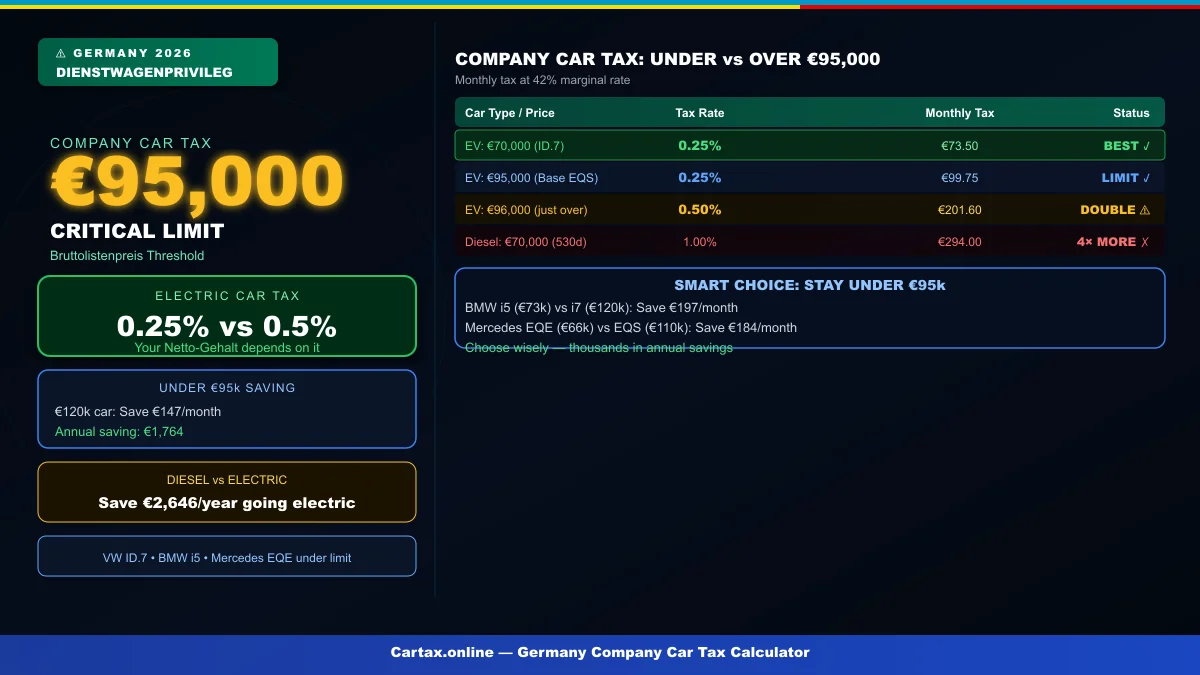
In Germany, the way your company car is taxed can mean the difference of hundreds of euros in your monthly Netto-Gehalt. The critical factor is whether your electric company car's list price sits above or below the €95,000 threshold — a boundary introduced to simplify the Dienstwagenprivileg (company car privilege) and incentivise electric vehicle adoption among German employees.
The €95,000 Threshold: Why It Matters for German Employees
Germany's company car tax system for electric vehicles operates on a two-tier structure based on the vehicle's Bruttolistenpreis (list price including VAT). This threshold is crucial because it directly determines how much of your company car's value you must declare as a taxable benefit each month.
The Two-Tier Electric Company Car Tax System
Electric Cars Up to €95,000 List Price:
- Taxable benefit: 0.25% of list price per month
- For a €70,000 electric car: €175/month taxable benefit
- At 42% tax rate: €73.50/month in additional income tax
- At 45% rate (higher earners): €78.75/month
Electric Cars Above €95,000 List Price:
- Taxable benefit: 0.5% of list price per month
- For a €120,000 electric car: €600/month taxable benefit
- At 42% tax rate: €252/month in additional income tax
- At 45% rate: €270/month
The difference between these two scenarios for a €120,000 car: €174-198 more per month in taxes compared to staying under the threshold. Over a year, this adds up to €2,088-2,376 in additional tax payments.
Your Net Salary: The Real Impact of Company Car Tax
Monthly Tax Comparison Table
| Vehicle Price | Tax Rate | Monthly Benefit | Tax at 42% | Tax at 45% |
|---|---|---|---|---|
| €50,000 (EV) | 0.25% | €125 | €52.50 | €56.25 |
| €70,000 (EV) | 0.25% | €175 | €73.50 | €78.75 |
| €95,000 (EV) | 0.25% | €237.50 | €99.75 | €106.88 |
| €96,000 (EV) | 0.50% | €480 | €201.60 | €216.00 |
| €120,000 (EV) | 0.50% | €600 | €252.00 | €270.00 |
| €70,000 (Diesel) | 1.00% | €700 | €294.00 | €315.00 |
Electric vs Conventional: Why Going Electric Makes Financial Sense
The tax advantage for electric company cars in Germany is substantial. Compare two identically-priced vehicles — one electric, one diesel:
€70,000 Volkswagen ID.7 (Electric) vs BMW 530d (Diesel)
Volkswagen ID.7 Electric:
- List price: €70,000
- Monthly taxable benefit: 0.25% × €70,000 = €175
- Tax at 42% marginal rate: €73.50/month
- Annual tax cost: €882
BMW 530d Diesel:
- List price: €70,000
- Monthly taxable benefit: 1.00% × €70,000 = €700
- Tax at 42% marginal rate: €294/month
- Annual tax cost: €3,528
Annual saving by choosing electric: €2,646
This tax advantage makes a compelling financial case for employees choosing between similar-priced electric and conventional company cars.
Which Popular EVs Stay Under the €95,000 Threshold?
Fully Under €95,000
- Volkswagen ID.7: From €56,000 — well under threshold
- Volkswagen ID. Buzz: From €58,000 — practical and tax-efficient
- BMW i5: From €73,000 — executive electric saloon
- Mercedes EQE: From €66,000 — luxury electric option
- Hyundai IONIQ 6: From €47,000 — exceptional range value
- Kia EV6: From €44,000 — strong warranty included
Near or Above Threshold
- BMW i7: From €120,000 — above threshold, taxed at 0.5%
- Mercedes EQS: From €110,000 — above threshold
- Porsche Taycan: From €90,000 — close to threshold
- Audi e-tron GT: From €104,000 — above threshold
Salary Sacrifice and Net Salary Considerations
How to Calculate Your Netto-Gehalt Impact
The company car reduces your net salary in two ways:
- Additional income tax: Based on the taxable benefit amount at your marginal rate
- Social security contributions: The company car benefit is included in gross salary for some calculations
Example Calculation:
- Annual gross salary: €75,000
- Tax bracket: 42%
- Company car value: €80,000 (electric)
- Monthly taxable benefit: €200
- Monthly tax on benefit: €84
- Annual cost: €1,008
Private Use Percentage
The tax rates mentioned assume 100% private use. If you restrict company car use to commuting only (Entfernungspauschale), you may be able to claim a reduction. However, most employees prefer the convenience of full private use despite the higher tax.
What If Your Car Exceeds the €95,000 Limit?
Options for High-Value Electric Company Cars
If your ideal company car exceeds €95,000, several strategies can help manage the tax impact:
- Choose lower specification: Selecting the base model of a premium brand often keeps you under the threshold
- Negotiate salary sacrifice: Some employers offer to cover part of the additional tax as a benefit
- Consider brand alternatives: Similar specification from a different manufacturer may be cheaper
- Lease vs. purchase: Leasing structures may offer different tax treatments worth exploring
The Bottom Line for German Employees
The €95,000 threshold is one of the most important numbers for German employees with company cars. Staying under this limit means your electric company car is taxed at the favourable 0.25% rate, while exceeding it doubles your taxable benefit to 0.5% of the full list price.
For most employees, the financial advantage of electric company cars remains substantial. Even with a 0.5% rate on an above-threshold electric car, you'll likely pay less tax than a conventional petrol or diesel equivalent. The government's incentive structure clearly favours electric mobility, and employees who take advantage of this can save thousands of euros annually while enjoying the latest electric vehicle technology.
Before signing your next company car agreement, compare the total cost of ownership including tax implications. Sometimes a slightly smaller or less premium electric vehicle can save you significant money each month while still delivering excellent electric driving experience.