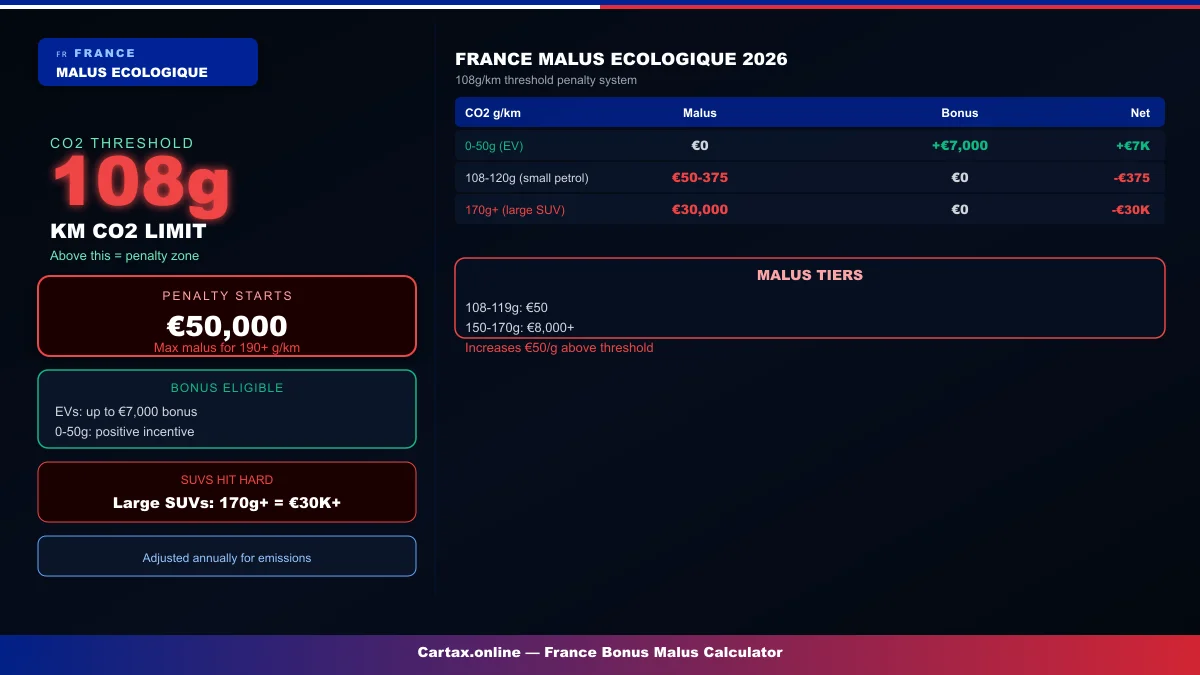
France has one of the most aggressive vehicle CO2 taxation systems in the world. The 2026 bonus-malus framework sets a malus threshold of just 108g/km, meaning any vehicle emitting above this level faces substantial penalties. For buyers of large SUVs and luxury combustion vehicles, malus charges can exceed €100,000, fundamentally altering the economics of vehicle purchases in France.
Understanding France's Bonus-Malus System
How the System Works
France's ecological taxation system combines purchase incentives (bonus) for clean vehicles with penalties (malus) for high-emission vehicles:
- Bonus: Incentive payment for low-emission vehicles (BEVs, low CO2)
- Malus: Penalty charge for vehicles exceeding CO2 threshold
- TVS: Annual company car tax based on emissions
- Threshold: 108g/km for malus applicability in 2026
The 108g/km Threshold
The dramatic lowering of the malus threshold from 123g/km to 108g/km means:
- Most petrol vehicles now fall into the malus zone
- Many diesel vehicles face the highest penalty brackets
- Only hybrid and electric vehicles avoid malus entirely
- The previous threshold captured only the highest emitters; the new threshold catches mainstream vehicles
2026 Malus Rates and Thresholds
Progressive Penalty Structure
| CO2 Emissions (g/km) | Malus Amount | Vehicle Examples |
|---|---|---|
| 108-118 | €50-250 | Small petrol hatchbacks |
| 118-138 | €250-6,000 | Family SUVs, sedans |
| 138-168 | €6,000-15,000 | Large SUVs, sports cars |
| 168-213 | €15,000-40,000 | Luxury SUVs, large engines |
| 213-255 | €40,000-80,000 | Premium large SUVs |
| Above 255 | Up to €100,000+ | Super SUVs, high-performance |
High-Impact Vehicles: Real Examples
Luxury SUVs Facing Major Malus
Mercedes GLS 400d AMG Line
- CO2 emissions: 261g/km
- Malus: €100,000+
- Base price: €115,000
- Total price with malus: €215,000+
BMW X7 xDrive40d M Sport
- CO2 emissions: 249g/km
- Malus: €80,000
- Base price: €125,000
- Total price with malus: €205,000
Range Rover 3.0L P400
- CO2 emissions: 252g/km
- Malus: €95,000
- Base price: €130,000
- Total price with malus: €225,000
Premium Sedans
- BMW 740d xDrive: 205g/km → €30,000 malus
- Mercedes S350d: 198g/km → €25,000 malus
- Audi A8 50 TDI: 187g/km → €18,000 malus
The Bonus for Electric Vehicles
Incentive Structure
To balance the malus system, France offers substantial bonuses for clean vehicles:
- BEV under €47,000: €7,000 bonus
- BEV €47,000-50,000: €5,000 bonus
- BEV over €50,000: No bonus
- Plug-in hybrid: €1,000 bonus
Net Cost Example
Tesla Model Y Long Range (BEV)
- Base price: €55,000
- Bonus: €0 (over €50,000 threshold)
- Malus: €0
- Net cost: €55,000
- vs BMW X7 equivalent: Saves €150,000+
Impact on Vehicle Choices
Market Shifts
The bonus-malus system has dramatically shifted French vehicle preferences:
- Electric vehicle share now exceeds 25% of new sales
- Large diesel SUV sales have collapsed by 60%
- Company car market dominated by BEVs
- Used car market benefiting from malus pushing new buyers to EVs
Company Car Considerations
For business users, the TVS (annual company car tax) compounds the malus impact:
- TVS based on CO2 emissions (€20-30 per g/km above threshold)
- A BMW X7 could pay €8,000+ annual TVS
- Electric vehicles: €0 TVS
- 5-year company car cost difference: €50,000+
The Bottom Line
France's 108g/km malus threshold has created a dramatic price divide between low and high-emission vehicles. For buyers considering large SUVs or powerful combustion vehicles, the malus can exceed the vehicle's base price. Conversely, electric vehicles benefit from substantial savings when total cost of ownership is considered.
The bonus-malus system represents one of Europe's most aggressive attempts to shift vehicle purchases toward sustainable transport. Whether you view it as environmental responsibility or government overreach, the financial implications are substantial and cannot be ignored when purchasing a vehicle in France.