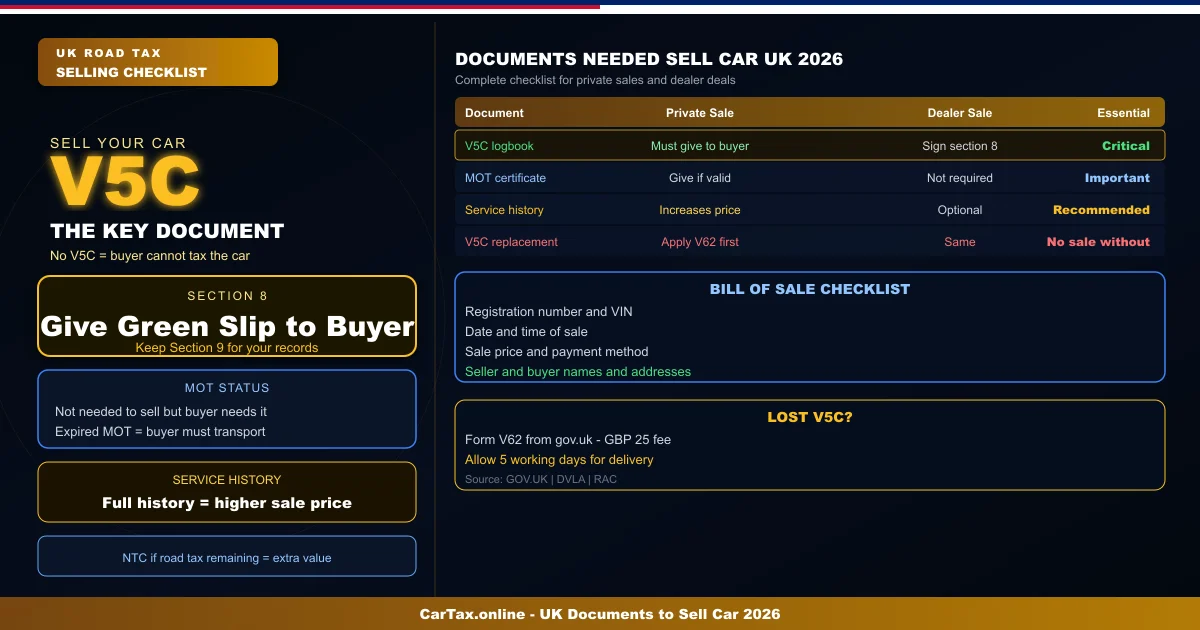
On 22 April 2026, across the UK, cars are changing hands — via dealer forecourts, private sales arranged through online marketplaces, and part-exchange deals at dealerships. Each transaction involves paperwork. Getting the documents right protects both seller and buyer, and missing or incorrect documentation is one of the most common causes of post-sale disputes. This complete checklist covers everything you need when selling your car in the UK.
The V5C Logbook: The Most Important Document
The V5C (vehicle registration certificate, commonly called the logbook) is the single most important document in any car sale. It proves the identity of the registered keeper, confirms the vehicle's registration details, and is the mechanism by which ownership transfers to the buyer.
When selling, you must give the buyer the V5C with section 8 (the Notice of Sale — the green tear-off slip at the back of the document) completed and signed. The buyer sends this to DVLA to register the change of ownership in their name. You keep section 9 as your record of the sale.
If you do not have your V5C — perhaps it has been lost or stolen — you must apply for a replacement before selling. Use form V62 available at gov.uk/replace-vehicle-registration-certificate. There is a fee of £25 for a replacement. DVLA aims to deliver within 5 working days, though postal delays can extend this to 2 to 3 weeks. Do not attempt to sell without the V5C — the buyer will not be able to tax or register the vehicle without it.
MOT Certificate: What Sellers Must Know
A valid MOT certificate is not a legal requirement for completing a car sale — a car with an expired MOT can legally change ownership. However, there are important practical implications:
A car without a valid MOT cannot be driven on public roads. This means the buyer must arrange collection via a transporter or trailer. This is inconvenient and adds cost for the buyer, which they will factor into their offer price. As a seller, you should disclose MOT status accurately — an expired MOT that is misrepresented can constitute a criminal offence under consumer protection legislation.
If your MOT is valid, provide the current certificate to the buyer. Ideally, show them the vehicle's MOT history via gov.uk/check-vehicle-tax — this confirms the mileage records and any advisories from previous tests.
For cars under 3 years old, no MOT is required, but you should still provide the V5C and any service records available.
Service History and Maintenance Records
While not legally required, a full service history significantly affects a car's sale value and buyer confidence. A documented service record demonstrates that the vehicle has been properly maintained, which reduces the buyer's risk of unexpected repair costs after purchase.
Ideally, you should provide:
- The vehicle's service book with stamps from each service appointment
- Invoices and receipts for any work done outside the main dealer network
- Any receipts for replacement parts (timing belt, clutch, brakes, tyres)
- The vehicle's handbook and operating guides
- Any manufacturer warranty documentation
If you have lost the service book or it is incomplete, you can reconstruct partial history from service providers' invoices. Online service records are increasingly common — many manufacturers now maintain digital service records accessible via their customer portals.
The Bill of Sale: Protecting Both Parties
There is no legal requirement for a formal bill of sale in the UK, but creating a simple one is strongly recommended for both seller and buyer. A bill of sale should record:
- The registration number and VIN of the vehicle
- The date and time of the sale
- The sale price agreed
- The names and addresses of both seller and buyer
- A declaration from the seller that they are the legal owner and have the right to sell the vehicle
- The V5C reference number
Both parties should sign the bill of sale. The seller keeps a copy; the buyer keeps a copy. This document becomes critical evidence in any dispute about the sale terms, condition of the vehicle, or the identities of the parties involved.
Road Tax Status: Disclosure Requirements
You must disclose the road tax status of the vehicle to potential buyers. This means stating clearly whether the car is taxed and when the tax expires. Road tax status is publicly verifiable by buyers via gov.uk/check-vehicle-tax, so misrepresenting it is both unethical and potentially illegal under consumer protection law.
If the car has remaining road tax, you are not legally required to provide an NTC certificate (as explained in our road tax transfer guide), but doing so adds value to the sale and is good practice. Buyers who understand the NTC process will specifically ask for it — sellers who provide it proactively demonstrate transparency and good faith.
For Dealer and Part-Exchange Sales
When selling to a dealer as a trade-in or part-exchange, the documentation requirements are slightly different. Dealers typically handle the V5C transfer and DVLA notification themselves as part of their acquisition process. You should still:
- Sign section 8 of the V5C and hand it to the dealer at the point of sale
- Keep section 9 for your own records
- Request a receipt or dealer purchase confirmation
- Note the date of sale and dealer details for your own reference
The dealer will notify DVLA, but it is still worth following up to confirm your name has been removed from the vehicle's registration within a few weeks of the sale.
Documents Checklist Summary
Before listing your car for sale, gather these documents:
- V5C logbook — essential, must be present and properly completed
- MOT certificate — required for cars over 3 years old; validity affects price
- Service history book — increases buyer confidence and sale value
- All sets of keys — buyers expect two or more keys
- Vehicle handbook — part of complete handover
- Recent repair receipts — demonstrates recent spend and transparency
- Bill of sale — creates clear record of the transaction
- NTC certificate (if applicable) — adds value to the sale
- V5C replacement (if lost) — apply before sale, form V62 from DVLA
Sellers who have complete, well-organised documentation command higher prices and complete sales faster. Buyers who see organised paperwork have confidence in the seller's overall approach to vehicle maintenance — a well-kept file of receipts and records signals a well-maintained car.