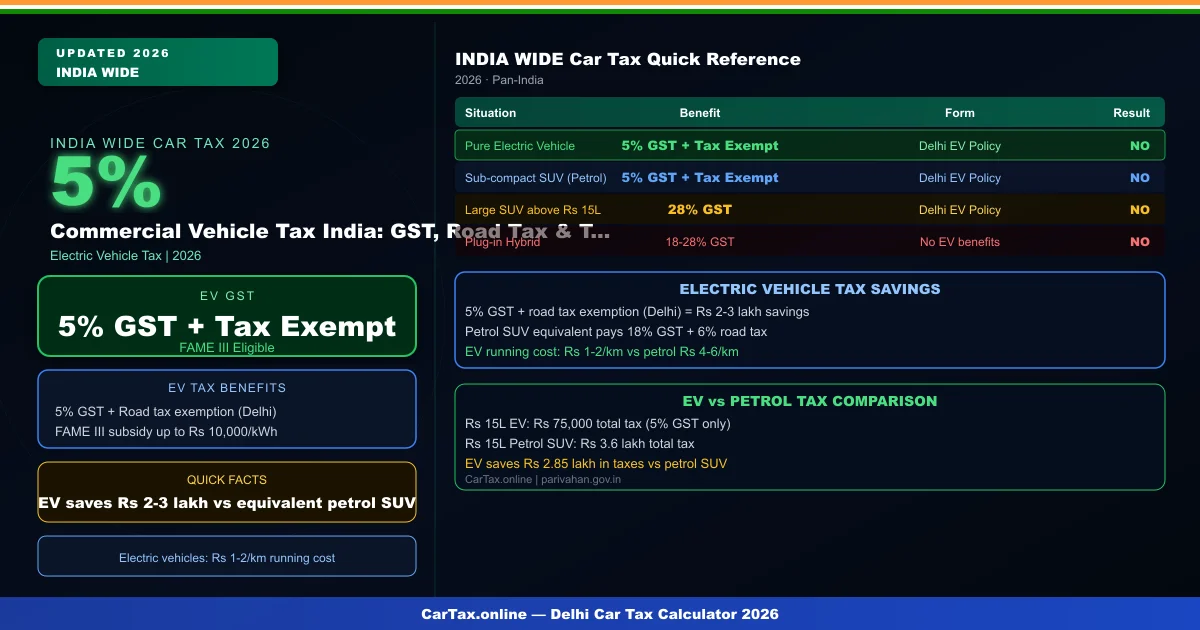
April 12, 2026 in India — Commercial vehicle tax in India differs significantly from personal vehicle taxes. Transport vehicles, goods carriers, and passenger transport vehicles have their own GST brackets, road tax structures, and operational tax implications. This guide covers all commercial vehicle tax rules for 2026.
Whether you're starting a logistics business, purchasing a taxi, or operating a bus service, understanding the tax structure is essential for profitability.
GST on Commercial Vehicles
| Vehicle Type | GST Rate | Notes |
|---|---|---|
| Goods vehicles (LCV) | 12% | Below 12 tonnes GVW |
| Goods vehicles ( HCV) | 18% | Above 12 tonnes GVW |
| Passenger transport | 12% | Buses, taxis |
| Electric commercial | 5% | Lower than diesel |
| Trucks for agriculture | 12% | With exemptions |
Commercial Vehicle Road Tax
Road tax for commercial vehicles varies by state and vehicle type:
| State | LCV Tax/Year | HCV Tax/Year | Bus Tax/Year |
|---|---|---|---|
| Maharashtra | Rs 4,500/tonne | Rs 6,500/tonne | Rs 8,000/seat |
| Karnataka | Rs 4,000/tonne | Rs 6,000/tonne | Rs 7,500/seat |
| Gujarat | Rs 2,500/tonne | Rs 4,000/tonne | Rs 5,000/seat |
| Tamil Nadu | Rs 4,200/tonne | Rs 6,200/tonne | Rs 7,200/seat |
Transport Vehicle Classification
Light Commercial Vehicles (LCV)
- GVW: Up to 12 tonnes
- Examples: Tata Ace, Mahindra Bolero Pickup, Eicher Pro 1059
- GST: 12%
- Road tax: Per tonne annually
Heavy Commercial Vehicles (HCV)
- GVW: Above 12 tonnes
- Examples: Tata Prima, Mahindra XUV500 Truck, Ashok Leyland 4820
- GST: 18%
- Road tax: Higher per tonne rate
Passenger Transport Vehicles
| Vehicle Type | Capacity | GST | Road Tax Basis |
|---|---|---|---|
| Auto rickshaw | 3 passengers | 12% | Fixed annual fee |
| Taxi (AC) | 4 passengers | 12% | Per vehicle |
| Mini Bus | 12-26 seats | 12% | Per seat |
| Standard Bus | 26+ seats | 12% | Per seat |
Input Tax Credit for Commercial Vehicles
Businesses can claim input tax credit (ITC) on commercial vehicle purchases:
- GST paid: ITC available for business use vehicles
- Fuel GST: Credit on diesel/CNG for transport vehicles
- Maintenance: ITC on spare parts and service
- Restriction: ITC not available for personal use portion
Operating Cost Tax Benefits
Transport business expenses are tax-deductible:
- Fuel expenses: Fully deductible
- Driver salary: Fully deductible
- Maintenance: Fully deductible
- Insurance: Fully deductible
- Depreciation: Higher rates for commercial vehicles
Commercial Vehicle Depreciation
Commercial vehicles get higher depreciation rates:
- Taxis/rental vehicles: 25% WDV rate
- Goods vehicles: 25% WDV rate
- Buses: 25% WDV rate
- Faster write-off: vs personal cars at 15%
State-wise Operating Permits
Commercial vehicles require state-specific permits:
- National Permit: For inter-state goods transport
- State Permit: For within-state operations
- Permit fees: Additional annual cost
Frequently Asked Questions
What GST applies to commercial trucks?
Light commercial vehicles (below 12 tonnes GVW) attract 12% GST, while heavy commercial vehicles above 12 tonnes GVW attract 18% GST.
Can I claim input tax credit on commercial vehicles?
Yes, businesses can claim full input tax credit on GST paid for commercial vehicles used for business purposes. This significantly reduces effective vehicle cost.
What is the depreciation rate for commercial vehicles?
Commercial vehicles (taxis, goods carriers, buses) qualify for 25% WDV depreciation rate, which is higher than the 15% rate for personal-use cars.
Are there road tax exemptions for electric commercial vehicles?
Many states offer road tax exemptions for electric commercial vehicles including buses and light transport vehicles. Check your state transport department for specific incentives.
Conclusion
Commercial vehicles have different tax treatment than personal cars. Use our commercial vehicle calculator to estimate total costs.
Disclaimer: This article is for informational purposes only. Tax rules for commercial vehicles are complex. Consult a chartered accountant.
अस्वीकरण: यह लेख केवल सूचनात्मक उद्देश्यों के लिए है। व्यावसायिक वाहनों के लिए कर नियम जटिल हैं।
Official Resources: Parivahan Portal | Vahan Road Tax | India GST Portal
It is worth noting that road tax and registration rules in India are governed by the Motor Vehicles Act, 1988, and vary significantly from state to state. The central government sets GST rates, but state governments determine road tax, which creates a price variation of Rs20,000-80,000 for the same vehicle model across different states. Always verify the latest rates with your state RTO before purchasing a vehicle, as rates are updated annually in most states.
For the most accurate calculation of your specific vehicle's total tax outgo, use CarTax.online's state-specific road tax calculator. Enter your vehicle's ex-showroom price, fuel type, and state of registration to get a detailed breakdown of GST, state road tax, registration fees, and smart card charges for your exact vehicle category.