car tax electric vehicles canada — Car Tax on Electric Vehicles Canada Overview
This guide covers car tax on electric vehicles canada for vehicle owners and buyers in 2026 In 2026, car tax electric vehicles canada . Tax rates, rules, and exemptions vary by province and vehicle type.
For more information, visit the Car Tax Calculator.
car tax electric vehicles canada — Car Tax on Electric Vehicles Canada Tax Rates and Calculations
Understanding car tax on electric vehicles canada requires knowing the applicable tax rates and how they are calculated. Provincial taxes are applied at registration, while federal luxury taxes apply on high-value vehicles above $100,000.
car tax electric vehicles canada — Car Tax on Electric Vehicles Canada Exemptions and Exceptions
Certain vehicle types, buyer categories, and purchase circumstances qualify for exemptions or reduced tax rates. High-GVWR vehicles, electric vehicles, and family transfers are among the common exemption categories.
For official information, visit BC Ministry of Finance, SGI Saskatchewan.
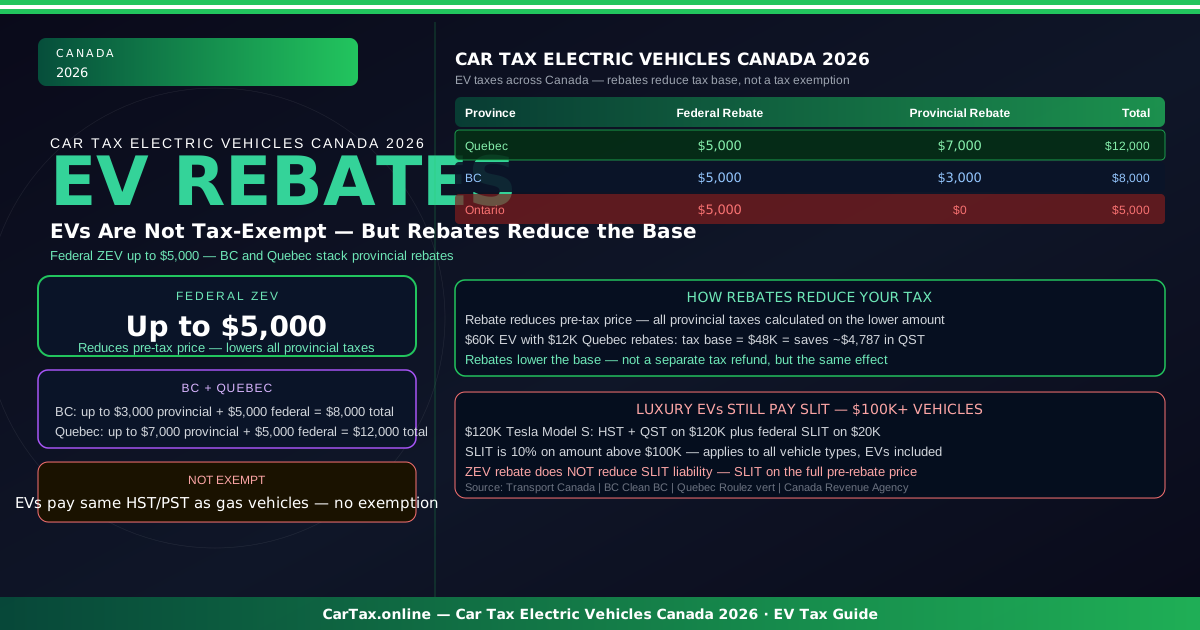
Car Tax on Electric Vehicles Canada 2026 Electric vehicles are subject to the same vehicle taxes as any other vehicle in Canada — HST, PST, or QST apply to EV purchases just as they do to gasoline vehicles. However, EV rebates reduce the pre-tax price, which reduces the tax base. Federal ZEV Rebate The federal Zero-Emission Vehicle (ZEV) rebate provides up to $5,000 for eligible battery electric and hydrogen fuel cell vehicles. This rebate is applied at the dealership — it reduces the pre-tax purchase price of the vehicle. Because the rebate reduces the pre-tax price, it also reduces the GST, HST, PST, or QST you pay. A $55,000 EV with a $5,000 federal rebate: - Pre-rebate pre-tax price: $55,000 - Federal rebate: $5,000 - Post-rebate pre-tax price: $50,000 - GST/HST/PST/QST calculated on $50,000 Example — $55,000 Tesla Model 3 in Ontario: - Pre-rebate: $55,000 x 13% HST = $7,150 - With $5,000 federal rebate: $50,000 x 13% HST = $6,500 - Savings from rebate + reduced HST: $5,650 total BC Provincial EV Rebates BC offers provincial rebates for eligible zero-emission vehicles, stacked on top of the federal rebate. BC's Clean BC Go program has provided up to $3,000 for new EVs, with additional incentives for used EVs. Combined federal + BC rebates of up to $8,000 significantly reduce the pre-tax purchase price for BC EV buyers, which also reduces the BC PST and GST base. BC is currently the most generous province for EV incentives. Quebec EV Rebates Quebec's Roulez vert program offers provincial rebates of up to $7,000 for new zero-emission vehicles. Combined with the federal $5,000 ZEV rebate, Quebec buyers can receive up to $12,000 in combined incentives. Quebec's high QST rate (9.975%) makes these rebates especially valuable — a $12,000 combined rebate reduces a $60,000 EV's pre-tax price to $48,000, saving approximately $4,787 in QST alone. Ontario EV Rebates Ontario terminated its provincial EV incentive program in 2018. EV buyers in Ontario currently rely only on the federal ZEV rebate of up to $5,000. This makes Ontario one of the less generous provinces for EV buyers. EVs Are Not Tax-Exempt It's a common misconception that EVs are exempt from vehicle taxes. They are not. EVs attract the same provincial HST, GST+PST, or QST as any other vehicle. The EV rebate reduces the purchase price, but it is not a tax exemption. Example — $70,000 EV in Alberta: - GST (5%): $3,500 - No provincial exemption applies - Federal ZEV rebate reduces pre-tax price but not the GST rate itself Luxury EVs and SLIT Electric vehicles priced at $100,000 or more are subject to the federal Select Luxury Items Tax (SLIT) on the amount above $100,000. This applies regardless of whether the vehicle is powered by electricity, gasoline, or hydrogen. A $120,000 Porsche Taycan pays the same SLIT as a $120,000 gasoline Porsche 911. Example — $120,000 luxury EV in Ontario: - HST (13% on $120,000): $15,600 - Federal SLIT (10% on $20,000 above $100K): $2,000 - Total tax: $17,600 Federal ZEV rebate does not reduce SLIT liability — SLIT applies to the full vehicle value. Charging Equipment and Tax Home EV charging equipment is subject to GST. However, some provinces rebate GST on EV charging equipment as an energy efficiency measure. Check your provincial energy programs for details. Key Takeaways EVs are not exempt from vehicle taxes — they pay the same HST, PST, or QST as any vehicle. Federal ZEV rebates up to $5,000 reduce the pre-tax price, which reduces all provincial taxes. BC and Quebec stack provincial rebates, making them the most EV-friendly provinces. Luxury EVs above $100,000 still pay the 10% federal SLIT. Home charging equipment is subject to GST. Sources: Transport Canada | BC Clean BC | Quebec Roulez vert | ServiceOntario | Canada Revenue Agency