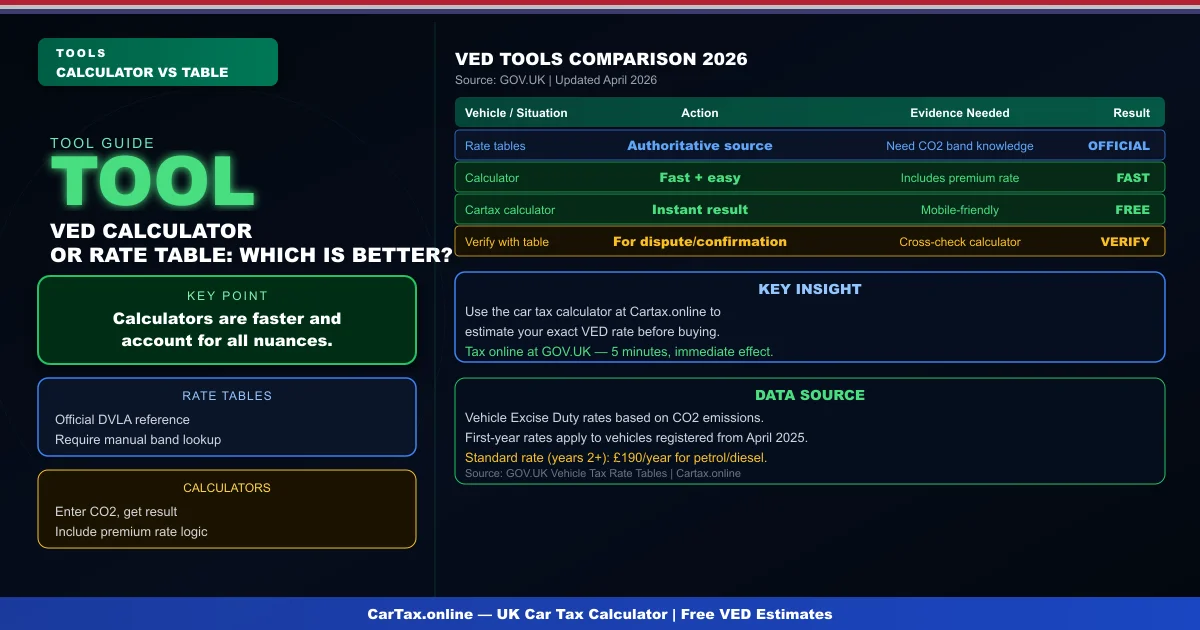
When you need to know your road tax cost, you have two main approaches: using a car tax calculator or referencing a static lookup table. Each has strengths and weaknesses depending on what you need to know.
Static VED Rate Tables
DVLA's official rate tables show the VED band structure for vehicles registered from April 2017 onward. They list the CO2 threshold for each band and the corresponding first-year and standard rate. Rate tables are accurate for the bands they cover, but they require you to know your vehicle's exact CO2 figure and which band it falls into. Rate tables do not account for nuances like the premium rate surcharge, transitional first-year rates for older vehicles, or special vehicle classifications.
Car Tax Calculators: Faster and Easier
A car tax calculator like the one at Cartax.online asks you to enter the vehicle's CO2, fuel type and first registration date, then automatically applies the correct rate. Calculators account for the premium rate surcharge, first-year vs standard rate timing, and special rates for EVs and hybrids. They eliminate the risk of misreading a table or applying the wrong band. For most people, a calculator is faster and less error-prone than referencing static tables.
When Lookup Tables Are Better
Lookup tables are better when you need the authoritative official rate for a specific CO2 band — for example, to verify what a calculator is telling you or to understand the band structure in detail. They are also useful for accountants and tax professionals who need to cross-reference rates for multiple vehicles. The official GOV.UK rate tables should always be the authoritative reference when there is any dispute about the correct rate. Related: Car Tax Calculator vs Lookup Table UK 2026 | Car Tax Price Calculator UK 2026 | DVLA Car Tax Calculator 2026 | Car Tax Calculator 2026 UK.
Why Calculators Are More Practical
Most car buyers do not know their vehicle's exact VED band — they know the CO2 figure from the V5C or listing. A calculator bridges the gap by accepting the CO2 figure directly and outputting the annual cost. This is more practical for the majority of car buyers and owners who are not VED experts. For the most accurate result, use both: calculate with a tool, then verify against the official table to confirm.
Official Resources: Parivahan Portal | Vahan Road Tax | India GST Portal | FAME-III Scheme
Frequently Asked Questions
Q: What is the current road tax rate for cars in India 2026?
Road tax rates in India vary by state and vehicle category. For new cars, GST is charged at 5% for EVs, 18% for hybrids under 1,200cc, and up to 28% for petrol/diesel SUVs. State road tax is charged separately and varies from Rs3,000-15,000 annually depending on the state's slab system. Check your specific state's RTO website for current rates.
Q: How do I calculate my car road tax online in India?
You can calculate your car road tax using online calculators available on state RTO portals and CarTax.online. The calculation considers your vehicle's ex-showroom price, fuel type, engine capacity, and state of registration. Road tax is payable annually or for the vehicle's lifetime depending on your state's rules.
Q: Is GST included in the road tax for new cars in India?
No — GST and road tax are separate charges. GST is a central tax charged by the vehicle manufacturer at the time of purchase. State road tax is a separate annual or one-time charge levied by your state's transport department. Both apply at the time of first registration, and annual road tax continues for subsequent years.
Q: Do electric vehicles get tax benefits in India 2026?
Yes — electric vehicles in India qualify for a reduced GST rate of 5% (down from 28% for petrol cars). Under FAME-III subsidies, EVs may also qualify for additional state-level incentives, reduced road tax, and free registration in many states. The exact benefits vary by state.
Q: What happens if I don't pay my car road tax on time?
If you don't pay road tax, your vehicle's registration can be flagged in the Vahan database, preventing renewal of fitness certificates and creating legal liability during police checks. Penalties range from Rs200-500 per day of default in most states. Road tax is a legal requirement under the Motor Vehicles Act.