Car Tax Calculator Alberta vs Ontario Overview
This guide covers car tax calculator alberta vs ontario for vehicle owners and buyers in 2026. Tax rates, rules, and exemptions vary by province and vehicle type.
For more information, visit the Car Tax Calculator.
Car Tax Calculator Alberta vs Ontario Tax Rates and Calculations
Understanding car tax calculator alberta vs ontario requires knowing the applicable tax rates and how they are calculated. Provincial taxes are applied at registration, while federal luxury taxes apply on high-value vehicles above $100,000.
Car Tax Calculator Alberta vs Ontario Exemptions and Exceptions
Certain vehicle types, buyer categories, and purchase circumstances qualify for exemptions or reduced tax rates. High-GVWR vehicles, electric vehicles, and family transfers are among the common exemption categories.
For official information, visit Manitoba Provincial Sales Tax, CRA HST Rebate Information.
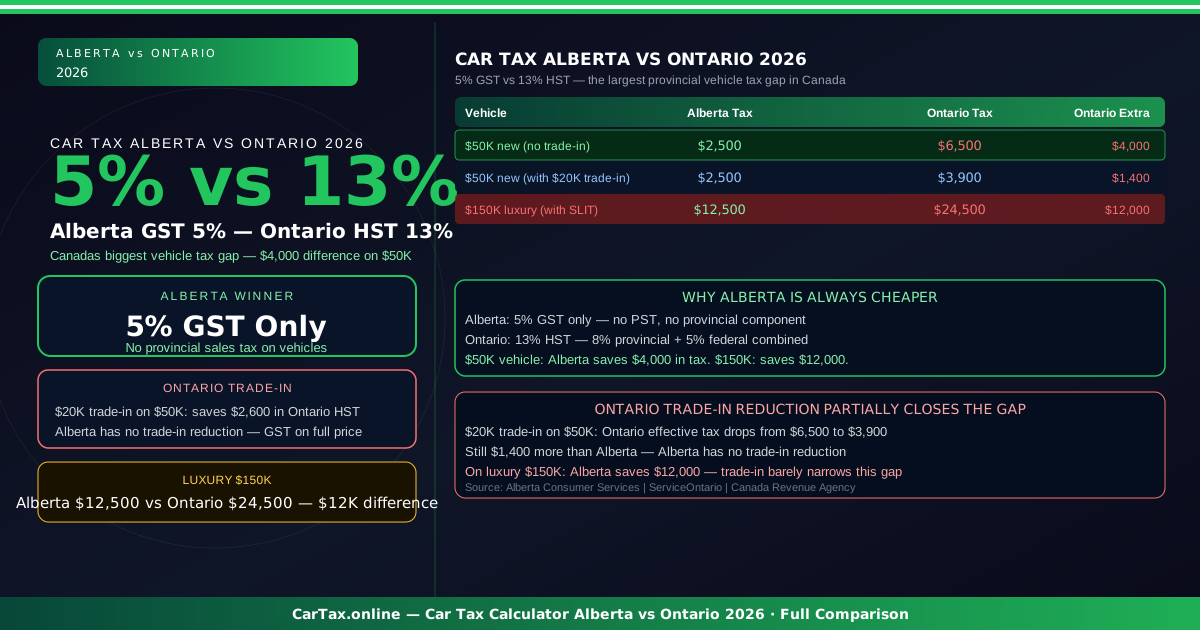
Car Tax Calculator Alberta vs Ontario 2026 Alberta and Ontario represent opposite ends of Canada's vehicle tax spectrum. Alberta charges just 5% GST — the lowest in the country. Ontario charges 13% HST. Here's the full comparison for 2026. Tax Rate Difference Alberta applies only the 5% federal GST on vehicle purchases. There is no provincial sales tax. Ontario applies 13% HST — 8% provincial and 5% federal combined. This 8 percentage point difference is the largest between any two provinces. On a $50,000 vehicle, that difference alone represents $4,000 in extra tax in Ontario. New Vehicle Purchase Example — $50,000 new SUV at a dealership: Alberta: - GST (5%): $2,500 - Total tax: $2,500 - Total cost: $52,500 Ontario: - HST (13%): $6,500 - Total tax: $6,500 - Total cost: $56,500 Ontario costs $4,000 more in tax on the same $50,000 vehicle. Trade-In and Taxable Amount Ontario's HST is calculated on the difference between the purchase price and the trade-in value. Alberta has no trade-in mechanism — GST is calculated on the full purchase price. $50,000 vehicle with $20,000 trade-in: Ontario: - Taxable amount: $50,000 - $20,000 = $30,000 - HST (13%): $3,900 - Trade-in savings: $6,500 - $3,900 = $2,600 Alberta: - GST (5% on $50,000): $2,500 - No reduction for trade-in With a $20,000 trade-in, Ontario's effective HST cost drops to $3,900. Alberta's GST is $2,500. Ontario is now only $1,400 more expensive with the trade-in — compared to $4,000 without one. Used Vehicle Purchases For private used car purchases, Alberta's advantage remains. Alberta charges only 5% GST. Ontario charges 13% HST. Example — $25,000 used car at a dealership: Alberta: GST $1,250 Ontario: HST $3,250 Ontario costs $2,000 more For private sales, Alberta generally does not collect GST between private individuals. Ontario charges 13% HST at registration on the purchase price or MVDA assessed value. Luxury Vehicles: Alberta vs Ontario For vehicles $100,000 and above, the federal Select Luxury Items Tax (SLIT) adds 10% on the amount above the threshold in both provinces. Ontario also adds 8% PST through HST on the full amount. $150,000 luxury vehicle comparison: Alberta: - GST (5%): $7,500 - Federal SLIT (10% on $50K above $100K): $5,000 - Total tax: $12,500 Ontario: - HST (13% on $150,000): $19,500 - Federal SLIT (10% on $50K above $100K): $5,000 - Total tax: $24,500 Ontario costs $12,000 more in tax on a $150,000 luxury vehicle. Registration Fees Alberta: approximately $93 annually through a registry agent, plus transfer fee of approximately $30. Ontario: approximately $120 annually for standard passenger plates. Alberta has a slight advantage on annual registration costs, but the difference is small compared to the upfront tax difference. Insurance Comparison Alberta has a private auto insurance market — rates vary significantly by driver profile. Ontario also has a private market with competitive pricing. Neither province has a clear insurance cost advantage over the other — it depends on individual driver factors. Overall Verdict Alberta is significantly cheaper for vehicle purchases. The 5% GST vs 13% HST difference creates a $2,000-$4,000 gap on typical vehicles, widening to $12,000 on luxury vehicles. Ontario's trade-in mechanism partially offsets the gap for new vehicle buyers, but Alberta remains cheaper even with a trade-in. Sources: Alberta Consumer Services | ServiceOntario | Canada Revenue Agency