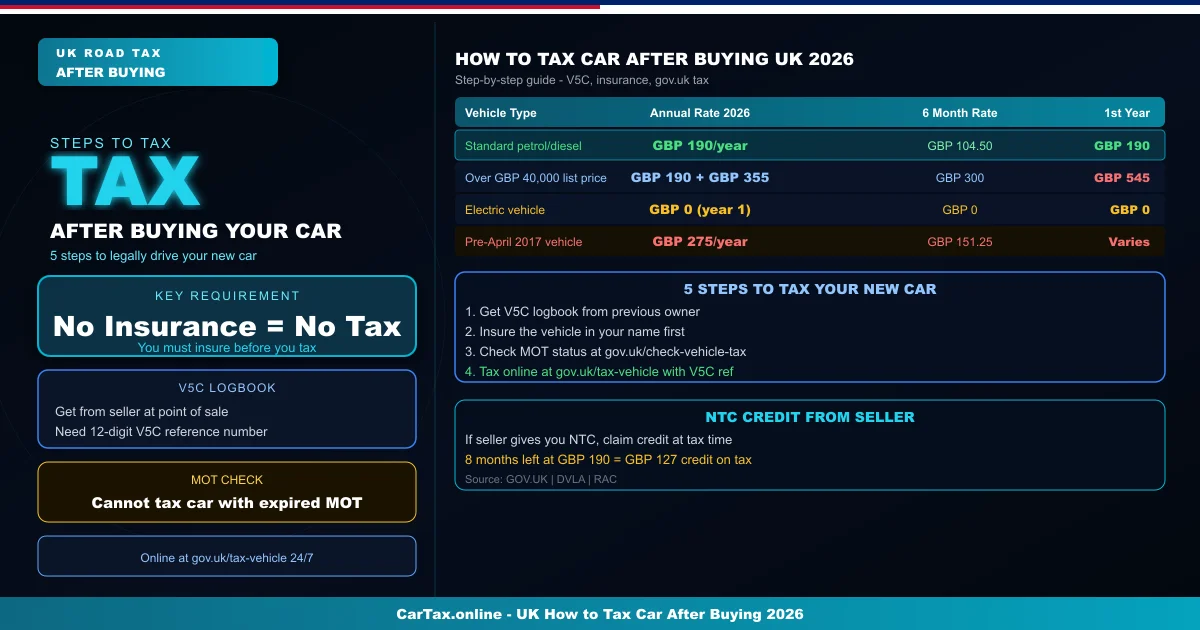
On 22 April 2026, thousands of people across the UK are completing car purchases — from brand-new vehicles rolling off dealer forecourts in Leeds to second-hand finds agreed through private sale in Edinburgh. The moment the keys change hands, a new legal obligation begins: the new owner must tax the vehicle before driving it on any public road. This guide explains exactly what you need to do, in what order, and how to do it quickly.
The Golden Rule: No Tax, No Driving
UK law is absolute on this point: a vehicle must be taxed before it is used or kept on a public road. There is no grace period after purchase. As soon as you take ownership of a car, you are responsible for ensuring it is legally taxed.
The only circumstance in which an untaxed vehicle can be moved legally is to drive it to a pre-booked MOT appointment — and even that exemption requires valid road tax to apply. There is no exemption for new owners to drive home untaxed after a purchase.
Dealers are aware of this obligation and most provide temporary tax cover — either a day licence or a short-period tax disc — so that buyers can legally drive away. If you are buying from a private seller, you must arrange tax before you move the car.
Step 1: Get the V5C Logbook From the Seller
Before you can do anything else, you need the vehicle's registration certificate — commonly called the V5C or logbook. When buying from a private seller, the V5C should be handed to you at the point of sale, or the seller should have it ready to transfer.
The V5C has a yellow panel on the front with an 11-digit reference number. When you register as the new keeper with DVLA, you will need this number. The green tear-off slip at the back (section 8) should already be signed by the seller — if it is not, ask them to sign it immediately. Without a properly signed V5C, you cannot complete the DVLA registration process.
If the seller does not have the V5C — perhaps it has been lost — they will need to apply to DVLA for a replacement before the sale can be properly completed. Do not complete a purchase without the V5C unless you are comfortable with a complex administrative process to obtain it afterward.
Step 2: Get Insurance Before You Tax
Road tax requires valid motor insurance as a prerequisite. You cannot tax a vehicle without having insurance in place. If you do not yet have insurance, you must obtain a quote and activate a policy before you can complete the tax transaction.
For newly purchased vehicles, you typically need to add the new car to an existing policy or take out a new policy. Most insurers allow you to add a new vehicle to an existing policy online or by phone, sometimes effective immediately. Get this sorted before attempting to tax — the DVLA system will check your insurance status in real time.
Note: a car cannot be driven to an insurance inspection without tax being in place. If a car has been purchased without road tax, arrange for it to be transported or use the seller's temporary tax cover.
Step 3: Tax Your Car Online (Fastest Method)
Go to gov.uk/tax-vehicle and have your V5C reference number ready. The online service accepts payment by Visa, Mastercard, or Maestro debit and credit cards. You can choose:
- 12-month tax: Pay for the full year and receive the annual rate. For standard vehicles in 2026, this is £190 per year.
- 6-month tax: Pay for 6 months at approximately 55% of the annual rate — useful if you want flexibility or are unsure how long you will keep the vehicle.
Once payment is processed, your road tax is active immediately. DVLA will post a tax disc to your address, though you do not need to display it physically — the system is now electronic and police check via registration records.
Step 4: Claim Any NTC Road Tax Credit
If the previous owner provided you with an NTC (No Test Certificate) for remaining road tax, present it when taxing the vehicle. DVLA will apply the credit to your first tax payment.
This is why it is worth requesting an NTC from a seller when buying a car with several months of road tax remaining — it reduces your first tax bill proportionally. A car with 8 months remaining at the standard £190 annual rate would give you a credit of approximately £127 on your first tax transaction.
If you do not have an NTC, the remaining road tax simply continues until it expires based on the previous owner's payment schedule. There is no credit and no refund — but the vehicle is validly taxed during that period.
Step 5: Register With DVLA as the New Keeper
Taxing the car online automatically notifies DVLA that you are the new keeper in most cases. However, you should also complete the V5C transfer by sending the green slip to DVLA. This confirms you as the registered keeper and removes the seller's liability for the vehicle.
If you have bought from a dealer, they typically handle the DVLA notification as part of their sales process. For private purchases, you are responsible for ensuring the transfer is completed. The gov.uk/sell-your-vehicle service that the seller should have used notifies DVLA of the sale — but you still need to confirm receipt of the V5C by sending the green slip.
What About the MOT?
Road tax and MOT are separate legal requirements. To keep a vehicle on the road, you need both a valid MOT certificate (for vehicles over 3 years old) and road tax. When you tax a car online, the system checks MOT status — if the MOT has expired, you cannot tax the vehicle until it passes an MOT test.
If you are buying a car with an expired MOT, you will need to book and pass an MOT before you can tax it. The car cannot legally be driven to the test centre without road tax — so you will need to arrange transporter collection or a short-term tax disc to get it to the testing station.
How Much Does It Cost to Tax a Car in 2026?
The standard annual road tax rate for most petrol and diesel cars registered after April 2017 with list prices under £40,000 is £190 per year (2026-27 rate). Cars with list prices over £40,000 pay an additional £355 supplement for the first 5 years, making the first-year rate £545.
Electric vehicles and zero-emission cars pay £0 road tax in year 1, rising to the standard rate from year 2 onwards. The first-year rates for all vehicle types can be checked at gov.uk/vehicle-tax-rate.
Paying for 6 months costs approximately £105 for standard vehicles — notably more than half the annual rate, so annual payment is better value if you can afford it.
Common Mistakes to Avoid
Driving home without tax from a private sale: If the seller has not provided temporary tax cover, do not drive the car on a public road. Arrange collection with a trailer or recovery vehicle.
Forgetting to send the V5C green slip: You may have taxed the car, but without completing the V5C transfer, you are not the registered keeper. This matters if the car is involved in any incident or offence.
Not checking MOT before buying: A car with an expired MOT cannot be taxed until it passes. Always check MOT status at gov.uk/check-vehicle-tax before completing a purchase.
Assuming road tax transfers automatically: It does not. The previous owner's tax may continue for a period, but without an NTC there is no monetary credit and the new owner must pay for any remaining tax period themselves.