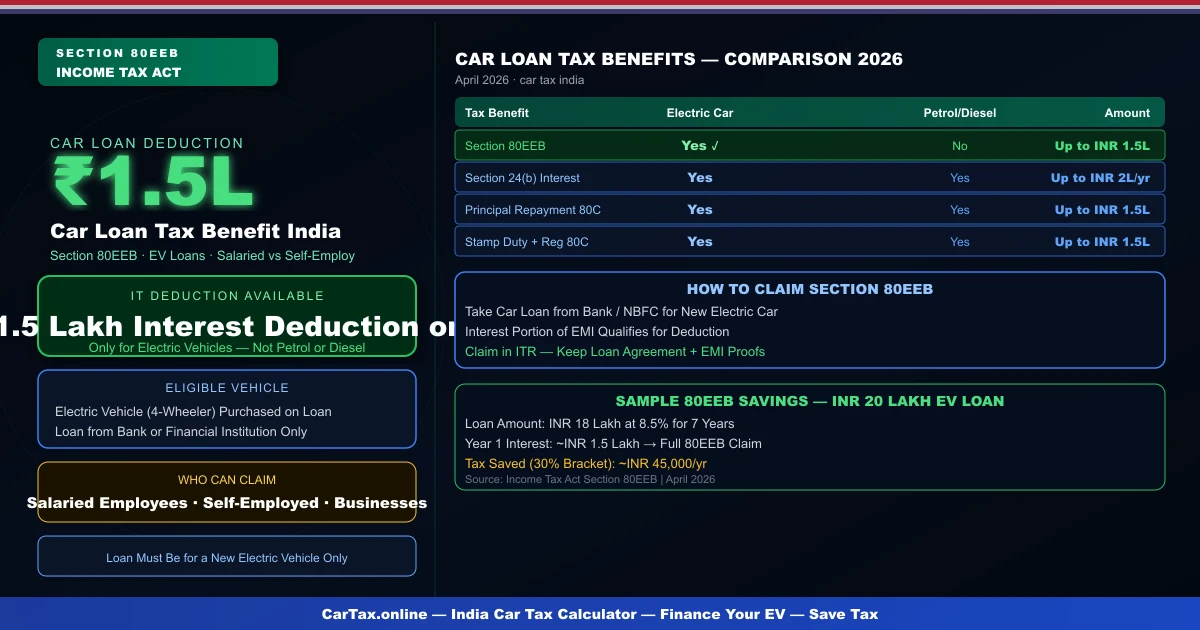
Car loan tax benefit in India for 2026 primarily centres on Section 80EEB, which provides a deduction of up to INR 1.5 lakh on interest paid for electric vehicle loans. Understanding which car loan benefits are available helps you make financially smarter vehicle purchase decisions, especially as EV adoption accelerates across India.
As of April 18, 2026, the tax framework for car loans in India differentiates clearly between electric vehicles and conventional vehicles. If you're planning to buy a car and want to maximise tax benefits, the EV route offers the most significant advantages through Section 80EEB, FAME-II subsidies, and lower GST rates.
Section 80EEB: Electric Vehicle Loan Deduction
Section 80EEB of the Income Tax Act, 1961, allows individual taxpayers to claim a deduction of up to INR 1.5 lakh per financial year on interest paid for loans taken to purchase an electric vehicle. This deduction was introduced to promote electric vehicle adoption and provides meaningful tax relief for EV buyers taking loans to finance their purchase.
The key requirements for claiming Section 80EEB are that the vehicle must be a registered electric vehicle, the loan must be taken from a registered financial institution or bank, and the deduction applies only to the interest component of the loan, not the principal. The vehicle must be used for personal or business purposes, and the deduction is available regardless of whether you are salaried or self-employed.
For example, if you take a loan of INR 15 lakh at 9% interest for an electric car and pay INR 1.35 lakh in interest during the financial year, you can claim the full INR 1.35 lakh as a deduction under Section 80EEB, reducing your taxable income by that amount. At the highest tax bracket of 30%, this saves approximately INR 40,500 in taxes annually.
Car Loan Tax Benefits for Salaried Employees
Salaried employees can claim Section 80EEB deduction by including the EV loan interest amount in their tax return under Chapter VI-A deductions. The deduction reduces your taxable income, and the resulting tax savings can be significant over the loan tenure. Additionally, any interest paid on car loans for business-owned vehicles can be claimed as a business expense, reducing business taxable income.
For salaried employees purchasing a personal EV, the Section 80EEB deduction is the only available tax benefit on the car loan itself. Principal repayments are not deductible, and the deduction applies only to interest. Employers may provide car lease arrangements that have different tax treatment, but direct car loan interest deduction is limited to Section 80EEB for EVs.
Car Loan Tax Benefits for Self-Employed Individuals
Self-employed individuals and business owners have additional flexibility in claiming car loan tax benefits. The interest paid on any car loan for a business-used vehicle can be claimed as a business expense under the Income Tax Act, reducing business taxable income. This applies to both EVs and conventional vehicles as long as the vehicle is used for business purposes.
Depreciation on business vehicles is also claimable under Section 32 of the Income Tax Act, allowing businesses to claim depreciation on the vehicle cost over its useful life. For a car used 100% for business, the entire interest and depreciation are deductible. For partially business-used vehicles, only the proportionate amount is claimable, which requires maintaining proper records of business versus personal usage.
Comparing EV vs Conventional Car Loan Tax Benefits
The tax advantage of buying an electric vehicle over a conventional car is substantial when financed with a loan. An EV loan of INR 20 lakh at 9% interest over 5 years means approximately INR 7.5 lakh in interest payments, of which INR 1.5 lakh per year can be claimed under Section 80EEB, totalling INR 7.5 lakh in deductions over the loan tenure. A conventional petrol car loan offers no such deduction.
Combined with the 5% GST on EVs versus 18-28% on conventional vehicles, lower road tax in most states, and FAME-II subsidies, the total cost advantage of an EV over its lifetime significantly outweighs the additional purchase price. Use our India car tax calculator to compare the total cost of ownership for EVs versus petrol vehicles in your state.
Frequently Asked Questions
What is Section 80EEB in India?
Section 80EEB of the Income Tax Act allows a deduction of up to INR 1.5 lakh per year on interest paid for loans taken to purchase an electric vehicle. This deduction applies only to registered electric vehicles and was introduced to promote EV adoption in India.
Can I claim Section 80EEB for a petrol or diesel car loan?
No, Section 80EEB deduction applies only to electric vehicle loans. The deduction is not available for loans taken to purchase conventional petrol or diesel vehicles, or even hybrid vehicles unless they qualify under the EV definition.
What is the maximum deduction under Section 80EEB?
The maximum deduction under Section 80EEB is INR 1.5 lakh per financial year on interest paid for an electric vehicle loan. This is in addition to other available deductions and is available for both self-employed individuals and salaried employees.
Can I claim both Section 80EEB and home loan Section 24 deductions?
Yes, you can claim multiple deductions simultaneously as long as they fall under different sections of the Income Tax Act. Section 80EEB is specific to EV loans while Section 24(b) covers home loan interest, so both can be claimed in the same year.
Are there any other tax benefits on car loans in India?
For business-owned vehicles, the entire interest on a car loan can be claimed as a business expense, reducing taxable income. For individuals, only the Section 80EEB EV interest deduction is available. Processing fees and interest paid on personal car loans for non-EV vehicles are not tax deductible.
Official Resources: Parivahan Portal | Vahan Road Tax | India GST Portal | FAME-III Scheme
Frequently Asked Questions
Q: What is the current road tax rate for cars in India 2026?
Road tax rates in India vary by state and vehicle category. For new cars, GST is charged at 5% for EVs, 18% for hybrids under 1,200cc, and up to 28% for petrol/diesel SUVs. State road tax is charged separately and varies from Rs3,000-15,000 annually depending on the state's slab system. Check your specific state's RTO website for current rates.
Q: How do I calculate my car road tax online in India?
You can calculate your car road tax using online calculators available on state RTO portals and CarTax.online. The calculation considers your vehicle's ex-showroom price, fuel type, engine capacity, and state of registration. Road tax is payable annually or for the vehicle's lifetime depending on your state's rules.
Q: Is GST included in the road tax for new cars in India?
No — GST and road tax are separate charges. GST is a central tax charged by the vehicle manufacturer at the time of purchase. State road tax is a separate annual or one-time charge levied by your state's transport department. Both apply at the time of first registration, and annual road tax continues for subsequent years.
Q: Do electric vehicles get tax benefits in India 2026?
Yes — electric vehicles in India qualify for a reduced GST rate of 5% (down from 28% for petrol cars). Under FAME-III subsidies, EVs may also qualify for additional state-level incentives, reduced road tax, and free registration in many states. The exact benefits vary by state.
Q: What happens if I don't pay my car road tax on time?
If you don't pay road tax, your vehicle's registration can be flagged in the Vahan database, preventing renewal of fitness certificates and creating legal liability during police checks. Penalties range from Rs200-500 per day of default in most states. Road tax is a legal requirement under the Motor Vehicles Act.