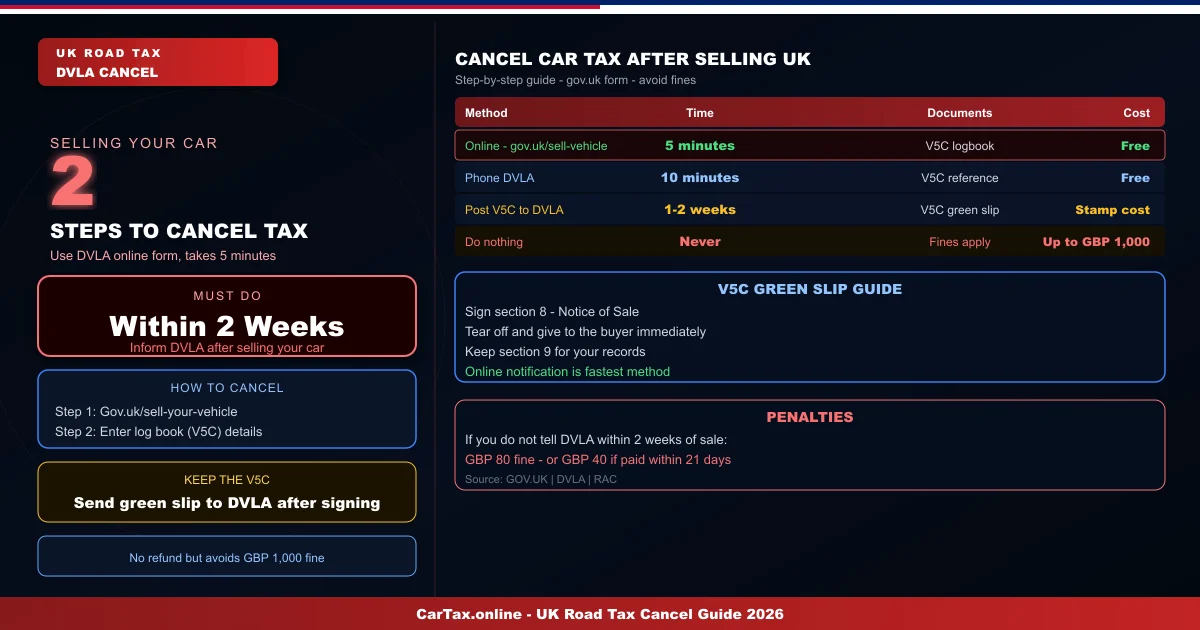
On 22 April 2026, someone in the UK sells a car every 23 seconds. Notifying DVLA is one of the most overlooked steps in the entire process — yet the consequences of skipping it range from an £80 fine to full legal liability for a vehicle you no longer own. This guide covers everything you need to know about cancelling car tax after selling your car in the UK.
The 2-Week Rule: Why Speed Matters
UK law requires you to notify DVLA that you have sold or transferred ownership of your vehicle within 14 days of the sale. This is not a suggestion — it is a legal requirement under the Road Traffic Act 1988. The deadline applies regardless of whether your car had road tax remaining, whether it was taxed at all, or whether you sold it to a dealer or a private buyer.
The reason for the two-week window is practical: DVLA needs timely information to update the vehicle's registered keeper record. Until that update happens, you remain the legal owner as far as the DVLA is concerned. This has real-world consequences that most sellers do not consider until it is too late.
The Penalties for Not Notifying DVLA
The Vehicle Registration and Identification (Enforcement) Regulations set out a clear penalty structure:
If you fail to notify DVLA of a vehicle sale within the required timeframe, you will receive a fixed penalty notice of £80. Pay that fine within 21 days and it drops to £40. Miss that window and the full £80 applies. For persistent failures — where DVLA believes you have deliberately avoided your obligations — the penalty can scale to £1,000.
But the financial penalty is only part of the story. Until DVLA's records are updated, you are still the registered keeper. If the car is involved in a serious traffic offence — speeding on a motorway camera, running a red light, using a bus lane — the notice of intended prosecution goes to the registered keeper. That is you. Resolving these cases is time-consuming and stressful, even when you can ultimately prove you no longer owned the vehicle.
Step 1: Notify DVLA Using the Online Service (Fastest)
The gov.uk/sell-your-vehicle service is the recommended method for notifying DVLA of a sale. It takes approximately 5 minutes and provides immediate confirmation that your notification has been received.
To use the online service, you will need your V5C logbook. You will need to provide:
- Your 11-digit V5C reference number (found in the yellow box on the front of the logbook)
- The date of sale
- The buyer's name and address (if known)
Once submitted, you receive an email confirmation. Keep this email — it is your proof that you notified DVLA within the required timeframe. If a dispute arises later about whether you met the deadline, this email is your evidence.
Step 2: Complete the V5C Logbook Section 8
The online notification and the V5C logbook process are two separate steps, and both need to be completed. The online notification tells DVLA that the vehicle has been sold. The V5C green slip process transfers legal ownership to the buyer.
When you hand over the V5C to the buyer, ensure they receive section 8 — the green tear-off slip. This is their proof that the sale has been completed and they need to send it to DVLA to formally register ownership in their name. You keep section 9, which is your record of the sale and useful if any disputes arise later.
The buyer will need the green slip to tax the vehicle. Without it, they cannot complete the DVLA registration change, and they will not be able to tax the car legally.
Alternative Methods: Phone and Post
If you prefer not to use the online service, you can notify DVLA by phone on 0300 790 6802. This takes approximately 10 minutes. Have your V5C reference number ready. Phone notifications are processed on the same day in most cases.
Posting your notification is the slowest method and the least recommended. If you send your V5C green slip by post to DVLA, you should expect the process to take 1 to 2 weeks minimum. During this time, your name remains on the vehicle's registration record. Royal Mail delays can push this further, and you have no real-time confirmation that DVLA has received or processed your notification.
What About Road Tax Cancellation?
Once you notify DVLA of the sale, the road tax on the vehicle is effectively cancelled from DVLA's records. However, road tax does not work the same way as a subscription — there is no pro-rata refund for the remaining months, as discussed in our road tax refund guide.
If the vehicle had valid road tax remaining at the point of sale, that credit stays with the vehicle until midnight of the sale day. From the next day onwards, the new owner is responsible for taxing it before driving on public roads. The buyer can apply to DVLA for any credit associated with remaining months, but this must be done via the NTC certificate route.
Selling to a Dealer: Do the Same Steps Apply?
Yes. When selling to a dealer — whether a franchise dealership or a second-hand car supermarket — you still must notify DVLA of the sale within two weeks. Many dealers will handle the V5C transfer paperwork on your behalf as part of their purchase process, but they are not legally obligated to notify DVLA on your behalf. You remain the registered keeper until DVLA records are updated.
Best practice is to complete the online notification yourself at the point of sale, even if the dealer tells you they will handle it. The 5-minute online process gives you an immediate confirmation email as proof of compliance.
Keeping Records After the Sale
Once you have completed both the online notification and handed over the V5C, keep the following records for at least 2 years:
- Your DVLA notification confirmation email
- Section 9 of your V5C logbook
- Any correspondence with the buyer (messages confirming the sale date, receipt of payment)
- A copy of the signed sale agreement if you created one
These records become critical if DVLA or another enforcement agency contacts you about the vehicle after the sale. The confirmation email alone is sufficient to demonstrate you notified DVLA on time.
The Bottom Line
Notifying DVLA after selling your car is a legal requirement, not an optional step. The process takes 5 minutes online, costs nothing, and eliminates the risk of fines and legal liability that come with remaining the registered keeper of a car you no longer own.
Whether you sold the car this morning or are planning the sale for next week, make the DVLA notification your first action after completing the transaction. Do not wait, do not delegate it, and do not assume the buyer will handle it. Your name comes off the record only when you tell DVLA yourself.