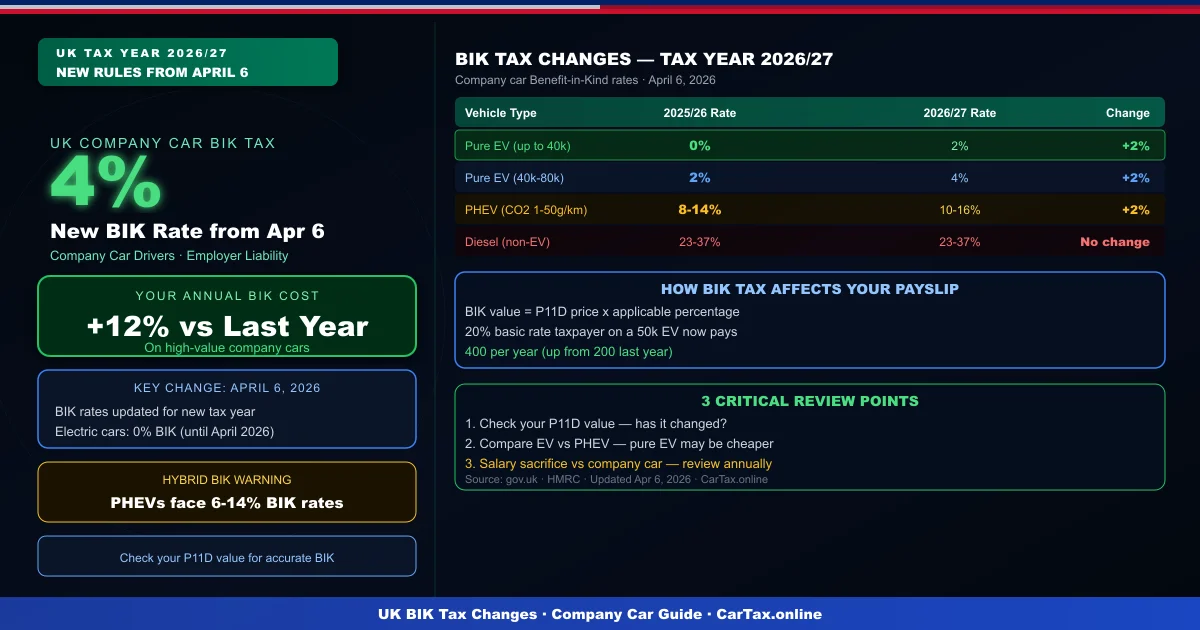
The UK tax year 2026/27 began on April 6, and for the estimated 1.2 million company car drivers in Britain, this is not an abstract compliance exercise — it directly affects your monthly payslip. The Benefit-in-Kind (BIK) rates for company cars have been updated, and for drivers of pure electric vehicles, the era of 0% BIK has officially ended. Here are the three changes that matter most to you right now.
Change 1: Pure EVs Now at 2% BIK (Was 0%)
From April 6, 2026, pure electric company cars are taxed at 2% BIK — up from 0% in the previous tax year. This is a significant shift for fleet managers and employees who chose an EV specifically for the zero BIK benefit. A company-provided Tesla Model 3 that previously cost a 20% taxpayer nothing in BIK now costs £400 per year in tax on a £50,000 list price.
Despite the increase, 2% BIK still makes pure EVs the most tax-efficient company car option available. A diesel BMW 3 Series at 24% BIK costs £5,760 per year for the same £50,000 value. The EV remains £5,360 per year cheaper in BIK terms alone.
Change 2: PHEVs Now at 10-16% BIK (Was 8-14%)
Plug-in hybrid vehicles face the steeper increase. The 2025/26 BIK range of 8-14% for PHEVs has been revised upward to 10-16% for 2026/27. This affects a significant portion of company car fleets, as PHEVs have been a popular middle-ground choice for employees who wanted electric capability without range anxiety. Related: Mileage Tracking and Car Tax UK 2026 | Car Tax and Business Use UK 2026 | Car Tax | Company Car vs Private Car Tax UK 2026.
The revised PHEV BIK now means a plug-in hybrid with CO2 emissions of 1-50g/km and a list price of £40,000 costs a 20% taxpayer £480 per year in BIK at 2% of £40,000. At the same price, a petrol car at 24% BIK would cost £5,760 — still far more expensive in BIK terms. So even at 16%, PHEVs remain more efficient than conventional fuel cars — but the gap has narrowed.
Change 3: Diesel Surcharge Remains at 4% (No Change)
Diesel company cars continue to carry a 4% surcharge on top of their standard CO2-based BIK rate. A diesel SUV with 150g/km CO2 that would normally sit at 23% BIK faces 27% total. For a £45,000 diesel SUV, a 20% taxpayer pays £5,670 per year in BIK — compared to £900 for a comparable pure EV at 2%.
This widening gap is deliberately designed by HMRC to accelerate the transition to zero-emission company cars. If you are currently driving a diesel company car and have the option to swap to a pure EV through your employer, the financial case has never been stronger.
How BIK Is Calculated: The P11D Form
Your employer reports the list price of your company car on Form P11D, submitted to HMRC annually. The BIK value is the P11D price multiplied by the applicable percentage. For a company car valued at £50,000 at 2% BIK, the BIK value is £1,000. A 20% taxpayer pays £200 per year. A 40% taxpayer pays £400 per year.
Three factors determine your exact BIK cost: the P11D list price, the vehicle's CO2 emissions (or electric-only range for EVs), and your income tax bracket. If your salary has not changed and your vehicle remains the same, your BIK cost has simply increased by 2 percentage points this April.
3 Critical Review Points for This Month
1. Check your P11D value for 2026/27
Your employer should have issued updated P11D documentation by April 6. Review the new list price — if your employer has upgraded the vehicle specification or changed the trim level, your BIK will change accordingly. Do not assume the number is the same as last year.
2. Compare pure EV vs. PHEV for your annual mileage
If you drive under 10,000 miles per year and have home or workplace charging, a pure EV at 2% BIK is now clearly superior. If you drive over 20,000 miles per year and cannot reliably charge, a PHEV at 10-16% may still make sense — but model selection matters more than ever.
3. Review salary sacrifice vs. company car arrangements
Salary sacrifice schemes, where you sacrifice part of your salary in exchange for a better vehicle, are increasingly attractive under the new BIK structure. Pure EVs remain exempt from the voluntary benefit-in-kind charge under salary sacrifice rules up to certain thresholds. Check with your HR department whether a salary sacrifice EV arrangement could save you more than your current company car lease.
Official Resources: GOV.UK Check Vehicle Tax | GOV.UK Vehicle Tax | DVLA Online | MOT Check
Frequently Asked Questions
Q: What is the new BIK rate for pure electric company cars in 2026/27?
2% BIK for pure EVs (up from 0% in 2025/26). This applies to all electric vehicles registered from April 6, 2026.
Q: How much more will a £50,000 EV cost in BIK tax this year?
At 2% BIK, a £50,000 EV costs £1,000 per year in BIK value. A 20% taxpayer pays £200 per year. At the previous 0% rate, this was nil.
Q: Are PHEVs still a good choice for company car drivers?
PHEVs at 10-16% BIK are still more tax-efficient than diesel (27%+) and petrol (23-25%) company cars. However, pure EVs at 2% are now the clear winner.
Q: What is the diesel surcharge on company car BIK?
Diesel company cars carry a 4% surcharge on top of their standard BIK rate. This remains unchanged for 2026/27.
Q: How do I calculate my BIK tax for a company car?
BIK value = P11D list price x BIK percentage. Multiply by your income tax rate to get annual cost. Example: £50,000 at 2% = £1,000 BIK value. At 20% tax = £200 per year.