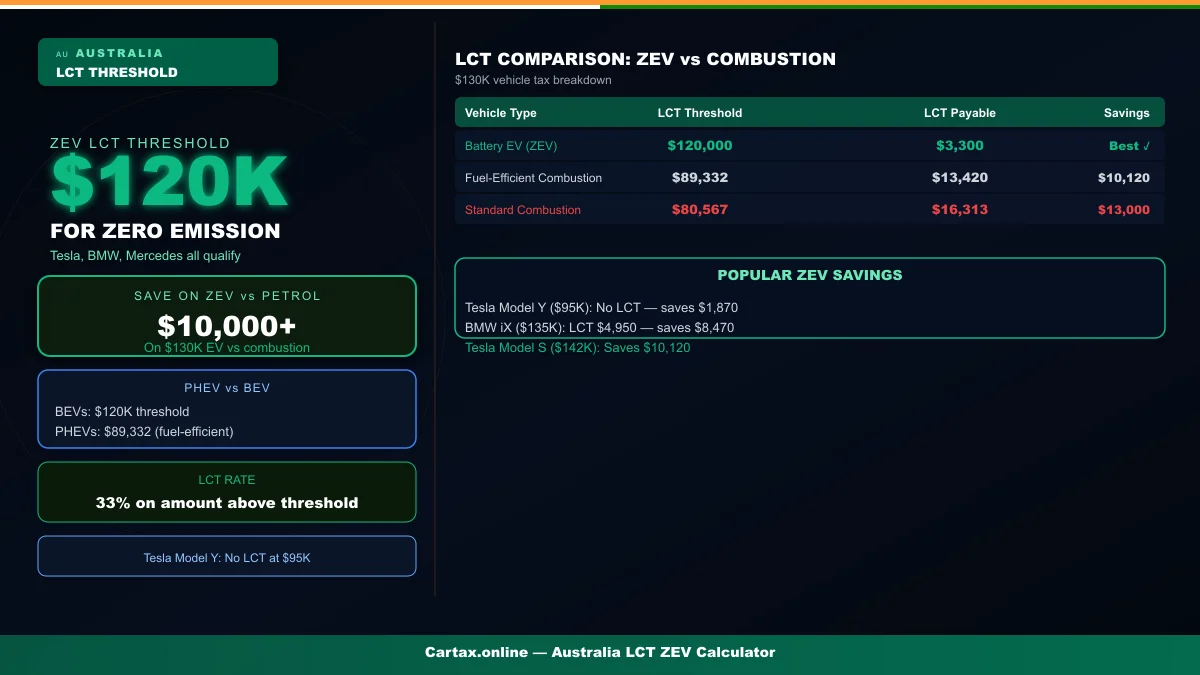
Australia's Luxury Car Tax system has received a significant update for Zero Emission Vehicles in 2026. The LCT threshold for ZEVs now sits at $120,000, providing substantial savings for buyers of high-end electric vehicles. This change aligns with the government's push to accelerate EV adoption while making premium electric vehicles more accessible to Australian buyers.
Understanding Australia's Luxury Car Tax for EVs
What is the Luxury Car Tax?
The Luxury Car Tax (LCT) is a federal tax applied to vehicles above a certain value. Originally designed to discourage imports of luxury vehicles, the LCT has been adjusted to support the transition to zero emission vehicles. The current LCT rate is 33% of the value above the threshold.
The New ZEV Threshold: $120,000
From April 2026, ZEVs enjoy a significantly higher LCT threshold:
- ZEVs (Battery Electric & Fuel Cell): $120,000 threshold
- Fuel-Efficient Vehicles (under 7L/100km): $89,332 threshold
- Standard Vehicles: $80,567 threshold
This means ZEV buyers have approximately $40,000 more headroom before LCT applies compared to standard vehicles.
Savings Examples for Popular EVs
Tesla Vehicles
Tesla Model Y Long Range ($95,000)
- LCT Threshold: $120,000
- Amount Above Threshold: $0
- LCT Payable: $0
- Previous LCT (at $89,332): $1,870
- New Savings: $1,870
Tesla Model S Plaid ($142,000)
- LCT Threshold: $120,000
- Amount Above Threshold: $22,000
- LCT Payable: $7,260
- Previous LCT (at $89,332): $17,380
- New Savings: $10,120
BMW Electric Vehicles
BMW iX xDrive40 ($135,000)
- LCT Threshold: $120,000
- Amount Above Threshold: $15,000
- LCT Payable: $4,950
- Comparison to combustion BMW X5: Saves approximately $8,000
Comparison: ZEV vs Combustion Vehicle LCT
LCT on a $130,000 Vehicle
| Vehicle Type | LCT Threshold | Amount Above | LCT Payable |
|---|---|---|---|
| Battery Electric Vehicle | $120,000 | $10,000 | $3,300 |
| Fuel-Efficient Combustion | $89,332 | $40,668 | $13,420 |
| Standard Combustion | $80,567 | $49,433 | $16,313 |
| ZEV Advantage | — | Saves $13,000+ | Up to 80% less |
Which EVs Are Most Affected by the Threshold Change?
Vehicles Now LCT-Free
Several popular EVs now fall below the LCT threshold entirely:
- Tesla Model 3 RWD: From $61,900 — no LCT
- Tesla Model Y RWD: From $72,900 — no LCT
- BYD Dolphin: From $38,990 — no LCT
- BYD Seal: From $50,000 — no LCT
- Polestar 2: From $67,400 — no LCT
- BMW iX1: From $89,000 — no LCT
Vehicles Above Threshold with Reduced LCT
- BMW iX3: $114,000 — minimal LCT
- Mercedes EQC: $124,000 — reduced LCT
- Tesla Model S: $142,000 — significant savings
- Mercedes EQS: $168,000 — major savings vs combustion
Tips for Maximising ZEV LCT Savings
Strategic Purchasing
- Choose base variants: Selecting standard-range versions can keep you below the $120,000 threshold
- Exclude options packages: Adding expensive options can push vehicles over the threshold
- Consider import options: Parallel imports of the same model may have different pricing structures
- Timing purchases: The $120,000 threshold applies from April 2026 onwards
Lease vs Buy Considerations
For fleet and business buyers, novated leasing arrangements can provide additional tax advantages:
- Business can claim GST credits on leased vehicles
- Employee benefit is calculated on post-LCT value
- Fleet discounts may push more models below threshold
The Bottom Line
Australia's new $120,000 LCT threshold for ZEVs represents a significant financial incentive for electric vehicle buyers. Whether you're purchasing a mainstream EV like the Tesla Model Y or a premium vehicle like the BMW iX, the new threshold can save you thousands of dollars compared to equivalent combustion vehicles.
The government's strategy is clear: make electric vehicles more affordable through tax incentives while maintaining revenue from high-end luxury purchases. For buyers in the market for a premium EV, now is an excellent time to take advantage of these favourable tax conditions.